
Why Bee Guards Sometimes Fail on Day One
When someone is looking for a bee guard feeder attachment, the temptation is to buy the first replacement pack that looks close enough. That is where many problems start. Feeding ports vary in shape, depth, attachment method, and the amount of space between the opening and the nectar.
If you are already dealing with bees and wasps at a bird feeder, a physical barrier can be useful, but it is not a guarantee. Cornell notes that bee guards help keep insects away from feeding ports, while saucer-style feeders can be naturally more resistant because the nectar sits below the top openings where insects have a harder time reaching it.
The basic idea is separation. A hummingbird’s bill and long tongue can reach nectar through a properly designed feeding port, while a guard makes the sugar solution harder for bees and wasps to reach. If the guard does not fit correctly, sits at the wrong depth, or leaves nectar exposed on the outside, that separation disappears.
The Three Main Bee-Guard Designs
Hummingbird feeders do not all use the same protection system. Before buying replacement parts, identify how your existing feeder controls access to the nectar. The names used by manufacturers vary, but most designs fall into a few practical groups.
| Guard Type | How It Works | Best Used For |
|---|---|---|
| Flexible nectar-guard tips | A flexible membrane or slit covers the inside of the feeding opening while allowing a hummingbird’s bill or tongue to reach through. | Feeders specifically designed to accept replaceable internal guard tips. |
| Exterior port guards | A small screen or cage sits over the feeding opening and increases the distance between an insect and the nectar. | Bottle-style feeders built for snap-on or replaceable external guards. |
| Built-in deep ports | The feeder lid or port is shaped so the nectar level sits below the opening and is easier for hummingbirds than insects to reach. | Saucer and other feeders designed with insect resistance built into the port geometry. |
The important distinction is whether the guard is an actual replacement part for your feeder or whether insect resistance is built into the feeder itself. A replacement guard cannot fix a port that was never designed to hold it.

Flexible membrane tips slide easily onto feeding ports to keep bees and wasps out of your nectar. Compatible with select Aspects hummingbird feeders. Pack of 12.
Check on AmazonIf you click this link and buy, we earn a commission at no additional cost to you.
Compatibility: Check the Feeder Before You Buy
The biggest buying mistake is assuming that a part labeled “bee guard” will fit any hummingbird feeder. It may not. Replacement guards can attach by snapping over a flower-shaped port, sliding onto a stem, pressing into the underside of a lid, or fitting a model-specific opening.
Field Note: At the store, the easiest compatibility check was the feeder itself. If someone could bring in a clean, empty base or the original removable port, we could compare the attachment directly instead of guessing from memory. Online, the equivalent is checking the feeder model and the replacement-part compatibility list before ordering.
I would not rely on an unsupported “one millimeter” rule. What matters is whether the part seats securely without cracking the port, falling loose, blocking the hummingbird, or leaving a path for insects to the nectar. If the listing names compatible feeder models, use that information. If it only says “universal,” compare the attachment style and dimensions carefully before assuming it will work.
Color Matters, but Fit Comes First
Cornell notes an odd problem with some hummingbird-feeder designs: bees and wasps can be attracted to yellow, so yellow bee guards may draw more insect attention even while the guard itself makes the nectar harder to reach.
That does not mean every yellow part makes a feeder unusable, and I would not replace a properly fitting guard with a poorly fitting clear one just for the color. Compatibility still comes first. But if the manufacturer offers the same correct guard in a non-yellow version, that can be a sensible choice when bees and wasps are persistent.
Hummingbirds do not need yellow ports to locate a feeder. Red feeder parts can help make the feeding station conspicuous, and Cornell also notes that hummingbirds learn to associate red with rewarding nectar sources. The nectar itself should remain clear.

30 petals and 30 stamens combine to form 30 complete flower ports with built-in bee guards. Tool-free installation and removal, compatible with most hummingbird feeders on the market. Durable UV and rain resistant plastic that stays firmly in place for long-term outdoor use.
Check on AmazonIf you click this link and buy, we earn a commission at no additional cost to you.
Installation and the Hidden Cleaning Challenge
Once you have a compatible guard, install it the way the feeder was designed rather than forcing it into place. A guard that bends the port, leaves a gap, or interferes with the lid seal can create the exact nectar leak you are trying to avoid.
Cleaning matters just as much as installation. If you read my general bird feeder tips, you know sugar-water feeders need frequent attention. Cornell recommends changing nectar every few days, more often in hot weather, and cleaning hummingbird feeders at least weekly. Small guard openings and removable flower parts deserve the same scrutiny because dried sugar and mold can hide around them.
Choose a design you can remove or open enough to scrub thoroughly. Hot water and a small brush work well for routine cleaning, and a dilute bleach solution can be used when deeper disinfection is needed, followed by thorough rinsing and complete drying. I would not use oil or sticky substances around ports to deter insects because they can contaminate nectar or soil feathers.
When a Bee Guard Cannot Fix the Real Problem
A bee guard works at the feeding opening. It cannot help much if nectar is already coating the outside of the feeder.
Bottle-style feeders are especially worth watching because Cornell notes that trapped air can expand when the feeder heats in direct sun and push nectar outward. Wind, a loose base, damaged parts, or an overfilled reservoir can also leave sugar water where bees and wasps can reach it without touching the guarded port.
Pro Tip: After every refill, wipe the outside of the feeder clean and watch it for a few minutes. If fresh nectar appears around seams, flowers, or the base, solve that leak before judging whether the bee guard works.
If leaking is a recurring problem, a saucer-style feeder may be easier to manage. Cornell specifically points to saucer feeders as relatively bee- and wasp-resistant because the syrup level is usually too low for insects to reach from the top ports.
What a Bee Guard Cannot Solve
A bee guard is designed around access to the nectar port. It is not a general pest barrier, and it does not replace leak control, feeder cleaning, or good nectar management.
It also does not solve ants. Ants travel along solid surfaces and can reach the feeder without using the same route as flying insects. If ants are walking down the hanger, a water-filled ant moat placed between the support and feeder is the more appropriate physical barrier.
After installing a new guard, watch the hummingbirds rather than assuming the fit is correct. If they can insert their bills normally and continue feeding, the guard is doing its job without creating a new problem. If they repeatedly probe but cannot access the nectar, or if the guard falls loose, the part may not be compatible.
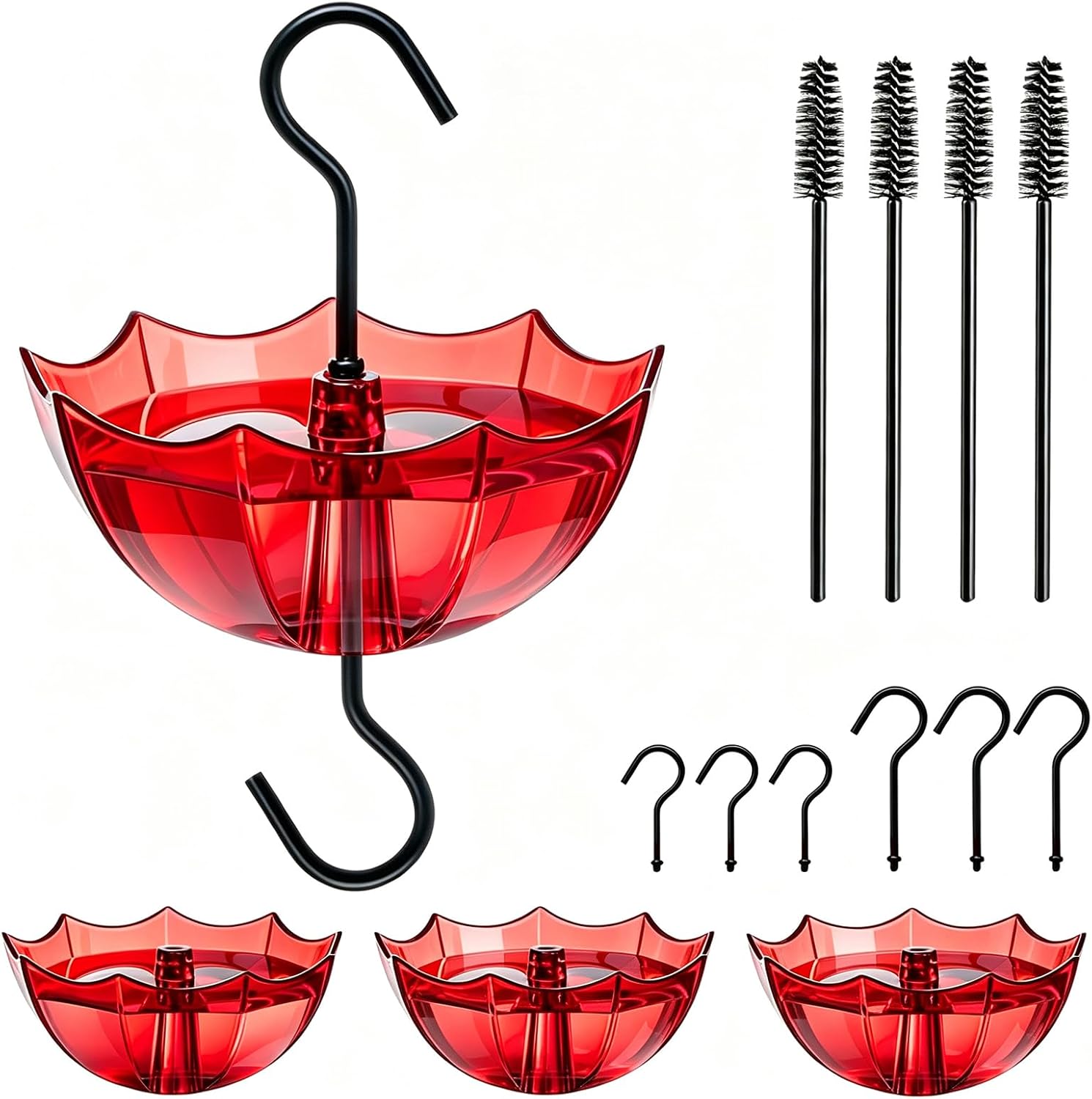
Large 3.94 inch clear cups hold up to 5 oz of water to block even big ants from reaching nectar. Bright red umbrella design adds a decorative touch to any garden. Includes 8 hooks in two sizes for easy top and bottom attachment.
Check on AmazonIf you click this link and buy, we earn a commission at no additional cost to you.
What to Look for When Comparing Products
When you compare replacement guards, I would put compatibility and cleanability ahead of marketing claims. A cheap pack is not a bargain if half the pieces do not fit your feeder or trap sugar residue where you cannot scrub it.
- Feeder compatibility: Does the replacement list your feeder model or clearly match the original attachment style and dimensions?
- Secure fit: Will it stay seated without forcing, cracking, or distorting the feeding port?
- Color: If equally compatible options exist, a non-yellow guard may reduce one visual cue that can attract bees and wasps.
- Cleanability: Can you remove or access the guard well enough to scrub dried nectar and mold from every surface?
- Condition: Replace guards that are cracked, warped, torn, brittle, or no longer stay securely attached. There is no useful universal “replace once a year” rule.
If no replacement guard fits well, do not force a generic part onto the feeder. A feeder with built-in deep ports or a saucer design may be a cleaner long-term solution than repeatedly buying incompatible attachments.
Final Thoughts: Buy for the Feeder You Actually Own
Bee guards can reduce access to hummingbird nectar, but I would not treat them as a guaranteed fix for every bee or wasp problem. Start by identifying your feeder design, confirm that the replacement actually fits, and keep the outside of the feeder free of leaked sugar water.
If insects still dominate the feeder after that, changing the feeder design can be more effective than stacking on more attachments. Cornell recommends saucer-style feeders as one of the better defenses because their nectar level is naturally harder for bees and wasps to reach. Moving the feeder can also help persistent insect problems.
The right purchase is the part that fits securely, stays clean, and lets hummingbirds feed normally. Everything else is secondary.

16 oz leak-proof saucer design with 5 raised ports, circular perch, and built-in ant moat keeps nectar clean and ants out. Transparent BPA-free plastic with measurement scale for easy monitoring and accurate refills. Disassembles in minutes for quick cleaning, dishwasher safe up to 176F. Includes 2 feeders and cleaning brushes.
Check on AmazonIf you click this link and buy, we earn a commission at no additional cost to you.
FAQs
🐝 Can hummingbirds still drink with a bee guard installed?
Yes, when the guard is designed for that feeder and installed correctly. Hummingbirds can reach through properly designed protected ports with their bills and long tongues, while the guard makes the nectar harder for bees and wasps to reach.
🟡 Why do so many feeders come with yellow bee guards if yellow attracts wasps?
Yellow has long been used in flower-shaped feeder parts, but Cornell notes that bees and wasps can be attracted to yellow, so the color may work against the purpose of the guard. If a correctly fitting non-yellow replacement is available, it can be worth considering, but fit matters more than color alone.
💧 How often do I need to replace nectar guard tips?
There is no universal annual replacement schedule. Replace a guard when it tears, cracks, warps, becomes brittle, no longer seals or stays attached properly, or cannot be cleaned well enough to remove residue.
🐜 Will a bee guard stop ants from getting into the nectar?
No. Bee guards protect the feeding port from flying insects but do not block ants traveling down the hanger or across another solid surface. For ants, use a plain-water ant moat in the access route above the feeder and remove any bypass around it.