The Feeder Most People Buy First (And Why It Is Usually A Mistake)
If you walk into a big box store looking for a bird feeder, a standard plastic tube is an easy first grab. It looks familiar, it is usually inexpensive, and it seems simple to fill. That does not make it a bad feeder. It only becomes the wrong feeder when you expect its short perches and narrow ports to serve birds built for a broad, stable feeding surface.
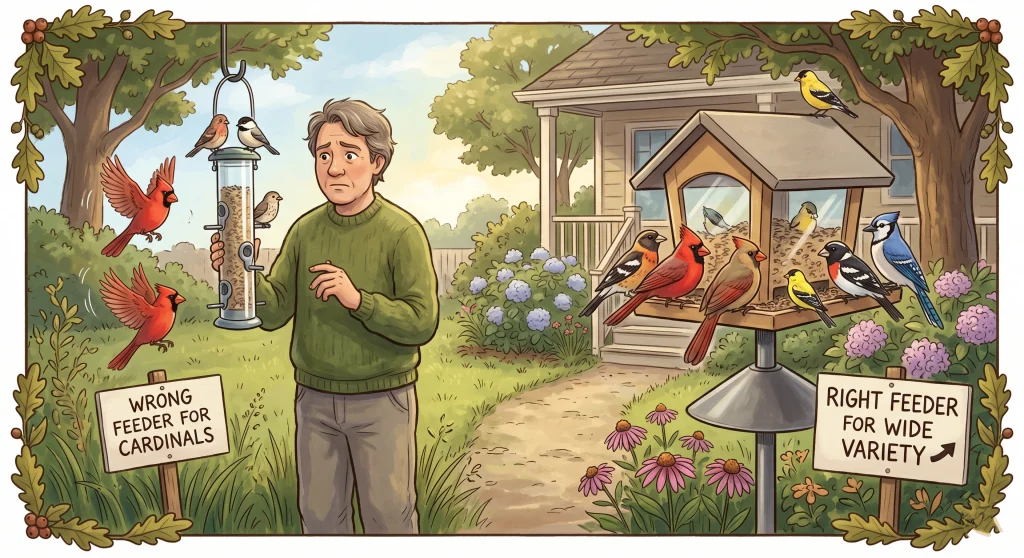
Bird size, posture, and feeding style all affect feeder use. Finches and chickadees handle small tube perches easily. Northern Cardinals usually look more comfortable on a hopper ledge or platform, although some will use a tube fitted with a roomy tray or perch ring. The useful question is not whether one design is good or bad. It is whether that design matches the birds you hope to see.
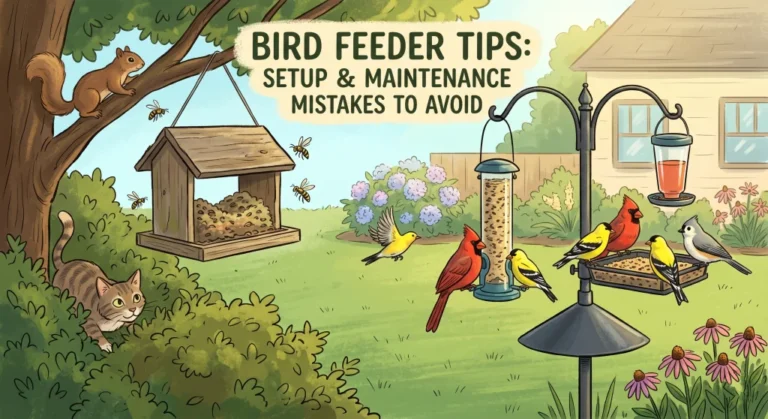
Understanding the different types of bird feeders is partly about matching hardware to bird biology and partly about living with the hardware after the birds leave. Perch size matters, but so do drainage, access to dirty corners, reservoir capacity, and whether the feeder comes apart without a wrestling match. A feeder that attracts plenty of birds but traps damp food where you cannot reach it is not a good beginner purchase.
The Main Feeder Types Compared
Before you spend any money, look at the job each design performs and the problem it creates in return. Bigger capacity is not automatically better if food sits long enough to become damp, and a broad roof does not help much when the base has poor drainage. The best model is one you can refill, inspect, and clean completely.
1. The Hopper Feeder (The Broad-Ledge Option)
A hopper feeder looks like a small house. Food is stored in a central bin and gravity feeds it down to a tray at the bottom. The roof limits direct exposure to rain, while the base gives cardinals, jays, grosbeaks, and smaller birds a stable place to land. A hopper can be a versatile first choice when you want medium and large birds, but inspect the corners and base before buying. Some house-shaped models hold moisture and are much harder to clean than their simple exterior suggests.
2. The Tube Feeder (The Small Bird Workhorse)
Tube feeders are tall cylinders equipped with perches and feeding ports. They are efficient for finches, titmice, chickadees, and nuthatches, and the narrow body can limit access by larger birds. Port size still has to match the food. A Nyjer tube uses tiny openings; larger seeds will block them, while Nyjer offered through wide sunflower ports can spill freely. Look for a removable base and ports you can reach with a brush, not just a lid that is easy to fill.
Field Note: I once checked a tube feeder that looked full but had gone quiet. A few flat seeds were wedged behind the lower ports, so birds could see food without reaching it. Clearing those ports solved the problem; replacing the entire feeder would not have.
3. The Platform or Tray Feeder (Maximum Visibility, Maximum Mess)
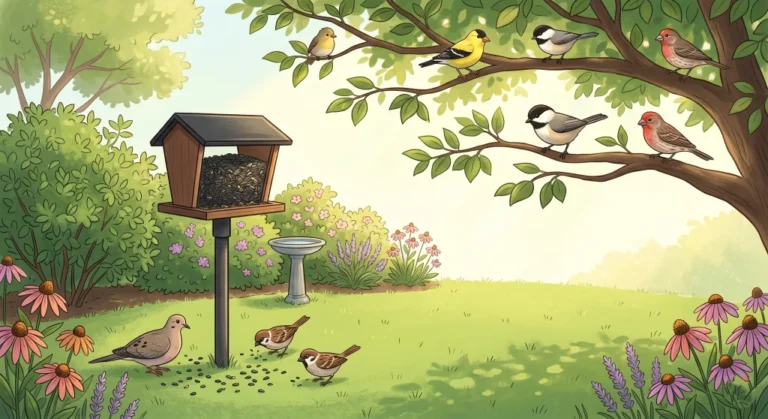
A platform feeder is a flat tray, ideally with a screened bottom for drainage. With no tight ports or short perches, it can accommodate a wide range of birds, including mourning doves and juncos when the tray is placed at a height they accept. That openness is also the trade-off. Food receives less protection from rain and droppings, and squirrels, raccoons, starlings, and other large visitors can reach the same surface. A small tray that is easy to empty may be more practical than an oversized one that stays wet after a storm.
4. The Suet Feeder (The Energy Station)
Suet feeders are cages or enclosed holders designed for firm suet cakes rather than loose seed. Woodpeckers, nuthatches, chickadees, and titmice use them readily, but jays, starlings, wrens, and other visitors may also investigate. A basic cage provides access from several directions. An upside-down or tail-prop design changes which birds can feed comfortably, while a roof limits direct rain without making soft or spoiled suet safe.
5. The Hummingbird Feeder (The Nectar Specialist)
These feeders hold sugar water rather than solid food. They generally come in two styles: an inverted bottle that relies on a vacuum seal, or a saucer-like dish. A dish is often easier to inspect and is less prone to leaking as trapped air warms. Whichever design you choose, favor a modest capacity and openings you can scrub completely because unused nectar still has to be replaced before the reservoir is empty.
Window feeders are usually small trays or hoppers attached directly to glass. They work well for close viewing and for people without a large yard, but limited capacity and frequent exposure to droppings make easy removal especially important. Check how the feeder detaches for cleaning and whether its mounting system remains secure under the combined weight of the feeder, food, and visiting birds.
The Starter Sequence: What Bird Feeder to Buy First
Most beginners do not need a predetermined collection of feeders. They need one design that fits a clear first goal and is easy enough to maintain consistently. A cardinal-focused yard, a finch-focused balcony, and a window-view setup can all have different correct starting points.
Use this sequence as a decision process rather than a shopping list:
- Step 1: Name the bird or viewing goal. Choose a hopper or platform for cardinals and larger birds, a tube for small perching birds, or a window feeder when close viewing and limited space matter most.
- Step 2: Inspect the ownership details. Check drainage, removable parts, access to corners, mounting method, and realistic capacity. If you cannot reach the bottom with a brush, you will not enjoy owning it.
- Step 3: Watch the first feeder. Note which birds use it, which birds cannot land comfortably, how quickly the food disappears, and where moisture or debris collects.
- Step 4: Add one feeder for one unmet job. A platform can serve doves that stay below a tube, a Nyjer feeder can reduce waste when targeting goldfinches, and a suet holder can provide a different feeding surface for woodpeckers.
- Step 5: Treat hummingbird feeding as a separate system. Use a small, easy-to-clean feeder when hummingbirds occur in your area. If one bird monopolizes it, several small feeders placed out of sight of one another can work better than one large reservoir.
This approach can still lead to a varied feeding station, but every addition has a reason. If the first feeder already serves the birds you want and remains manageable, there is no prize for buying four more.
Feeder type and food choice are separate decisions. Once the hardware is settled, use the best bird seed guide to match the food to the feeder and the birds you want, rather than expecting one design to handle every option.

Large seed capacity - Holds over 6 quarts of seed and two suet cakes. Seed diverter and drainage holes help to keep seed fresh. Large perching area provides space for multiple birds to feed and watch others. Built-in socket to mount to Stokes Bird Feeder Pole.
Check on AmazonIf you click this link and buy, we earn a commission at no additional cost to you.
Feeder Types by Season
The feeder body does not have an expiration date at the end of each season, but weather changes which product features matter most. Regional bird movements also differ, so a calendar rule that works in Maine may make little sense in Arizona or along the Gulf Coast.
In cold, wet, or snowy conditions, a roof, good drainage, and parts that do not become brittle are more useful than capacity alone. A large hopper feeder may shelter food from direct precipitation, but damp material can still collect along the base. An easy-to-open upside-down suet feeder can be useful for clinging birds when the suet remains firm and fresh.
During hot weather, small reservoirs and simple disassembly become more valuable because food may need attention before a large feeder is empty. A hummingbird feeder is not automatically a spring-only product: much of the Pacific Coast, Arizona, the Gulf Coast, and parts of the Southeast can host hummingbirds beyond the usual migration window. Follow local occurrence rather than a national calendar. For suet, a roof or shade may slow softening but cannot make raw, rancid, or oily suet safe; use a formulation suited to the temperature or pause until cooler weather.
Decision Table: Which Birds Need Which Feeder
If you have a specific bird in mind, you need to match your hardware to their habits. Use this breakdown to make sure you are placing the right feeder in your cart.
| Target Bird Species | Primary Feeder Choice | Alternative Option |
|---|---|---|
| Northern Cardinals | Hopper or Platform Feeder | Tube Feeder with a Wide Tray |
| Woodpeckers | Suet Feeder | Tail-Prop or Upside-Down Suet Feeder |
| Goldfinches | Nyjer Tube Feeder | Mesh Feeder or Sunflower Tube |
| Blue Jays | Platform Tray | Hopper with a Broad Ledge |
| Mourning Doves | Ground Tray | Low or Elevated Platform |
| Chickadees & Titmice | Standard Tube Feeder | Hopper or Window Feeder |
How to Evaluate a Weight-Sensitive Feeder Safely
A weight-sensitive feeder uses a spring-loaded perch or shroud to cover its feeding ports when a heavier animal lands. It can reduce squirrel access without excluding every medium-sized bird, but it introduces moving parts that deserve inspection before the feeder goes outside.
Move the shroud through its full travel by hand. It should descend and reset smoothly without slamming, sticking, or leaving a narrow pinch point beside a port. Test the adjustment at several settings, then repeat the check after cleaning because hulls and sticky residue can change how the mechanism moves. A worn spring, bent perch, or packed seam matters more than whether the feeder has an impressive label.
Inspection Check: Follow the product instructions, check every moving part before filling, and watch the feeder during its first active visits. Stop using it if the shroud snaps, catches, fails to reopen, or creates a gap where a head, foot, or wing could become trapped.
A caged squirrel proof bird feeder avoids a closing shroud, but it has its own trade-offs. The grid may exclude cardinals, jays, and other wanted birds, and a cage that sits too close to the inner tube may still let squirrels reach the ports. Choose between the two designs by inspecting the mechanism, cage spacing, target birds, and ease of cleaning rather than assuming either style is risk-free.

This hanging tube bird feeder provides six feeding ports and metal perches so several small backyard birds can feed at the same time. The clear seed tube makes the remaining seed level easy to monitor, while the metal lid, base, ports, and perches provide a durable outdoor design. A locking lid, adjustable hanger, and drainage openings help simplify refilling and regular backyard use.
Check on AmazonIf you click this link and buy, we earn a commission at no additional cost to you.
The Upside-Down Suet Trick
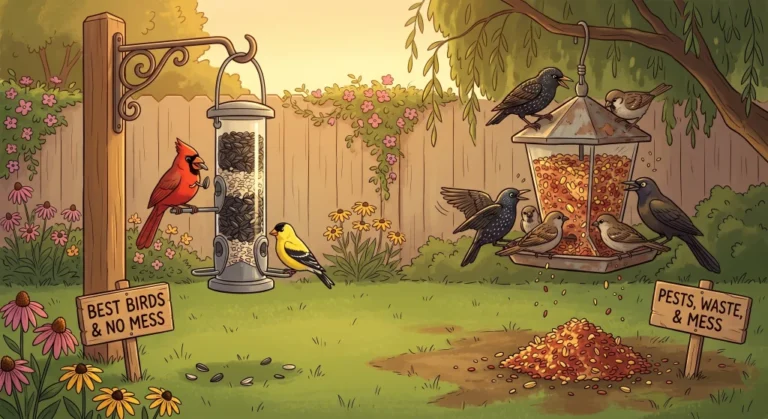
Woodpeckers are a major draw for backyard birders, which is why suet feeders are so popular. A standard cage can also give European Starlings an easy landing surface. When a flock finds it, the suet may disappear much faster than expected.
An upside-down design takes advantage of the way different birds move. Woodpeckers have zygodactyl feet, with two toes facing forward and two backward, plus stiff tails that help brace them against vertical surfaces. Nuthatches and chickadees do not share that exact foot arrangement, but their strong claws and agile feeding behavior still let them reach food from below. Starlings can cling briefly, yet sustained upside-down feeding is more difficult for them.
By making birds feed from the bottom, the feeder discourages starlings without guaranteeing complete exclusion. Some individuals may still investigate or adapt for short visits, and desired birds may need time to approach the new opening. The design shifts access in favor of woodpeckers, nuthatches, and chickadees; it does not create a perfect barrier.

The upside-down suet feeder design naturally eliminates nuisance birds like blackbirds and grackles that are not comfortable hanging upside-down to eat. Woodpeckers, titmice, nuthatches, and chickadees can all feed comfortably upside-down from this feeder. Constructed from naturally rot-resistant premium Cedar using stainless steel screws, this feeder is built for years of birding enjoyment. This feeder holds 1 suet cake.
Check on AmazonIf you click this link and buy, we earn a commission at no additional cost to you.
Action Log: Setting Up Your First 30 Days
The first month is more useful as an observation period than as a promise about when each species will arrive. Birds may inspect a new feeder within hours, ignore it for weeks, or change their use as natural food and weather change. Record what happens in your yard instead of trying to force it onto a universal schedule.
Days 1 to 7: Install and Inspect
Start with a modest amount of food, confirm that the mount stays secure, and check the base after wind or rain. Quiet activity does not prove the feeder is wrong. It may simply be new, or the birds may have abundant natural food nearby.
Days 8 to 14: Watch How It Is Used
Look beyond the number of visits. Notice whether birds can face the ports comfortably, whether larger birds displace smaller ones, and whether food collects below an unreachable corner. A cardinal standing nearby but avoiding short perches tells you more than a calendar does.
Days 15 to 21: Evaluate Capacity and Cleaning
Check how much food is actually consumed before it becomes damp or stale. Empty and clean the feeder before refilling it automatically. If a large reservoir still contains old food, reduce the fill level rather than treating unused capacity as a failure.
Days 22 to 30: Decide Whether a Gap Exists
Add another feeder only if your observations point to a specific unmet job. A low platform tray may help doves that remain below the current feeder, while a suet cage offers woodpeckers a different feeding surface. If the first feeder is clean, active, and serving your target birds, leave the setup alone.
Final Thoughts: Do Not Rush the Process
The urge to buy everything at once is strong when every feeder promises a different cast of visitors. Resist it. Start with a design that fits your target birds and that you can clean without special tools. Then let actual use reveal the next decision.
A useful setup is not measured by the price or number of feeders. It is one you can inspect regularly, keep clean, and adjust when the weather or visiting birds change. Sometimes the right next feeder is a platform, tube, or suet holder. Sometimes the right answer is to keep the one you already have.

Wagner's Four Season Sunflower Seed is 100% black oil sunflower seed. Sunflower seed is the favorite seed of most wild birds. It is high in energy and has a thin shell making it easy for all birds to consume. Use tray feeders or hopper feeders to attract sunflower loving songbirds. Cardinals, Chickadees, Finches, Nuthatches, Woodpeckers and much more. Trust your backyard birds to the experts at Wagner’s.
Check on AmazonIf you click this link and buy, we earn a commission at no additional cost to you.
Explore Specific Feeder Types
Once you know the job a feeder needs to perform, compare the details that affect daily use: perch shape, drainage, capacity, mounting, moving parts, and access for cleaning. The categories below narrow those decisions without assuming one design fits every yard.
| Feeder Category | Find the Right Model |
|---|---|
| Tube Bird Feeders | Compare port sizes, perch designs, capacity, and access for cleaning. |
| Hopper Bird Feeders | Choose among broad ledges, weather protection, materials, and removable bases. |
| Platform Bird Feeders | Compare open trays by drainage, mounting height, size, and cleaning access. |
| Window Bird Feeders | Review mounting systems, tray access, capacity, and routine attachment checks. |
| Suet Feeders | Compare standard cages, upside-down access, tail props, and weather protection. |
| Hummingbird Feeders | Compare dish and bottle designs by leakage, capacity, access, and cleaning effort. |
| Squirrel Proof Bird Feeders | Understand the trade-offs among weight-sensitive, caged, and other mechanisms. |
| Bird Feeder Cameras | Compare power, storage, subscriptions, image capture, and feeder maintenance. |
| Bird Feeder Poles | Match pole style and load capacity to the feeders and mounting surface. |
FAQs
🐦 What is the easiest bird feeder for beginners to start with?
There is no single easiest feeder for every beginner. A hopper or platform suits cardinals and larger birds, while a tube may be simpler for finches and chickadees. Favor a modest capacity, good drainage, secure mounting, and parts you can remove and clean completely.
🐿️ Are weight-sensitive bird feeders safe for birds?
The design should move and reset smoothly when tested according to its instructions. Check for pinch points, sticking parts, damaged springs, and residue around the shroud, then monitor the first active visits. Stop using the feeder if its mechanism snaps, catches, or fails to reopen correctly.
🌧️ Do I need to bring my bird feeder inside when it rains?
A roof reduces direct exposure but does not guarantee that food stays dry. Check drainage holes, seams, and the bottom of the reservoir after heavy rain. Empty wet food and let the feeder dry completely; with an open platform, offering only a modest amount limits waste.
⏳ How long does it usually take for birds to find a new feeder?
There is no dependable timetable. Birds may arrive within hours, after several weeks, or only when weather and natural food change. Start with a modest fill, keep it fresh, and assess the feeder by condition and bird behavior rather than a deadline.
🚫 Why won’t cardinals use my tube feeder?
Many tube feeders have short pegs that are uncomfortable for a cardinal’s larger body and forward-facing feeding posture. A hopper or platform is usually easier, but a tube with a broad tray or roomy perch ring can also work. The limitation is the perch design, not the tube shape alone.