
The Mistake That Keeps Hummingbirds Away All Season
If you are looking to set up your first hummingbird feeder, the most important thing you need to understand is that most of the models sold in big-box stores are engineered to appeal to humans, not birds. They are shaped like beautiful vintage glass bottles, mason jars, or colorful glass blown art pieces. They look fantastic hanging from a porch. But in practice, that classic gravity-fed bottle design is the exact reason so many beginners give up on feeding hummingbirds altogether.
When I was managing the birding store, the number one reason people brought back a hummingbird setup wasn’t because it broke. It was because they accidentally built a wasp feeding station. A feeder that leaks even slightly will cover your patio or deck railing in sticky sugar water. Within a matter of hours, that spill becomes a beacon for every wasp, yellowjacket, and ant in the neighborhood.
Once a swarm of aggressive stinging insects claims the area, hummingbirds will simply move on to a safer food source. They are incredibly fast and agile, but they are not going to waste their limited energy reserves fighting a dozen yellowjackets for a drink of sugar water.
The fix for this is almost entirely in the hardware. You do not need to buy peppermint oil, hang sticky traps, or spray expensive bug repellents near your patio. You just need a hummingbird feeder that keeps bees away through basic geometry and fluid physics. If you are exploring the wider world of backyard birding, you will quickly learn that hummingbird setups are unique. Unlike other types of bird feeders where seeds simply sit in a dry tray, nectar feeding involves liquid, heat expansion, and a completely different set of aggressive pests.
Hummingbird Feeder Dish vs Bottle: The Bee Access Mechanism
There are two primary categories of nectar feeders: bottles (which are gravity-fed) and dishes (which are saucer-style). The structural differences between these two designs will dictate whether you spend your summer watching birds or fighting bees. If you want to dive deeper into the specific mechanics, my dish vs bottle hummingbird feeder comparison breaks down exactly why those leaks happen.
Bottle feeders operate on a strict vacuum seal. You fill the central bottle, screw on the feeding base, and flip the whole unit upside down. The nectar flows down into the base until it covers the internal port openings, which creates a vacuum in the empty space at the top of the bottle. This vacuum holds the rest of the liquid inside. The problem with this design is thermal expansion. When the cool morning air inside that bottle is hit by the hot afternoon sun, the trapped air pocket heats up and expands. That expanding air physically pushes the nectar down, forcing it out through the feeding ports. The result is a slow, continuous, sticky drip.
Dish feeders, on the other hand, are simply covered bowls. You pour the nectar directly into the basin, and then you snap or screw the lid (which contains the feeding ports) directly on top. There is no inverted bottle, which means there is no vacuum seal. Because there is no pressure buildup inside the unit, thermal expansion cannot cause a dish feeder to leak. Even in 90-degree heat, the liquid just sits peacefully in the bowl. If you are looking for a reliable starting point, the Aspects HummZinger line is widely considered the industry standard for a saucer design, though several other brands make excellent variations.
Relying on aftermarket plastic “bee guards” that snap over the ports of a leaking bottle feeder. Wasps are persistent and will eventually figure out how to bypass them, especially if the bottle has been dripping and the outside hardware is already coated in dried sugar.
Using a dish feeder where the nectar sits physically below the reach of insects. The vertical distance between the feeding port and the liquid level is the ultimate, foolproof pest control.
This brings us to the biological advantage of the dish design. A hummingbird’s tongue is incredibly long. It features tiny grooves and acts almost like a microscopic pump, allowing it to extend far past the tip of its bill to lap up nectar deep inside a flower. A bee or a wasp, however, has a very short proboscis.
A well-designed saucer feeder takes advantage of this anatomical difference. It keeps the nectar level exactly low enough that a hummingbird can easily reach it, but a wasp physically cannot touch the liquid. Upgrading to the best hummingbird feeder to keep bees away is entirely about finding these exact proportions. I have watched this pattern repeat more times than I can count: a wasp lands on a dish feeder, sticks its head into the port, realizes it cannot reach the food, and flies away permanently.
| Design Feature | Bottle Feeder | Dish (Saucer) Feeder |
|---|---|---|
| Leak Potential | High (prone to vacuum failure and thermal expansion) | Zero (unpressurized basin cannot drip) |
| Pest Attraction | High (constant drips attract ants and wasps) | Low (nectar stays fully contained) |
| Cleaning Ease | Difficult (requires specialized long brushes) | Easy (often top-rack dishwasher safe) |
| Capacity Range | Often unnecessarily large (16-40 ounces) | Perfectly sized for freshness (8-16 ounces) |
| View of Birds | Obstructed by the central glass or plastic bottle | Unobstructed 360-degree viewing angle |
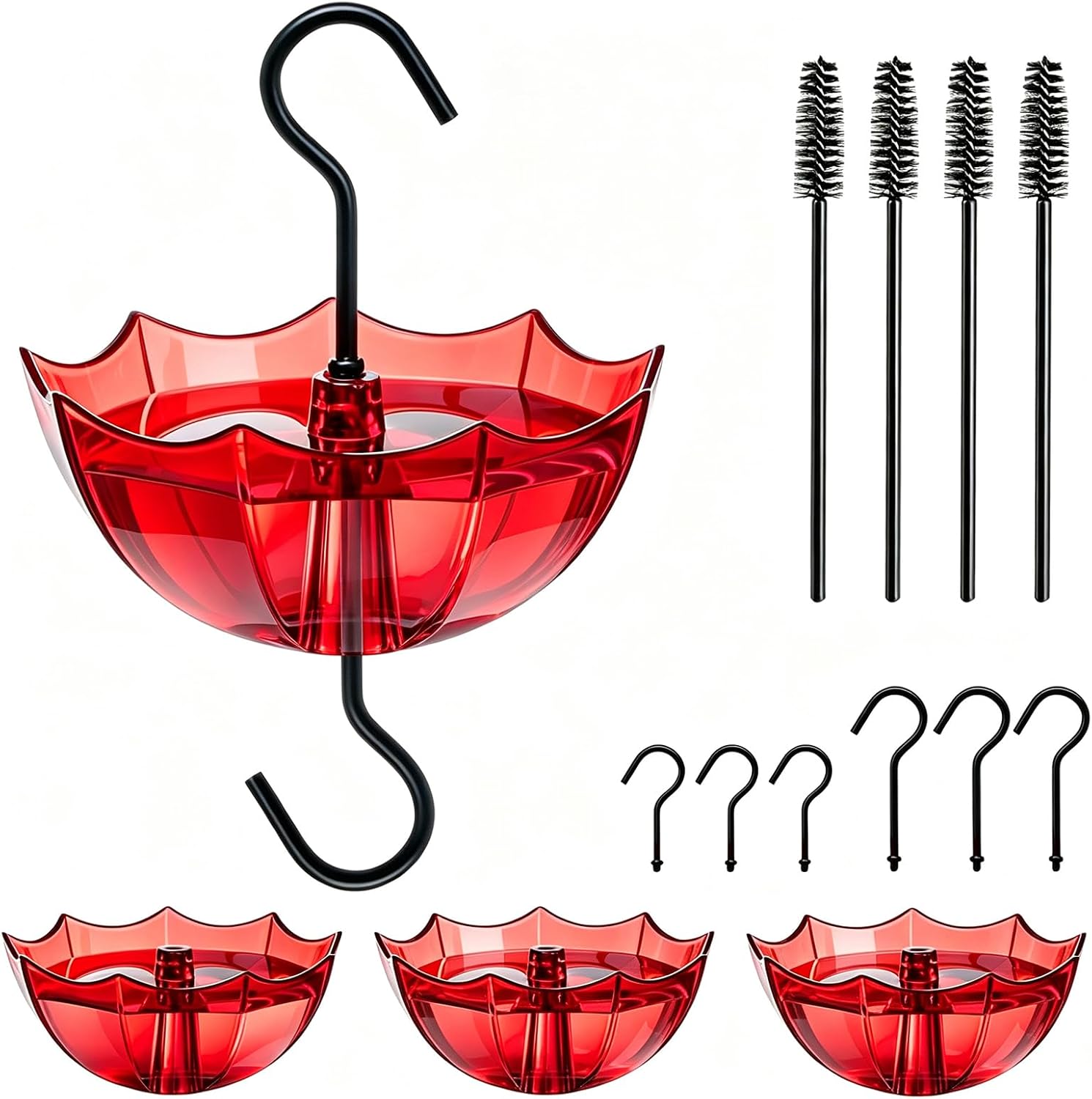
Large 3.94 inch clear cups hold up to 5 oz of water to block even big ants from reaching nectar. Bright red umbrella design adds a decorative touch to any garden. Includes 8 hooks in two sizes for easy top and bottom attachment.
Check on AmazonIf you click this link and buy, we earn a commission at no additional cost to you.
Built-in Ant Moats: The Non-Negotiable Feature
Protecting your nectar from the sun and wasps is only half the battle. Crawling pests require a completely different line of defense. Ants are relentless scavengers, and they will march up the side of your house, across your deck, and down any hanging wire to reach a source of sugar.
When an ant finds the ports, it will crawl inside and drown in the nectar. This is more than just unsightly. When ants drown in sugar water, their bodies release formic acid. This instantly changes the pH of the nectar, making it bitter and potentially toxic to the birds. A single drowned ant can ruin an entire batch, and hummingbirds will immediately abandon a feeder that tastes acidic.
Warning: Never use Vaseline, cooking oil, or any sticky grease on your feeder pole to stop ants. If a bird brushes against the pole, the grease gets into their feathers. Hummingbirds cannot clean heavy oils off their wings, which destroys their ability to fly and regulate their body heat.
The only safe and effective defense against ants is a water barrier. An ant moat is a small cup of water positioned between the hanging wire and the feeder itself. As the ants climb down the wire, they hit the miniature pool of water and cannot cross it to reach the food below.
You can buy separate, add-on ant moats to hang above any unit, but the best hummingbird feeder models have an ant moat built directly into the center of the lid. You simply fill the center depression with plain tap water when you fill the nectar. It is a brilliant, zero-chemical solution. Your only job is to remember to top up the water every few days, as it evaporates quickly in the heat, and occasionally flush out the dead bugs that accumulate in the moat water.

4 feeding ports with raised flowers that divert rain, built-in ant moat, and drip-proof design. Made from brass and polycarbonate for durability. Easy to fill and clean.
Check on AmazonIf you click this link and buy, we earn a commission at no additional cost to you.
Capacity Planning: Why Smaller Is Actually Better
When people shop for a new setup, they naturally gravitate toward the largest capacity they can find. A massive 30-ounce or 40-ounce reservoir sounds incredibly convenient because you assume you won’t have to go outside and refill it as often. This is a trap that leads to massive amounts of wasted nectar.
Hummingbird nectar is just a simple solution of one part refined white sugar to four parts water. In the heat of summer, this mixture ferments and spoils rapidly. When daytime temperatures consistently hit 80 degrees Fahrenheit, the nectar needs to be completely replaced every three to five days, regardless of how much liquid is left inside. If you leave it longer than that, the solution ferments, toxic mold develops, and the birds will stop coming.
| Daytime Temperature | Required Replacement Frequency |
|---|---|
| Below 70°F (21°C) | Every 7 days |
| 70°F – 80°F (21°C – 26°C) | Every 5 days |
| 81°F – 90°F (27°C – 32°C) | Every 3 days |
| Above 90°F (32°C+) | Every 1 to 2 days |
Field Note: A common frustration I handled at the store involved customers who bought a giant, 32-ounce bottle feeder. They would fill it to the brim, see a few birds the first week, and then watch the yard go silent. By day five, the huge vat of sugar water had spoiled. The birds knew it was bad and left, while the owner was stuck pouring 25 ounces of fermented, cloudy syrup down the drain. Over time, they always downsized.
Unless you live in a dense migration flyway and have swarms of hummingbirds emptying your station daily, a large capacity is a total waste of time and resources. A small-to-medium capacity model (usually holding between 8 and 12 ounces) is vastly superior for standard backyard birding.
Many product reviews list the smaller capacity of saucer feeders as a negative trait because it requires more frequent refilling. I view this entirely differently. That smaller capacity is a built-in freshness guarantee. It forces you to clean the unit and swap the food on the exact schedule required to keep the birds healthy. By the time the 12 ounces is getting low, it is exactly the right time to wash the dish anyway.
Glass vs Plastic Hummingbird Feeder: UV Durability
If you decide that a traditional bottle design is the right fit for your yard despite the leak risks, you have to choose between materials. The glass vs plastic hummingbird feeder debate is usually framed around aesthetics, but the real issue is structural integrity under constant sun exposure.
Plastic feeders are lightweight and inexpensive. However, plastic degrades under continuous ultraviolet (UV) light. Over the course of a hot summer, the microscopic threads where the plastic bottle screws into the plastic base will begin to warp. Once those threads lose their perfect shape, the vacuum seal is permanently broken. This is why a plastic bottle feeder that worked perfectly in its first year will often drip relentlessly in its second year. The material has simply warped beyond its ability to hold pressure.
Glass reservoirs are practically impervious to UV degradation. The threads on a heavy glass bottle will not warp in the sun, meaning the vacuum seal remains as tight in year five as it was on day one. For those who want to avoid plastic degradation entirely, investing in a heavy-duty glass hummingbird feeder ensures your hardware will outlast the summer sun. Glass also prevents microscopic scratches from forming on the inside during cleaning, which is where black mold spores anchor and grow in plastic bottles.
There is a weight trade-off, however. A thick glass bottle filled with 20 ounces of liquid is remarkably heavy. You must ensure that your shepherd’s hook, tree branch, or hanging hardware is rated for that kind of swinging weight, especially in high winds.
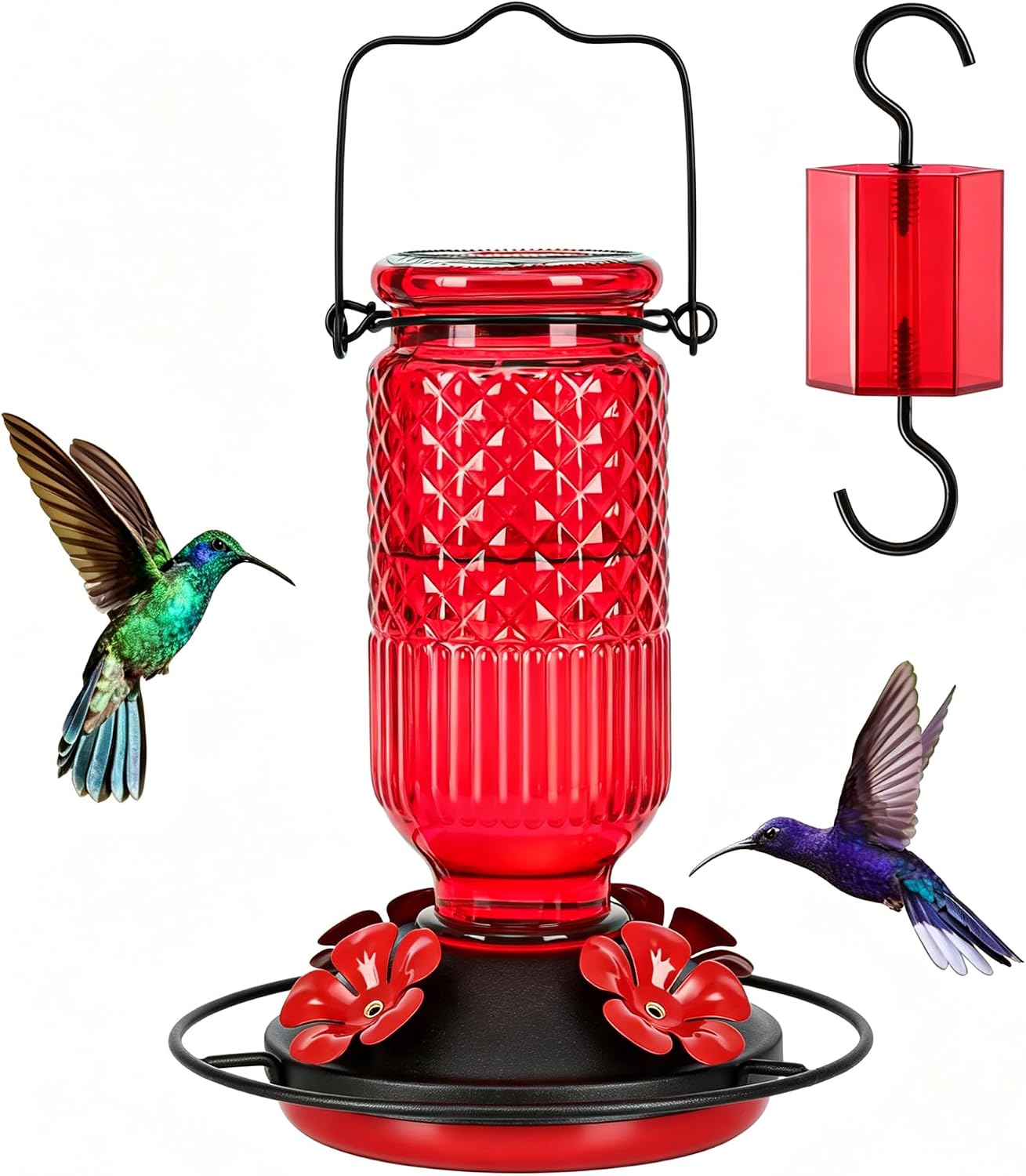
Wide-mouth glass bottle with 4 metal flower ports, 360-degree perches, and built-in ant moat to keep bees and ants away. Leak-proof gasket prevents spills even in wind. Transparent glass makes monitoring nectar levels effortless. BPA-free, weather-resistant, and a lovely gift for any nature lover.
Check on AmazonIf you click this link and buy, we earn a commission at no additional cost to you.
Dealing With Bullies: Why You Need More Than One Feeder
Once the hardware decision is settled and your station is running cleanly, a new behavioral problem tends to emerge. Hummingbirds are fiercely territorial, and a single dominant male will often claim the feeder and aggressively chase all others away. They will perch in a nearby tree and spend their entire day guarding “their” food source, dive-bombing any other bird that tries to take a sip.
Buying a larger feeder with more port holes does not solve this problem. A dominant bird will guard a six-port feeder just as aggressively as a three-port feeder.
The only effective way to reduce this territorial aggression and invite a true flock to your yard is to break their line of sight. By hanging two or three smaller dish feeders in different locations around your house (such as one in the front yard, one in the back, or separated by the corner of the house) you make it physically impossible for one bird to guard all the food at once. This forces the dominant bully to choose one station, freeing up the other feeders for the rest of the local population.
The Color Rule: Red Attracts Hummingbirds, Yellow Attracts Wasps
Hummingbirds are naturally drawn to the color red, which is why nearly every commercial model features red plastic bases or tinted red glass. Having a bright red lid or a red reservoir is an excellent way to catch the visual attention of passing migrants.
However, many manufacturers insist on putting little yellow plastic flowers around the feeding ports to make the product look more like a real garden. This is a severe functional mistake. While hummingbirds like red, wasps and bees are evolutionarily wired to seek out yellow. Adding bright yellow accents directly on top of a sugar source is the equivalent of rolling out a welcome mat for stinging insects.
Key point: If you want to keep pests away, choose a model that is entirely red, with no yellow parts. If you already own one with yellow plastic flowers, you can carefully pop them off with a screwdriver, or paint over them with non-toxic outdoor red paint.
This is also a good time to mention the nectar itself. You never need to use red food coloring in your sugar water. Red dye is completely unnecessary to attract the birds, and the chemical additives can be harmful to their tiny kidneys. The red hardware on the outside of the unit is more than enough color to bring them in.
Ease of Cleaning Comparison
No matter which type of setup you choose, it must be cleaned every single time you refill it. Black mold spots (specifically Aspergillus) love to grow inside the dark, sugary environments of reservoirs and port holes. If a bird ingests this mold, it can cause fatal respiratory infections.
This is the final reason dish designs tend to win out in practical, day-to-day use. Cleaning them is as simple as washing a cereal bowl. You pop the lid off, wash the two flat halves in the sink with hot water and a mild vinegar solution, and you are done. Many high-quality polycarbonate dish models can even be placed on the top rack of your dishwasher for a deep sanitation cycle.
Bottle models require significantly more manual effort. You need a specialized, long-handled bottle brush to reach the internal curves and shoulders of the glass or plastic. More importantly, you need tiny, specialized port brushes (like pipe cleaners) to scrub out the intricate, hidden channels inside the two-piece base where mold loves to hide.
If a piece of hardware is difficult or annoying to clean, you are far less likely to do it as often as you should. By reducing the friction of maintenance, you naturally ensure a healthier, safer environment for the birds in your yard.

Two 16 oz saucer feeders each with 6 flower-shaped ports and raised petals to keep rainwater out. Built-in ant moat blocks insects from reaching the nectar. Clear reservoir with fill markings for easy monitoring. Hang with included brass rod or pole mount on a 5/8 inch dowel or 1/2 inch copper pole.
Check on AmazonIf you click this link and buy, we earn a commission at no additional cost to you.
Final Thoughts: Setting Up for Success
Attracting these incredible birds to your yard shouldn’t feel like a part-time job that involves constantly scrubbing sticky patio floors and battling angry swarms of insects. By prioritizing mechanical function over pretty aesthetics, you remove almost all the frustration from the hobby.
In my experience, a saucer-style hummingbird nectar feeder equipped with a built-in ant moat, entirely red hardware with no yellow accents, and a modest capacity of around 8 to 12 ounces will solve the vast majority of problems beginners face. It will never leak in the sun, wasps will not be able to reach the liquid, and the smaller capacity will force a refill schedule that ensures the food is always safe and fresh. It is the most practical, reliable way to keep your local hummingbirds happy and healthy all summer long.
FAQs
🐝 Why won’t bees leave my hummingbird setup alone?
Bees and wasps are usually attracted to leaks caused by thermal expansion in bottle-style reservoirs, or to yellow decorative plastic accents on the ports. Switching to a leak-proof dish design and removing any yellow parts is the fastest way to stop them from swarming.
🐜 How do I stop ants from drowning in the sugar water?
You need to use an ant moat. This is a small cup of water that sits directly above the main unit. Ants climbing down the hanging wire hit the water barrier and cannot cross it to reach the sugar, keeping the nectar clean.
☀️ Should I hang my setup in the direct sun or the shade?
Shade or dappled sunlight is always the best choice. Direct, intense afternoon sunlight rapidly heats the sugar solution, causing it to ferment, spoil, and grow mold much faster, which can make the birds sick.
🧼 How often do I really need to wash it and change the food?
In hot summer weather when temperatures rise above 80 degrees, you must change the nectar every three to five days. If the weather is cooler, you can sometimes wait up to a week, but you should empty and clean it immediately if the liquid looks cloudy.
🎨 Does the nectar actually need to be dyed red?
Absolutely not. Red dye is completely unnecessary to attract them and the chemical additives can potentially harm their organs. The red plastic or glass on the outside of the hardware provides more than enough color to catch their attention.
🚰 Can I use regular tap water to make the nectar?
Yes, standard tap water is perfectly fine to use in most municipal areas. You do not need to buy bottled or distilled water to feed hummingbirds safely.