The Seed and Feeder Combo Most People Miss
During my time working in wild bird retail, I heard the same frustration again and again. Someone had plenty of finches, chickadees, or sparrows at a feeder but never seemed to see a cardinal. Seed was usually the first thing they blamed, even when the food itself was perfectly suitable. In many cases, the more useful question was whether the feeder gave a larger bird enough room to land and feed comfortably, and whether the yard had the kind of shrubby cover cardinals use throughout the day.
Seed is only part of the equation. Northern Cardinals forage on or near the ground, use low branches and dense tangles, and often seem more comfortable on feeders that provide a stable landing area. They can use several feeder types, so I would not treat a small tube feeder as an automatic failure. The useful idea is to remove avoidable friction: offer a food they like, make the feeder easy to use, and give them nearby habitat that feels familiar.
Getting regular visits is partly about whether cardinals already live in your area and partly about how useful your yard is to them. A feeder cannot pull birds out of a region where they are absent, and even a good setup may take time to become part of a local bird’s routine. What you can control is food quality, feeder access, cover, water, and keeping the station safe.
Why Your Current Feeder Is Probably Wrong for Cardinals
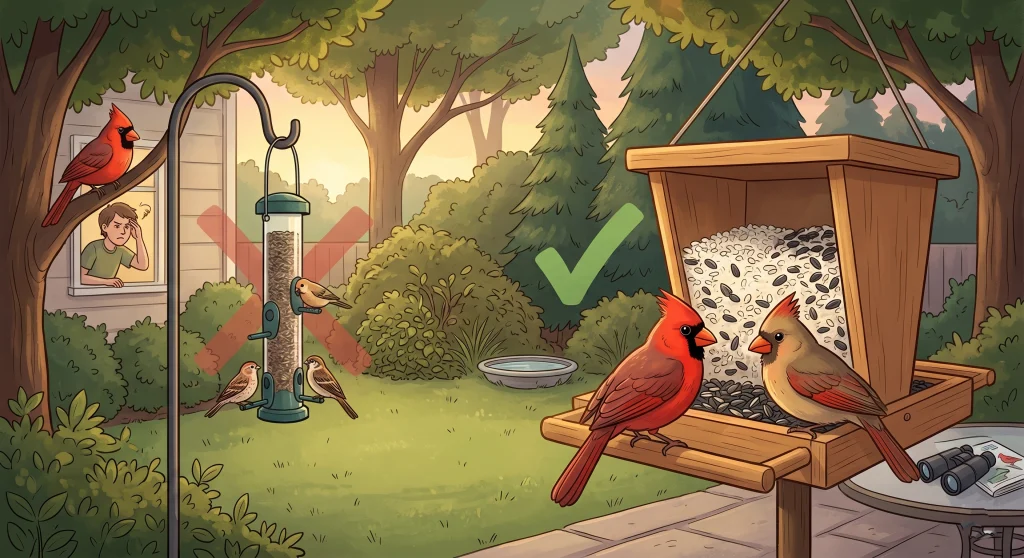
If cardinals are present but rarely use your feeder, the physical design is worth checking. Small tube feeders are excellent for chickadees, titmice, and finches, but a very short perch and tight feeding port can be less comfortable for a larger Northern Cardinal. That does not mean cardinals never use tubes. Cornell notes that nearly any feeder may attract them, while tray and hopper designs are especially practical when offering foods such as safflower.
Northern Cardinals are larger and less acrobatic than birds such as chickadees, and they often look more at home on broad trays, hopper ledges, or the ground. A cramped tube with tiny perches can make feeding awkward, but there is no anatomical rule that says a cardinal must face food straight on or cannot use a tube feeder. If a cardinal can land securely and reach the port without struggling, the feeder may work perfectly well.
Field Note: One pattern I saw often was a yard with good sunflower seed and plenty of bird activity, but the only feeder available had tiny perches. Adding a broader landing surface sometimes made cardinals much easier to observe. I treat that as a practical setup improvement, not proof that every tube feeder is unsuitable.
A hopper, platform, or tray feeder is an easy place to start because it gives cardinals a stable surface and works well with sunflower or safflower. A tube feeder can still work if the perches are long enough or a tray gives larger birds room to land. If you are troubleshooting why are no cardinals coming to my feeder, feeder access is one useful check, but it belongs beside food, cover, local presence, and normal variation in when the birds visit.

A premium cedar hopper feeder with crack-resistant acrylic windows and rust-free hardware. The removable seed tray features a seed diverter and drainage holes to reduce waste and keep seed fresh. Wide opening for spill-free filling and extra perching space for both large and small birds.
Check on AmazonIf you click this link and buy, we earn a commission at no additional cost to you.
The Cardinal Seed Hierarchy: Sunflower First, Safflower Second
Once the feeder is easy to use, food becomes the next variable. Northern Cardinals have strong, cone-shaped bills and eat a wide range of seeds and fruit. Cornell specifically highlights black oil sunflower as a common feeder favorite. Cardinals may also eat corn, grasses, and other seeds, so I would not describe millet or every small grain as food they automatically reject.
Black oil sunflower is the most dependable first choice I would use for Northern Cardinals. Its relatively thin shell makes it easy for many feeder birds to open, which is also why squirrels and several other species like it. If a broad tray is constantly crowded by larger or more dominant visitors, cardinals may have fewer comfortable openings to feed, so food choice and feeder design need to be considered together.
Safflower is a useful second option, especially if you want to experiment with a food that cardinals readily eat but some squirrels, House Sparrows, or starlings may use less enthusiastically. That effect is not universal. Cornell specifically notes that unwanted visitors develop a taste for safflower in some areas. I use it as a selective tool to test, not as a seed that creates a cardinal-only feeder.
Warning: A sudden switch from sunflower to safflower can make a feeder quieter, and acceptance varies from yard to yard. Some cardinals use safflower readily while others strongly favor sunflower. Give the change enough time to observe a pattern, or introduce safflower gradually, but do not wait for a promised one- or two-week deadline.

A premium safflower seed that attracts cardinals, chickadees, titmice, and grosbeaks while naturally deterring squirrels, grackles, and starlings. Its bitter taste keeps unwanted visitors away without any extra effort. Can be used alone or gradually mixed with other seed blends to transition your feeder to a more desirable bird-friendly environment.
Check on AmazonIf you click this link and buy, we earn a commission at no additional cost to you.
Cardinal Timing: When to Actually Watch Your Feeder
Timing can also explain why someone thinks cardinals are missing when they are simply checking the feeder during a quieter part of that particular yard’s day. I have often seen cardinals early and late, but I would never use time of day as proof that they are absent or present. Cardinals can and do feed during the middle of the day.
In my own observation, dawn and late afternoon are useful times to check because cardinals are often active then, and Cornell notes that their songs are among the first sounds of the morning. That is very different from saying they follow a strict feeder schedule. I also would not explain early or late feeding by claiming the male’s red plumage makes midday feeding unsafe. Treat dawn and dusk as good observation windows, not a behavioral rule.
If you want to confirm whether cardinals are using the yard, add an early-morning or late-day check to your usual viewing time rather than replacing it. A bird that appears at noon is no less normal than one that arrives at dawn. Watching at more than one time of day gives you a better picture than assuming the first or last thirty minutes of daylight are the only windows that count.
Female Cardinal Identification
Another common source of confusion is looking only for the bright red adult male. Female Northern Cardinals are much browner overall, so a quick glance can miss them even though the crest, heavy bill, and red accents are distinctive once you know what to watch for. This is an identification problem, not a reason to change the feeder.
The female has a thick orange-red bill, a pointed crest, and a warm brown body with reddish tones in the wings, tail, and crest. Her face is less strongly black than the male’s. Those field marks separate her from a female House Finch or many native sparrows without needing a speculative explanation about why her plumage evolved.
If you see a large brown bird with that heavy orange-red bill, pointed crest, and reddish highlights, you may already have the cardinal you thought was missing. Males and females commonly move around as pairs during the breeding season, although they do not follow a fixed rule about taking turns at a feeder. If you want to confirm the identification, I cover the details in how to attract female cardinals. Their social behavior also changes later in the year, which is why winter yards can look very different.
The Winter Shift
Northern Cardinals are territorial during the breeding season and often move around as pairs. That does not mean a feeder is limited to exactly one pair or that every neighboring male is chased from an entire yard. In fall and winter, Cornell records a clear social shift: cardinals can gather in flocks ranging from about a dozen to several dozen birds. That seasonal change is real, but the size of any flock at your feeder depends on the local population and food conditions.
If your summer observations are mostly a pair and your winter observations suddenly include a larger group, that pattern fits the species’ seasonal behavior. You cannot trigger a flock on command, but you can make the yard useful when local birds begin associating more loosely outside the breeding season. The seasonal details are covered in how to attract cardinals in winter.
The Missing Pieces: Shelter and Water
Food and feeder design are only part of the yard. Northern Cardinals are strongly associated with shrubby edges, hedgerows, vines, and dense tangles, so nearby cover can make a feeding station fit the habitat they already use. I would not say an open lawn guarantees failure, but a yard with no useful shrubs or low cover is offering less of what cardinals use for foraging, shelter, and nesting.
Dense shrubs, vine tangles, hedges, and similar cover are useful because cardinals naturally spend a great deal of time in this kind of habitat. Around 10 feet from useful cover is a practical feeder-placement starting point, but there is no universal 10-to-15-foot sweet spot. You also need to consider squirrel launch points and whether dense low vegetation gives outdoor cats an ambush route. For nesting, Cornell reports cardinal nests in saplings, shrubs, and vine tangles from roughly 1 to 15 feet high. Adding dense vegetation may improve habitat, but it cannot guarantee that a pair will nest in your yard.
Windows deserve separate attention for two reasons. Cardinals sometimes attack their own reflection, especially during the territorial breeding season, and any feeder near glass also needs to be placed with collision safety in mind. If reflection aggression starts, Cornell recommends altering the outside of the reflective surface so the image is disrupted. For collision risk, a feeder mounted directly on the glass or within about 3 feet of the window can be safer than placing it at an intermediate distance where birds can build up speed.
Water is another useful resource, but not because dry seed makes cardinals uniquely thirsty. A clean birdbath can attract many species for drinking and bathing whether or not they use the feeder heavily. Cornell recommends shallow water, about 1 inch deep at the edge and no more than about 2 inches in the center, with frequent water changes. A gentle drip can make the bath easier for birds to notice. Water is therefore a sensible part of learning how to attract birds, but it should be treated as habitat support rather than a cardinal-specific trick.

Creates gentle ripples that attract more birds to any bird bath. Circulates water silently to prevent stagnation and reduce disease. No wiring or plumbing needed, fits most bird baths, and works with heated baths in winter. Runs on 2 D-cell batteries.
Check on AmazonIf you click this link and buy, we earn a commission at no additional cost to you.
Final Thoughts on Creating a Cardinal Haven
If Northern Cardinals already occur in your area, the most dependable setup is straightforward: start with black oil sunflower, offer it in a feeder they can use comfortably, keep useful shrubs or tangles nearby, and add clean water if you can maintain it. Safflower is an optional second tool, not a requirement, and dawn or dusk are useful observation times rather than feeding deadlines. Build a yard that remains useful across the day and across the seasons, then let the local birds decide how often they visit.

High-fat, high-protein peanut pieces that attract Cardinals, Woodpeckers, Nuthatches, Jays, Indigo Buntings, and more year-round. Works with hopper, tube, or platform feeders. Trusted by bird enthusiasts for over 150 years.
Check on AmazonIf you click this link and buy, we earn a commission at no additional cost to you.
More Resources for Attracting Cardinals
If you want to dive deeper into specific cardinal behaviors and seasonal strategies, I have put together a few targeted guides to help you out. Whether you are trying to identify a mystery bird or want to prepare your yard for the cold months, these resources cover the specifics.
| Topic | Description |
|---|---|
| Why Are No Cardinals Coming to My Feeder? | A focused troubleshooting guide for feeder access, placement, timing, and other reasons cardinals may be missing from your setup. |
| How to Attract Female Cardinals | Learn the key female field marks and confirm whether the brown cardinal you are seeing has been overlooked. |
| How to Attract Cardinals in Winter | See how cardinal social behavior changes outside the breeding season and how to support winter visits without assuming a flock is guaranteed. |
FAQs
🥜 Do cardinals eat peanuts?
They can. Northern Cardinals eat a broad seed-and-fruit diet and may take peanut pieces at feeders, although black oil sunflower is the more dependable food to start with. Offer plain, unsalted peanut pieces if you use them, and keep them fresh and dry.
🐦 Do Northern Cardinals migrate in the winter?
Northern Cardinals are considered resident, nonmigratory birds across their normal range. That means they can be present year-round, although it does not guarantee that the exact same individual will visit your feeder every season or remain in the same small area.
☀️ Will a cardinal use a window feeder?
They can use a window feeder if it gives them enough room to land and reach the food. A tray-style design is more comfortable for a cardinal than tiny perches. A feeder attached directly to the glass also has the advantage of reducing the speed a bird can build up before a window collision.
🪶 Do male cardinals change color in the winter?
Male Northern Cardinals remain red through winter rather than changing into the dull seasonal plumage seen in birds such as American Goldfinches. They still molt feathers, but the replacement plumage remains recognizably red.
🏡 Where do cardinals sleep at night?
Northern Cardinals commonly use dense shrubs, tangles, and other protective vegetation throughout the day, and similar cover can provide sheltered roosting sites at night. The exact roost changes with the individual bird, weather, and habitat, so there is no single preferred plant type you need to provide.