The Winter Flocking Secret
If you are trying to figure out how to attract cardinals in winter, the good news is that Northern Cardinals do not migrate out of their range for the season. They can remain around the same neighborhoods, parks, thickets, and backyards all year. Winter changes how conspicuous they are and how they interact with one another, so a few cold-weather adjustments can make the feeder easier for them to use.
When looking at general ways on how to attract birds, it is easy to assume that a summer feeder needs no adjustment for winter. In practice, snow, wet seed, frozen water, shorter daylight, and seasonal changes in bird behavior all affect how useful a station is. For cardinals, one of the clearest seasonal differences is that birds that are territorial during breeding can become much more social in fall and winter.
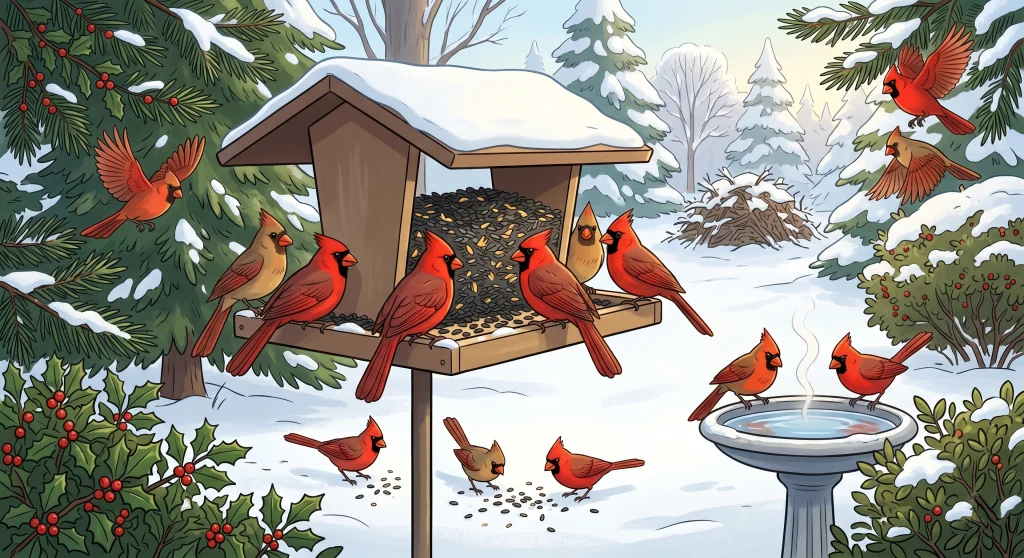
During the breeding season, Northern Cardinals commonly move around as pairs and defend territories. In fall and winter, Cornell notes that they can form flocks of a dozen to several dozen birds. That does not mean every territorial boundary disappears or that every yard gets a large flock, but it explains why winter visits can look very different from the pair-by-pair activity you may notice in spring.
That seasonal shift changes the practical question from “can one cardinal land here?” to “can several birds use this area without crowding one tiny perch?” You do not need to build a huge feeding station, but landing space, seed access, drainage, and nearby cover become more noticeable when multiple birds arrive at once.
The Boom-or-Bust Arrival Pattern
One winter pattern I learned not to overreact to was a quiet feeder followed by a sudden burst of cardinal activity. Because Northern Cardinals are year-round residents, a few empty days do not automatically mean they migrated away. A flock may simply be feeding elsewhere in the neighborhood and then appear together when your station fits into that day’s route.
Winter flocking can make feeder activity feel uneven. Cornell’s feeder cam has documented several Northern Cardinals gathering at once during winter evenings, while the species can still visit feeders at other times of day. A useful feeder may become one of several places a flock checks, but there is no guarantee that a single visit turns your yard into a permanent daily stop.
Field Note: If a winter feeder is quiet for several days, I would check the seed, snow cover, feeder access, and nearby bird activity before moving everything. Cardinals may still be present but feeding elsewhere. Keeping the setup clean and predictable gives you a better test than changing the location every few days.
If several cardinals are arriving together, a feeder with only one tiny landing point can create unnecessary competition. A wider hopper, platform, large tube feeder, or clean ground-feeding area can give more than one bird access. The important point is usable space and stable footing, not the idea that cardinals require one specific feeder shape.
Choosing the Right Winter Setup
Feeder design matters because Northern Cardinals are larger than chickadees and many finches and have a heavy seed-cracking bill. They often use hopper, platform, ground, and larger tube feeders. A feeder that gives them enough room to perch or stand comfortably is usually more useful than one built around very small ports and tiny perches.
Very small tube feeders can be awkward for cardinals when the ports and perches are sized for tiny finches, but tube feeders are not automatically a bad choice. Cornell specifically lists large tube feeders among the feeder types that can attract Northern Cardinals. If your current tube has short, narrow perches and cardinals repeatedly approach without settling, moving to a larger tube, hopper, or platform is a reasonable test.
Using a feeder whose ports or perches are clearly too small for the birds you are trying to serve, then assuming the seed is the problem.
Using a stable hopper, platform, ground feeder, or large tube feeder that gives cardinals enough room to feed comfortably.
A hopper feeder is useful in snowy weather because the roof can help keep seed drier, while a platform offers generous landing space but needs more protection from wet weather. If you prefer a tube feeder, choose a larger design with perches that cardinals can actually use. Capacity should match your real bird traffic rather than an assumed flock size, because oversized feeders can leave seed sitting too long and becoming damp or stale.
Snow management matters regardless of feeder style. Blowing snow can cover a platform, block ports, or leave seed wet as it melts. After a storm, clear access points, remove wet or clumped food, and make sure drainage is open before simply topping the feeder off.

The Perky-Pet Squirrel-Be-Gone II is a large hopper-style wild bird feeder with an 8-pound seed capacity. Its weight-activated perch closes access to the feeding ports when a squirrel lands on the feeder, while the removable locking roof makes filling and cleaning easier. The metal construction accepts mixed seed, sunflower seed, or safflower seed and provides a broad feeding area suitable for cardinals and other backyard birds.
Check on AmazonIf you click this link and buy, we earn a commission at no additional cost to you.
The Best Seed for Cold Weather Survival
Cold weather raises the energetic demands on small birds, and high-energy feeder foods can be especially useful when natural foods are harder to reach. Northern Cardinals still eat a varied diet of seeds, fruits, and other foods in winter, so feeder seed is supplemental rather than their only source of calories. The best choices are foods they readily recognize and can handle efficiently.
Seed mixes heavy in red millet, oats, and other ingredients many feeder birds leave behind can create a lot of waste. For cardinals, sunflower is the strongest general starting point, while safflower is another common option. Sunflower hearts can also work well when you want less hull debris, although they need extra protection from moisture.
| Seed Type | Why Cardinals Love It in Winter |
|---|---|
| Black Oil Sunflower | A strong all-around choice. Black oil sunflower has a thin shell and attracts a wide range of seed-eating birds, including cardinals. |
| Safflower Seed | A thick-shelled seed that cardinals often use. Some squirrels and blackbirds avoid it, but that varies by location and individual animals. |
| Sunflower Hearts | Pre-shelled sunflower that reduces hull cleanup and is easy to eat, but it is more exposed to moisture and should be offered in modest amounts. |
Safflower can be worth testing if squirrels dominate a cardinal feeder, but it is not a guaranteed squirrel deterrent. Cornell notes that squirrels avoid safflower in some places and develop a taste for it in others. If squirrels continue using it, rely on feeder placement and physical exclusion rather than repeatedly changing seed.
Cardinals often forage on or near the ground, so a clean low tray or ground feeder can complement a hopper or large tube feeder. I prefer a tray that can be emptied and cleaned rather than repeatedly scattering seed into wet soil or snow, where food is harder to monitor and can also attract rodents. Offer only what birds will use before it becomes damp or buried.

A premium safflower seed that attracts cardinals, chickadees, titmice, and grosbeaks while naturally deterring squirrels, grackles, and starlings. Its bitter taste keeps unwanted visitors away without any extra effort. Can be used alone or gradually mixed with other seed blends to transition your feeder to a more desirable bird-friendly environment.
Check on AmazonIf you click this link and buy, we earn a commission at no additional cost to you.
Open Water and Safe Shelter
If you want to attract birds in winter, accessible water is another useful resource. Cornell notes that keeping a birdbath ice-free is not essential for birds to survive, because they can obtain water in other ways, but open water can attract additional visitors when local sources are frozen. Keep the bath shallow, clean, and easy for birds to stand at safely.
A heater should only keep the water from freezing; it does not need to make the bath warm. A purpose-built heated bath or immersion heater can work, but follow the manufacturer’s electrical instructions and use a ground-fault protected outlet. Open winter water may increase bird activity, but I would not promise that it will pull in a cardinal flock by itself.
Dense vegetation is useful cardinal habitat throughout the year. Northern Cardinals are not cavity nesters and normally build open cup nests in shrubs, saplings, or vine tangles rather than using enclosed nest boxes. In winter, shrubs and evergreens can provide cover from weather and predators, so preserving useful vegetation can matter as much as adding another feeder.
A feeder near useful cover can give cardinals a place to pause before and after feeding. I would not treat ten to fifteen feet as a universal rule because yard layout, predators, cats, and window placement all matter. The practical goal is nearby escape cover without putting the feeder directly beside a hiding place that creates an easy ambush point.
The Winter Photography Advantage
Winter is also a striking time to watch male cardinals. Cornell explains that after the late-summer and fall molt, gray tips on new red feathers gradually wear away, so males can approach peak redness by midwinter. Snow adds even more visual contrast, but the brighter appearance is not just a photography trick.
Pro Tips: If you enjoy photography, winter can be especially rewarding because male plumage is fresh and the background may be simpler. Dawn and late afternoon often give softer light, but cardinals can visit at any time of day. Watch the feeder pattern in your own yard rather than waiting for one supposedly perfect hour.

44-watt heater keeps bird bath water from freezing all winter long. Heavy-duty malleable foil molds to fit any fountain or bath shape. Runs continuously with no thermostat, 10 inch grounded cord with 3-prong plug. Measures 10 x 10 x 1 inches, weighs just 0.58 lbs.
Check on AmazonIf you click this link and buy, we earn a commission at no additional cost to you.
Final Thoughts
Attracting cardinals in winter is mostly about making a familiar food source easy to use in cold, wet, or snowy conditions. Offer sunflower or safflower in a feeder with enough space, keep the food dry, preserve nearby cover, and provide clean water if you can. Those resources can make the yard more useful without implying that feeder food or heated water is required for cardinals to survive.
Do not get discouraged if the feeder is quiet for a few days. Keep snow away from feeding ports, replace wet seed, and watch whether cardinals are using natural food elsewhere nearby. If you already know how to attract cardinals during the rest of the year, these cold-weather adjustments make the same setup easier to use in winter. They may return regularly, but wild birds will continue shifting among multiple food sources.

Wagner's Four Season Sunflower Seed is 100% black oil sunflower seed. Sunflower seed is the favorite seed of most wild birds. It is high in energy and has a thin shell making it easy for all birds to consume. Use tray feeders or hopper feeders to attract sunflower loving songbirds. Cardinals, Chickadees, Finches, Nuthatches, Woodpeckers and much more. Trust your backyard birds to the experts at Wagner’s.
Check on AmazonIf you click this link and buy, we earn a commission at no additional cost to you.
FAQs
❄️ Why do I only see cardinals in winter sometimes?
Northern Cardinals are year-round residents throughout their range, but they can become more social in fall and winter and may forage in flocks. A quiet feeder does not necessarily mean they left the area. They may be using natural food, another feeding site, or cover elsewhere in the neighborhood.
🥜 What is the best seed to offer cardinals when it snows?
Black oil sunflower is an excellent starting choice, and safflower is another seed cardinals readily use. Sunflower hearts can work well too when kept dry. The advantage is that cardinals recognize and use these foods readily, not that one specific seed is required for winter survival.
🏠 Do cardinals use birdhouses in the winter?
Northern Cardinals are not cavity nesters and do not normally use enclosed nest boxes. They build open cup nests in dense vegetation during the breeding season and commonly use shrubs, tangles, and other cover throughout the year. Preserving dense vegetation is more useful for them than adding a conventional birdhouse.
⏰ What time of day is best to see them at the feeder?
Cardinals can visit feeders at any time of day, but Cornell notes that they are often among the first visitors in the morning and the last to linger before dusk. Dawn and late afternoon are good times to watch, but midday visits are completely normal too.
💦 Will a heated birdbath really make a difference?
It can help. Ice-free water gives birds another resource when local water is frozen, and Cornell notes that heated baths can attract more birds in winter. It is not essential for their survival and it is not guaranteed to outperform a good food source, so treat it as a useful addition rather than a magic attractor.