Why Most Squirrel Solutions Fail
In my experience, figuring out how to attract birds but not squirrels is one of the most common problems people bring to a bird feeding store. The pattern is familiar: someone buys a baffle or a weight-sensitive feeder, assumes the hardware alone will solve the problem, and then watches a squirrel reach the food from a direction the setup never blocked. Good equipment helps, but it only works when the surrounding yard is part of the plan.
The equipment may be fine. The weak point is often how it sits in the environment. Squirrels climb, jump, descend, and use fences, rails, branches, roofs, and furniture as alternate routes. If you want to keep squirrels away from a bird feeder, look at the entire approach path rather than only the pole beneath the feeder.
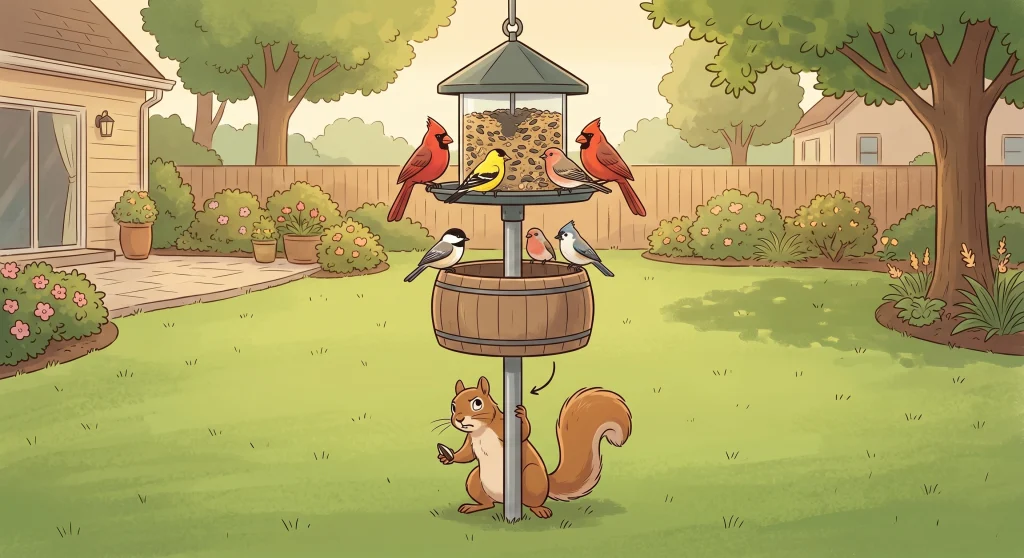
Take a standard pole baffle. When it is sized and mounted correctly, it can block the direct climb from the ground. It cannot stop a squirrel that can bypass the pole entirely by jumping from a tree, fence, deck rail, roof, or other nearby structure. I have seen plenty of otherwise solid setups fail for exactly that reason: the baffle guarded one route while the yard offered another.
The same principle applies to weight-sensitive and other squirrel-resistant feeders. Their mechanisms work best when squirrels have to approach the feeder the way the design expects. Put one within easy reach of a trunk or railing and a squirrel may brace itself on the nearby structure instead of loading the feeder normally. Placement does not replace hardware, but it determines whether the hardware gets a fair chance to work.
Field Note: One pattern I saw repeatedly was a squirrel-resistant feeder being blamed when the real problem was a nearby launch point. A branch, railing, or trunk let the squirrel reach the food without using the feeder the way its deterrent mechanism was designed to work. Before replacing the feeder, I would always audit the approach routes around it.
The 5-7-9 Rule for Feeder Placement
The 5-7-9 rule is a practical WBU-style rule of thumb for thinking about squirrel clearance, not a biological law. It reminds you to protect the feeder from approaches from below, from the side, and from above. Actual jumping ability and yard geometry vary, so I use these numbers as a starting framework and add more clearance when a persistent squirrel proves the setup is still reachable.
The numbers are best understood as a quick clearance checklist around the feeding station:
- 5 feet at the baffle: A common WBU recommendation is to place the top of a properly sized pole baffle about 5 feet above the ground so squirrels cannot simply jump over it. Check the instructions for your specific baffle because shape and mounting height matter.
- 7 feet or more from the sides: Keep the station well away from fences, deck rails, trunks, furniture, and other launch points. Seven feet is a useful minimum for some squirrel-resistant setups, while some WBU guidance uses roughly 10 to 11 feet of clearance for a conventional baffled pole.
- Watch the space above: A branch, roofline, or other structure above the feeder can defeat a perfect pole setup. The traditional 5-7-9 rule uses 9 feet as the overhead reminder, but the real test is simpler: there should be no practical route for a squirrel to drop or climb directly onto the feeder.
When you are reading our broader guide on how to attract birds, you will notice that nearby cover can make a feeding area more useful to birds. That creates a real tradeoff: branches that provide staging and escape cover can also become squirrel launch points, and dense low cover can hide cats. I usually start with useful cover roughly around 10 feet away and then adjust for the actual layout of the yard rather than forcing every site into one exact measurement.
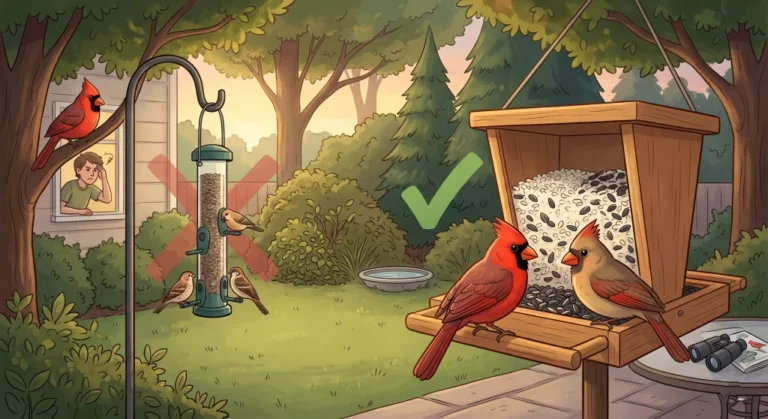
Hanging a feeder from a branch while relying on a pole-style baffle concept. A squirrel can use the trunk and branch as an alternate route that never encounters the barrier.
Mounting the feeder on a smooth pole with a properly sized baffle and enough open clearance that nearby trees, fences, rails, and roofs do not provide an easy bypass route.

This 92-inch bird feeder pole combines a squirrel-deterring spring-loaded baffle with four adjustable shepherd hooks for hanging multiple feeders or garden accessories. Its nine-prong ground base helps improve stability, while the adjustable six-section pole allows the overall height to be changed for different backyard setups. The station also includes a detachable bird bath and mesh feeding tray, providing several feeding and watering options around one central pole.
Check on AmazonIf you click this link and buy, we earn a commission at no additional cost to you.
The Safflower Strategy and the Waiting Game
If your yard is too small, heavily wooded, or surrounded by fences to create generous clearance, food choice can become part of the strategy. Safflower is worth testing because cardinals, grosbeaks, chickadees, doves, and some other feeder birds eat it, while squirrels often show less interest in it than in sunflower. The important word is often. Cornell notes that squirrels and other unwanted visitors do eat safflower in some areas, so I never sell it as squirrel-proof seed.
Another reason safflower gets mixed reviews is that local birds do not all accept it at the same rate. A yard accustomed to black oil sunflower may become quieter after a sudden switch, while another yard may have cardinals using safflower almost immediately. That variation is normal. Give the birds time to sample it before deciding the seed does not work in your location.
I would not attach a universal two-to-three-week deadline to the transition. Some birds accept safflower quickly and some barely use it at all. If squirrels ignore it and your target birds begin eating it, you have found a useful tool; if the birds stay away and squirrels keep eating it, safflower is not solving the problem in that yard. Judge the result by what you actually observe rather than by waiting for a promised date.
Pro Tips: If you want to ease the change, mix some safflower into the food birds already use and increase the proportion gradually. This keeps familiar food available while birds investigate the new seed. The tradeoff is that any sunflower left in the mix can still give squirrels a strong reason to keep visiting.

A premium safflower seed that attracts cardinals, chickadees, titmice, and grosbeaks while naturally deterring squirrels, grackles, and starlings. Its bitter taste keeps unwanted visitors away without any extra effort. Can be used alone or gradually mixed with other seed blends to transition your feeder to a more desirable bird-friendly environment.
Check on AmazonIf you click this link and buy, we earn a commission at no additional cost to you.
The Seedless Suet Option
For a yard focused mainly on woodpeckers, nuthatches, chickadees, and other suet users, another option is to reduce or temporarily stop loose seed. That removes much of the shell and seed scatter produced by a conventional seed station. It narrows the birds you are feeding, so I see it as a targeted tradeoff rather than a universal upgrade.
Suet can attract woodpeckers, nuthatches, chickadees, and some wrens, but squirrels also eat ordinary suet readily. Commercial hot-pepper foods are designed around the fact that birds are far less sensitive to capsaicin than mammals. They discourage squirrels in some yards, but Cornell reports mixed results, so I treat hot-pepper suet as another deterrent to test rather than something every squirrel will avoid.
Reducing loose seed can also reduce the amount of hulls and kernels under the station. It does not make the ground perfectly clean because suet crumbs can still fall, and mammals may still investigate the feeder itself. The useful change is simply that less edible seed accumulates on the lawn, which removes one of the easiest food sources for rodents and other ground-foraging visitors.

A no-melt suet dough made with beef suet and roasted peanut pieces, staying solid up to 100F for year-round use in any climate. Fully consumable with no shells or waste, keeping feeders clean. Rich in healthy fats and protein to support daily activity, nesting, and migration. Attracts woodpeckers, nuthatches, chickadees, wrens, and other songbirds. Made in the USA.
Check on AmazonIf you click this link and buy, we earn a commission at no additional cost to you.
Managing Rats and Ground Mess
Bird feeding can contribute to a rodent problem when accessible food accumulates around the station, especially on the ground. Spilled seed is one of the most obvious pathways because rats and mice can feed without ever climbing the feeder. A squirrel problem does not automatically mean you have rats, but a carpet of edible seed under the feeder is worth fixing before nocturnal rodents discover it.
The first job is managing the spill. A hulled or “no-mess” blend reduces shells and the amount of material birds discard while opening seeds, but anything edible that reaches the ground can still feed rodents. Do not count on doves or juncos to clean up every kernel before dark. Use smaller fills, rake or sweep beneath the station, and remove wet or accumulated food regularly.
A seed catcher can intercept some debris before it reaches the ground, although it needs regular cleaning because birds may feed from the tray and droppings can contaminate it. If rats or other mammals are visiting mainly at night, bringing feeders in at dusk can help, but store both feeders and seed in a secure rodent-resistant container rather than simply leaving food accessible inside a garage or shed.
What About Raccoons and Chipmunks?
Squirrels get most of the attention, but chipmunks and raccoons can also raid a feeding station. Chipmunks climb well and can exploit many of the same routes as tree squirrels, so the same baffle-and-clearance logic is useful. I would not promise that 5-7-9 makes a station completely chipmunk-proof, especially when nearby structures provide an alternate route.
Raccoons often visit after dark and can be strong enough to bend, pull, or manipulate lightweight feeder hardware. Hot-pepper food may discourage some mammals, but I would not rely on it as the main raccoon solution. If nighttime raids are the pattern, removing the food at dusk and storing it securely is usually the cleaner first test.
Handling Bully Birds: Pigeons, Sparrows, and Starlings
Squirrels are not the only visitors that can dominate a feeding station. Rock Pigeons, House Sparrows, and European Starlings can become abundant around feeders and may reduce access for other birds simply through numbers, feeder design, or competitive behavior. The solution is not to harm or chase birds indiscriminately, but to change the food and access points so the station better favors the species you want to support.
For common urban Rock Pigeons, feeder design is one of the strongest levers. They feed readily on the ground and on broad trays, so eliminating ground seed and using a hanging tube feeder with small ports and short perches can make access much harder. I would not say a pigeon physically cannot use every tube feeder, and western Band-tailed Pigeons behave differently. The practical goal is to remove the easy flat landing and ground-feeding opportunities that are supporting the flock.
House Sparrows require a different approach because they readily use many tube feeders and eat a wide range of seed. White proso millet is particularly attractive to them, so removing millet can reduce one strong food incentive while still leaving options for other feeder birds. Straight sunflower will not exclude House Sparrows, and safflower only discourages them in some areas. Feeder design and a second, more specialized food source such as nyjer can be just as important as the seed switch.
European Starlings can be especially persistent around suet. An upside-down suet feeder is a useful way to shift access toward woodpeckers and nuthatches because those birds readily feed in an inverted position. Cornell recommends downward-facing suet designs to limit starlings, but I would not describe starlings as having weak feet or promise complete exclusion. The design makes feeding less convenient for them, which is often enough to reduce pressure.

An upside-down suet feeder that naturally deters nuisance birds like blackbirds and grackles, while welcoming woodpeckers, titmice, nuthatches, and chickadees that feed comfortably in an inverted position. Built from naturally rot-resistant cedar with stainless steel screws for lasting durability. Holds 1 standard suet cake.
Check on AmazonIf you click this link and buy, we earn a commission at no additional cost to you.
Specific Solutions for Unwanted Visitors
When you are managing a backyard feeding station, dealing with one unwanted visitor often leads to questions about another. If you need to dive deeper into specific issues beyond squirrels, here is where to look next:
| Topic | What to Know |
|---|---|
| Does a Bird Feeder Attract Rats? | How spilled food contributes to rodent activity and the practical ways to reduce what reaches the ground. |
| How to Attract Birds But Not Pigeons | How reducing ground seed and using less pigeon-friendly feeder designs can make a station harder for common Rock Pigeons to dominate. |
| How to Attract Birds But Not Sparrows | Ways to reduce House Sparrow pressure while creating more targeted feeding opportunities for other birds. |
Final Thoughts on Creating a Balanced Yard
You will probably never eliminate every squirrel or every bird you did not intend to feed, and that is normal. A backyard feeding station is an open resource, not a controlled enclosure. Success means reducing easy access for problem visitors while keeping the station safe, clean, and useful for the birds you want to watch.
Start with the route squirrels are using, then fix that route before buying more hardware. Add a properly mounted baffle or squirrel-resistant feeder, increase clearance where possible, test foods such as safflower without expecting a guarantee, and keep spilled seed off the ground. That combination gives you a much better chance of reducing mammal traffic without pretending any single measurement, seed, or feeder design works in every yard.

The Pmsanzay Bird Seed Catcher Tray hangs beneath an existing bird feeder to collect dropped seed and husks before they reach the ground. Its open platform design can also provide an additional feeding area, while drainage holes allow rainwater to escape instead of collecting in the tray. The universal hanging design uses dark chains and hooks and is intended to fit a wide range of outdoor bird feeders.
Check on AmazonIf you click this link and buy, we earn a commission at no additional cost to you.
FAQs
🐿️ How do I squirrel proof my bird feeder pole?
A properly sized pole baffle is a strong starting point. Mount it according to the manufacturer’s instructions, commonly with the top around 5 feet above the ground, and give the pole as much lateral clearance as your yard allows. Seven feet may work with some squirrel-resistant setups, while a conventional baffled pole often benefits from roughly 10 to 11 feet from sturdy launch points.
🌶️ Does cayenne pepper keep squirrels away from bird seed?
Commercial capsaicin-treated bird foods can discourage some squirrels because birds are far less sensitive to capsaicin than mammals, but Cornell reports mixed results. I would use a commercially prepared product if you want to test this approach rather than adding loose cayenne powder yourself, and I would still pair it with good feeder placement.
🦅 What is the best squirrel deterrent for a bird feeder?
Clearance is one of the most important parts of squirrel control because a baffle cannot stop a squirrel that jumps around it. The strongest setups combine distance from launch points with a correctly mounted baffle or squirrel-resistant feeder rather than relying on distance alone.
🌻 Will birds eat safflower seed if I switch?
Cardinals, grosbeaks, chickadees, doves, and some other feeder birds eat safflower, but acceptance varies by yard and species. Some birds take to it quickly while others barely use it, so there is no reliable two-to-three-week transition deadline. Introduce it gradually if a sudden switch makes your feeder go quiet.
🕊️ How do I stop pigeons from eating all my bird seed?
For common urban Rock Pigeons, stop broadcasting seed on the ground and reduce access to broad platform trays. A hanging tube feeder with small ports and short perches is harder for them to use, although no feeder design is a perfect exclusion device and other pigeon species may behave differently.
🐁 Do bird feeders attract rats?
Accessible bird food can contribute to rat activity, especially when edible seed accumulates on the ground. A catcher tray, smaller fills, regular cleanup, and hulled seed can reduce the food available below the feeder, but none of those replaces basic sanitation and rodent-resistant storage.