Why Pigeons Have Taken Over Your Yard
I have heard the same pigeon complaint many times: people try noise makers, decoys, or other scare tactics while continuing to offer exactly the kind of feeding access Rock Pigeons use well. Large platforms, hopper feeders with broad trays, and seed scattered on the ground all give a flock an easy place to land and feed. Before buying another deterrent, I would audit those food-access points first.
The practical goal is not to make the entire yard physically incompatible with pigeons. It is to make the bird-food station less convenient for them. Reduce edible seed on the ground, limit broad landing surfaces, and make the remaining food easier for smaller target birds to reach than for a large flock of Rock Pigeons.
The Anatomy Difference: Songbirds vs. Pigeons
The common urban bird most people mean here is the Rock Pigeon. Rock Pigeons spend a great deal of time feeding on open ground and readily use broad ledges and platform-style feeding surfaces. They can perch, so the issue is not that their feet are physically incapable of gripping anything narrow. The useful difference is that a large pigeon is much less comfortable on a tiny perch beside a small feeding port than it is on the ground or a roomy tray.
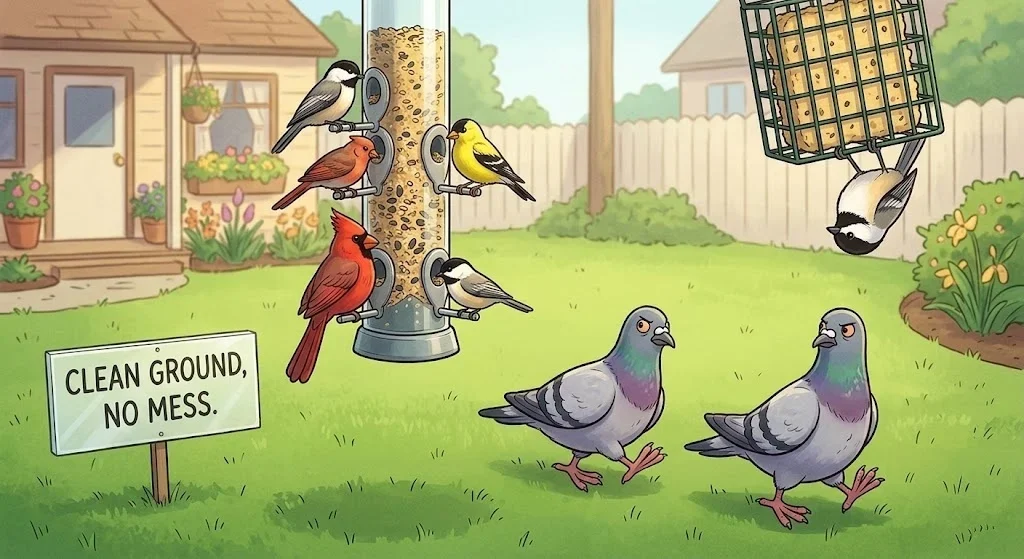
Small birds such as finches and chickadees can use compact tube-feeder perches that provide very little room for a pigeon-sized bird. That size difference is useful even without pretending pigeons cannot perch at all. The idea is to remove the broad surfaces they prefer and shift more of the food to access points built around smaller birds.
The Ground-Seed Problem
Ground food is one of the strongest reasons Rock Pigeons gather beneath a feeding station. Cornell notes that they are attracted to open areas where they can find food on the ground. Seed feeders can create that opportunity when birds sort through mixes, drop kernels, or leave edible pieces beneath the station. A broad platform can create the same easy access even when the ground itself is clean.
A flock can therefore spend much of its time under a feeder instead of trying to use the feeder itself. Empty hulls are not food, but dropped kernels and rejected seed are. If edible seed is accumulating under the station, clean that up before assuming you need a more complicated deterrent.
Leaving dropped seed on the ground and hoping the pigeons eventually get full and leave.
Reducing edible spill with smaller fills, regular sweeping or raking, and a catcher that is cleaned often enough not to become another open platform feeder.
Managing the spill zone is one of the most useful changes you can make. A seed catcher can intercept part of the waste, but remember that a large open catcher can also become a landing tray for pigeons if they can reach it. Hulled or “no-mess” blends reduce shells and sorting waste, yet any edible kernel that lands on the ground can still feed pigeons or rodents. Smaller fills and regular cleanup matter more than assuming other birds will remove every piece. The same ground-food control is useful when working on how to attract birds but not squirrels.

Pole-mounted tray that catches fallen seeds, keeping your lawn clean and weed-free. Made from durable anti-UV clear PC plastic, stable in strong winds with no swaying. Fits poles 0.5 to 1 inch, installs tool-free with 2 clamps. Features 6 seed compartments and drain holes to keep seeds dry. Doubles as a feeder!
Check on AmazonIf you click this link and buy, we earn a commission at no additional cost to you.
Feeder Redesign: The Tube Advantage
If you want to favor small songbirds over Rock Pigeons, feeder design is one of your strongest tools. Broad trays and roomy platforms are easy for pigeons to use, while small feeding ports and short perches create much less usable space for a large bird. The tradeoff is that restrictive feeders also exclude some desirable larger species, so choose the design around the birds you actually want to serve.
A small-port tube feeder can make direct feeding much harder for Rock Pigeons because there is little room to land, balance, and reach the seed. I would not call any feeder truly pigeon-proof or claim that pigeons are physically incapable of gripping a short perch. The advantage is practical rather than absolute: a properly chosen tube feeder gives small birds a comfortable access point without providing the broad platform a pigeon flock prefers.
| Feeder Type | Likely Rock Pigeon Access |
|---|---|
| Platform / Tray | High. The broad, flat landing surface is easy for Rock Pigeons to use. |
| Traditional Hopper | Often high when the hopper has a wide base tray that supports a large bird comfortably. |
| Weight-Activated | Variable. A correctly adjusted weight-sensitive design may exclude a heavy pigeon, but performance depends on the feeder and its settings. |
| Tube (Small Ports) | Usually lower when ports are small and perches are short, although it is not guaranteed exclusion. |
If you currently have a hopper feeder that you do not want to replace, a restrictive dome or cage can sometimes reduce access for larger birds while leaving smaller birds room to enter. Do not lower a cover so far that target birds have to squeeze through an unsafe gap, and watch the feeder after every adjustment. The useful measure is whether pigeons can still land and feed comfortably, not whether the setup matches one exact clearance rule.

Designed for finches and small birds, works great with Nyjer, Thistle, and black oil sunflower seeds. Features 12 small feeding ports and 8 metal perches so multiple birds can feed at once. Internal V-spacer and 4 drain holes keep seeds dry and fresh. Easy to refill and rinse clean. A great gift for any bird lover!
Check on AmazonIf you click this link and buy, we earn a commission at no additional cost to you.
Seed Selection to Discourage Flocks
Food choice matters because some inexpensive mixes contain a high proportion of grains that many common feeder songbirds use less readily than sunflower. Cracked corn and milo are not automatically worthless ingredients, but they can be attractive to ground-feeding birds, including Rock Pigeons, while also increasing the amount of food that ends up beneath a feeder when the species at the ports are sorting through the mix.
I would not build the strategy around finding a seed that pigeons supposedly refuse to eat. Safflower can be useful for cardinals, grosbeaks, chickadees, doves, and some native sparrows, but pigeons and other doves may eat it as well. A better food strategy is to remove corn- and millet-heavy ground-feeding opportunities, use a cleaner seed that your target birds actually want, and pair that choice with a feeder pigeons have difficulty using.
Field Note: The successful pigeon fixes I saw were rarely one-product fixes. The pattern was usually the same: remove the easy ground food first, then replace broad feeding surfaces with something the target songbirds could use more efficiently than the pigeons. When that combination worked, the flock had much less reason to remain at the station.
Here are the rules for seed selection when dealing with this specific problem:
- Reduce or remove cracked corn, milo, and other foods that are accumulating on the ground when Rock Pigeons are the problem.
- Use foods such as black oil sunflower, sunflower hearts, or safflower only when they match the birds you want to attract, and keep them in a feeder design pigeons cannot use easily.
- Do not add bread or kitchen scraps to the yard as an alternative feeding source.
- If you offer suet, an upside-down or otherwise restrictive suet feeder can favor clinging species such as woodpeckers and nuthatches over pigeons.
Food and feeder design work together. Whether you are dealing with a persistent Rock Pigeon flock or just learning how to attract birds for the first time, watch which species are actually using each food and where the waste lands. That observation is more useful than assuming one seed will repel every unwanted bird.

A premium safflower seed that attracts cardinals, chickadees, titmice, and grosbeaks while naturally deterring squirrels, grackles, and starlings. Its bitter taste keeps unwanted visitors away without any extra effort. Can be used alone or gradually mixed with other seed blends to transition your feeder to a more desirable bird-friendly environment.
Check on AmazonIf you click this link and buy, we earn a commission at no additional cost to you.
A Quick Note on Western Pigeons
There is an important regional distinction in western North America. The urban pigeon most people are trying to discourage is the Rock Pigeon, but the native Band-tailed Pigeon also visits backyards and bird feeders in parts of the West. Do not assume the two species will respond identically to the same feeder changes.
Band-tailed Pigeons naturally perch in trees and Cornell documents them visiting feeders for seeds. If this is the bird using your station, I would not rely on safflower as a special deterrent. Identify the species first, then use the least disruptive access change that fits the problem, such as a feeder with smaller entry space or a correctly adjusted weight-sensitive mechanism if you need to exclude larger birds while continuing to feed smaller species.
What If They Still Do Not Leave?
Sometimes you can remove the food incentive and still see pigeons spending hours on the roof, ledges, or other structures. That is a useful clue that feeding is only part of the issue. A regular resting or nesting site will not disappear simply because the seed underneath it changed.
For a true roosting problem, physical exclusion is more relevant than feeder changes. Repairing access points and properly installed ledge deterrents can make a structure less attractive without harming birds. Identify the species before disturbing a nest or blocking an occupied site, and check local rules when native birds may be involved. The objective is to remove the roosting opportunity safely, not to injure birds that are already using the structure.

PANGCH Bird Spikes provide 10.82 feet of coverage with ten stainless-steel strips for deterring birds from landing or nesting on exposed surfaces. The 304 stainless-steel construction is intended for outdoor use on roofs, fences, ledges, gutters, and similar areas. Each strip can be mounted with screws, ties, tape, or suitable adhesive and can be adjusted to fit different installation spaces.
Check on AmazonIf you click this link and buy, we earn a commission at no additional cost to you.
Final Thoughts on Reclaiming Your Yard
Do not expect a flock to stop checking the yard the moment you change the feeder. Birds that have repeatedly found food in one place may continue returning for a while, especially if even a small amount of seed still reaches the ground. Consistent cleanup matters more than hitting a particular number of days.
If the new setup leaves pigeons with little accessible food while your target birds can still use the feeders, pigeon pressure may decline gradually. Some flocks will keep checking, and some yards will need further adjustment. The useful sign of success is not that every pigeon disappears, but that they can no longer dominate the food you intended for smaller birds.

The most popular large-capacity squirrel-proof feeder around. When a squirrel climbs on, its own weight automatically closes the feeding ports, keeping seed safe without harming the animal. Patented weight-adjustable spring lets you control which birds can feed. Built with UV-stabilized, chew-proof materials for long-lasting outdoor use. Backed by lifetime support with real humans on the phone.
Check on AmazonIf you click this link and buy, we earn a commission at no additional cost to you.
FAQs
🦉 Do fake owls keep pigeons away?
A stationary fake owl may cause a short-term reaction, but pigeons can habituate when the decoy never behaves like a real predator. I would not rely on one as a long-term solution unless it is part of a broader, frequently changed deterrent setup.
🌶️ Will spicy bird seed deter them?
Capsaicin is used mainly as a mammal deterrent because birds are far less sensitive to it than mammals. That means hot-pepper bird food is not a reliable pigeon deterrent. If pigeons can reach the feeder or spilled seed, changing the food to a spicy version does not address the main access problem.
🌽 What is their favorite food to avoid?
Rock Pigeons readily eat grains and seeds on the ground, including corn and milo, and bread or other scraps can keep a flock returning even when the bird feeder changes. Avoid deliberately providing those easy ground foods when your goal is to reduce pigeon activity.
🐦 Will safflower seed scare away my songbirds?
Cardinals, grosbeaks, chickadees, doves, and some native sparrows eat safflower, but acceptance varies by species and yard. Finches are not a reason I would choose safflower, and there is no guaranteed one- or two-week transition period. Use it if it serves the birds you want, not because you expect pigeons to refuse it.
⏱️ How long does it take for them to leave?
There is no reliable three-to-seven-day timetable. A flock may reduce its visits quickly, or it may continue checking a previously productive yard for much longer. Keep ground food consistently unavailable and judge the change by whether pigeon feeding actually declines over time.