Why Summer Feeder Activity Often Drops
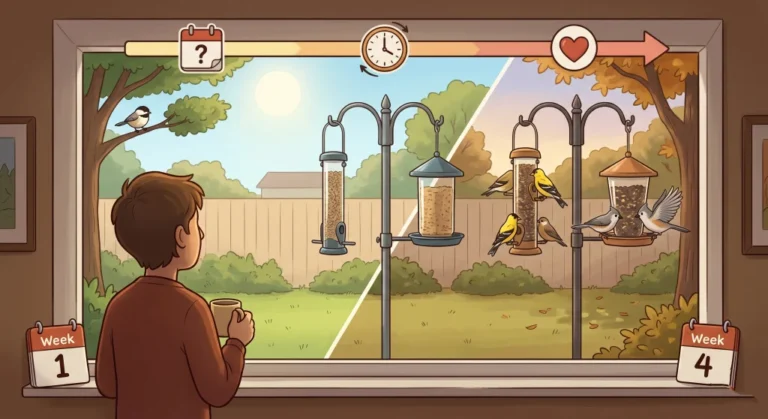
Every year as warm weather settled in, the same kind of question came into the store. Someone had a busy feeder earlier in the season, then suddenly noticed much less traffic and assumed the setup had failed. The first thing I learned to check was whether anything had actually changed, because a seasonal slowdown can look dramatic even when the feeder itself is fine.
Often, nothing was mechanically wrong with the feeder. I have seen plenty of yards lose much of their regular feeder traffic as natural insects, seeds, and fruit became easier to find elsewhere. That does not mean every quiet feeder is seasonal, so I still check seed freshness, cleanliness, and predator activity. But summer is one of the times when lower feeder use can be perfectly ordinary.
Understanding the main seasonal reasons saves a lot of unnecessary tinkering. Instead of moving the feeder every few days or dumping in a new blend, I would first look at breeding activity, natural food, migration, and the condition of the seed. Those four checks usually tell you whether the feeder needs attention or simply needs patience.
Why Feeder Use Can Drop During Nesting Season
A common beginner assumption is that an adult bird eating sunflower seed will simply carry the same food to its nestlings. Many familiar songbirds rely heavily on insects and other arthropods when raising young because growing chicks need nutrient-rich animal food. That does not mean every species stops eating seed, and it does not mean all nestlings have the same diet. It means breeding can change how much time some adults spend at a feeder.
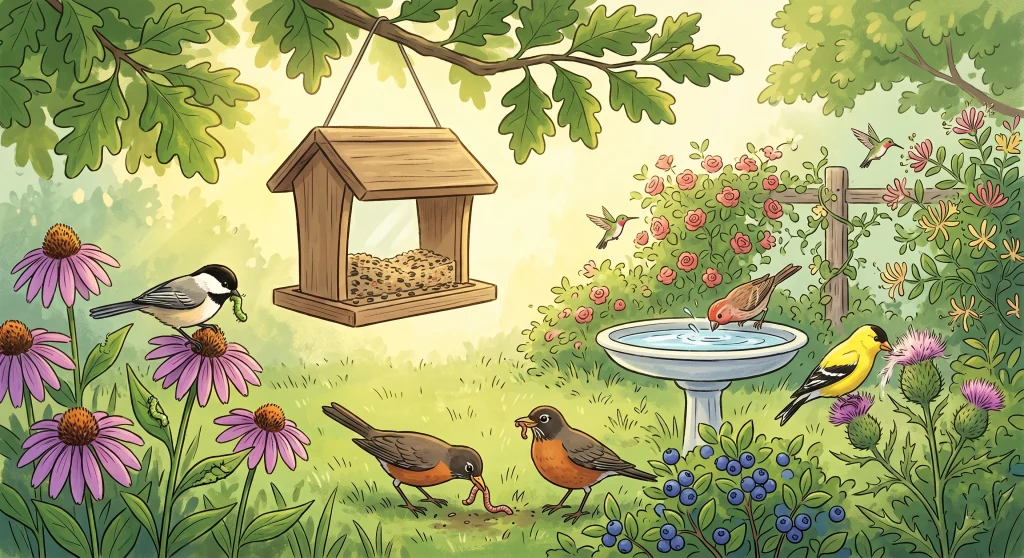
Chickadees are a good example: parents feed nestlings large numbers of caterpillars and other insects even though the adults also eat seeds. During that stage, an adult may spend much more time searching leaves, bark, and branches than sitting at a seed feeder. Other species divide their feeding differently, so I would never use one nesting rule for the entire backyard. The broader pattern is simply that breeding changes both diet and daily behavior.
Field Note: I used to tell customers to watch where the birds were spending their time before deciding the feeder had failed. A chickadee working leaves and twigs for caterpillars, or a robin crossing the lawn for invertebrates, is not evidence that the yard is empty. During breeding, the most interesting activity may simply have shifted away from the feeder.
Adults may still visit feeders while raising young, but visit frequency can change as their workload and food needs change. A summer slowdown by itself is not proof of a healthy breeding population, just as it is not proof that something is wrong. If you are still seeing birds foraging in trees, shrubs, lawns, or native plants, that is a useful clue that activity has shifted rather than vanished.

Oven-dried mealworms that serve as a high-protein, high-energy treat for wild birds. Attracts bluebirds, wrens, robins, chickadees, woodpeckers, and cardinals - species that are often difficult to attract with seed alone. An important food source for baby birds. Serve alone or mixed with seed.
Check on AmazonIf you click this link and buy, we earn a commission at no additional cost to you.
The Natural Lull in Neighborhood Flocks
Another reason feeder traffic changes is that the local bird community itself changes through the year. Spring migration can briefly put species in your area that will not remain there for summer, while other birds arrive later, breed locally, or move elsewhere after nesting. Many migrants such as warblers, vireos, and flycatchers are not regular seed-feeder birds anyway, so I would not count their departure as the main explanation for an empty tube feeder. The important point is that the birds available to visit your yard are not constant from month to month.
In many parts of the United States, familiar cool-season visitors such as Dark-eyed Juncos or White-throated Sparrows may also be absent from summer yards, although their seasonal movements vary by region. That can make the feeder crowd look smaller even before you account for breeding behavior and natural food. A yard in Florida, Minnesota, Arizona, and coastal California will not follow the same calendar.
When seasonal movement, breeding behavior, and natural food all overlap, feeder activity can look very different from what you saw a few months earlier. If you are learning how to attract birds to your property long-term, learning which species are actually present in your region at a given time is more useful than chasing a fixed summer schedule. You cannot make a feeder produce winter visitors that are currently hundreds of miles away.
Competing With Wild Berries and Blooms
Even the birds that remain nearby may have many more natural choices in warm weather. Depending on your region, insects, berries, seeds, flowers, and other foods can become abundant enough that a feeder is only one option among many. That does not make the feeder useless. It simply means supplemental food may be less important or less attractive than it was during a leaner part of the year.
Native berries may ripen, seed heads mature, and insect numbers rise at different times through the season. Birds track those changing food supplies and may spend more time where the current surplus is easiest to exploit. A yard with native plants can therefore stay busy with bird activity even while the feeder itself looks quiet.
If feeder visits drop while birds are still active elsewhere in the yard, look at what has become available naturally. You may find them working a fruiting shrub, picking insects from leaves, or feeding on fresh seed heads instead. That is a much better clue than assuming temperature alone caused the change.
Key point: A bird feeder supplements the foods wild birds find on their own. When natural food is plentiful, lower feeder use can simply mean the birds have more choices.

A frost- and weather-resistant resin bird bath with an antique finish, Fleur-de-Lis accents, and clean perforation detailing. The hollow pedestal column fills with sand or water for added stability. Made from high-density polyresin that resists tarnishing, cracking, and UV damage. Holds 0.8 gallons of water. Measures 20 inches wide by 28 inches tall.
Check on AmazonIf you click this link and buy, we earn a commission at no additional cost to you.
The Hidden Danger of Summer Seed Spoilage
While the summer slowdown is natural, there is one mechanical issue that can make it worse. Often, people wonder why birds avoid their feeders in the summer, only to realize the seed itself has become the problem.
Hot, humid weather can make seed spoil more quickly, especially when moisture gets into the feeder. The problems I watch for are mold, clumping, sprouting, insect contamination, and stale or musty seed, not a fixed one-week deadline or a specific temperature. Birds may reject spoiled food, but I would not claim they can smell rancid oil from a set distance. The practical fix is simpler: do not leave a large amount sitting outside when the feeder is barely being used.
Filling a large feeder to the top during a slow, hot, humid period and leaving the same seed outside through repeated heat and rain.
Putting out a smaller amount of seed, checking it often, and replacing it whenever it becomes wet, moldy, clumped, sprouted, stale, or otherwise questionable.
If the feeder has been sitting mostly untouched, inspect both the seed and the feeder before blaming the season. Any obvious mold, moisture, clumping, sprouting, insects, or off odor is enough reason for me to discard the seed, clean the feeder, let it dry fully, and refill with a smaller amount. If this keeps happening, the more detailed breakdown on how to keep bird seed fresh can help you reduce waste without overfilling during slow periods.
What to Offer When the Seed Feeder Goes Quiet
A quieter sunflower feeder does not mean every supplemental food will be ignored. Summer can be a good time to offer smaller, more targeted resources for birds that naturally use them, while accepting that no menu change can manufacture feeder traffic if the local birds are busy elsewhere. I would add one useful option rather than replacing the entire setup at once.
I would not completely rebuild a working station just because summer arrived. Keep the parts birds still use, reduce quantities where food is sitting too long, and add only the resources that fit species actually present in your area.
| Food Type | Why It Works in Summer |
|---|---|
| Live Mealworms | Can attract insect-eating birds such as bluebirds and some wrens. Live mealworms are preferable to dry mealworms when feeding nesting birds, but natural insects should remain a major part of what parents find for their young. |
| Fruit (such as orange halves) | Can attract orioles and some fruit-eating birds that rarely use a standard seed feeder. Offer small amounts and remove fruit before it spoils. |
| Hummingbird Nectar | Useful where hummingbirds are present. During hot spells, change the sugar water daily or at most every two days, and clean the feeder before the nectar becomes cloudy or fermented. |
| Fresh Water | A clean, shallow bird bath can draw species that do not use seed feeders and can be especially useful during hot or dry weather. |
If local birds are still using black oil sunflower, I prefer keeping a small amount fresh rather than filling a large feeder and waiting for it to empty. There is no requirement to keep seed out all summer, and local disease guidance or bear activity can be good reasons to take feeders down temporarily. When seasonal conditions change, the advice on how to attract birds in winter can help you adjust the station again without assuming every region follows the same timetable.

A nectar concentrate that mixes with water to make up to 96 fl oz of hummingbird food. Simply mix and fill your feeder - quick and easy to prepare. Each bottle contains 32 oz of concentrate.
Check on AmazonIf you click this link and buy, we earn a commission at no additional cost to you.
When Will the Birds Come Back?
Patience is the hardest part of summer bird feeding because there is no single date when activity returns. Feeder traffic changes with fledging, molt, migration, natural food, weather, and the species in your region. I use the following sequence as a set of things to watch for, not as a calendar that every yard will follow.
- After Fledging: Some young birds begin appearing around feeders as they become independent, although timing varies widely by species and some birds raise more than one brood.
- Late Summer and Early Fall: Natural food can remain abundant, so feeder activity may stay low even as breeding winds down. Molt and early migration can also change which birds are visible.
- Fall Migration and Cooler Weather: Some feeder species become more noticeable again as migration progresses and local food conditions change. The timing and size of that increase depend heavily on region and species.
Once you recognize those moving parts, a quiet week becomes easier to interpret. The useful question is no longer “When will every bird come back?” but “What are the birds in my region doing right now?” That keeps you from chasing a rigid timeline that may not fit your yard.
Final Thoughts: Wait Out the Heat
A slow stretch can be a useful maintenance window. If a feeder is barely being used, I take the opportunity to empty old seed, clean and dry the feeder thoroughly, and check poles, baffles, drainage, and damaged parts. Keeping the station clean matters more in warm, humid weather, not less.
If you have checked food condition, feeder cleanliness, local bird activity, and seasonal changes but the disappearance still seems unusual, my full breakdown on why birds stopped coming to your feeder covers other causes such as predators and changes around the feeding station. Otherwise, resist the urge to keep changing a setup that was working. Summer traffic may stay light, recover gradually, or shift again with migration, and all three outcomes can be normal.

A no-melt suet dough made with beef suet and roasted peanut pieces, staying solid up to 100F for year-round use in any climate. Fully consumable with no shells or waste, keeping feeders clean. Rich in healthy fats and protein to support daily activity, nesting, and migration. Attracts woodpeckers, nuthatches, chickadees, wrens, and other songbirds. Made in the USA.
Check on AmazonIf you click this link and buy, we earn a commission at no additional cost to you.
FAQs
🛑 Should I take my feeders down entirely in the summer?
No. You can keep feeders up in summer if you maintain them well, although reducing the amount of seed can help prevent waste when traffic is light. Take feeders down when local wildlife or disease guidance calls for it, or when bears or other conflicts make summer feeding inappropriate in your area.
🥵 Does bird seed go bad faster in hot weather?
Yes, especially when heat is combined with humidity or moisture. Do not rely on an eighty-degree cutoff or a fixed number of weeks; check for mold, clumping, sprouting, insects, stale odors, and seed that has been sitting wet. Smaller fills that empty quickly are easier to keep fresh in summer.
🐛 Are dried mealworms as good as live ones for nesting birds?
Live mealworms are the better choice for nesting birds. Cornell NestWatch cautions that dried mealworms are nutritionally poorer than live ones and can be dehydrating when fed dry, so I would not treat them as an equal substitute for nestlings. Supplemental mealworms should also complement, not replace, the natural insects parents collect.
💦 Is water more important than food in July?
Not as a universal rule, but clean water can be especially valuable during hot or dry periods and may attract birds that never use seed feeders. Keep the bath shallow and clean, and refresh it often enough that the water stays clear. Whether it draws more activity than food depends on local weather and the species around you.
🧈 Do birds need suet in hot weather?
Woodpeckers and other suet-eating birds may still use suet in warm weather, but raw suet should be reserved for cold conditions because it becomes rancid quickly. Rendered or no-melt products hold up better, yet even they can soften in high heat. Remove any suet that becomes greasy, spoiled, or soft enough to coat feathers.