Too Many Sparrows, Not Enough Other Birds?
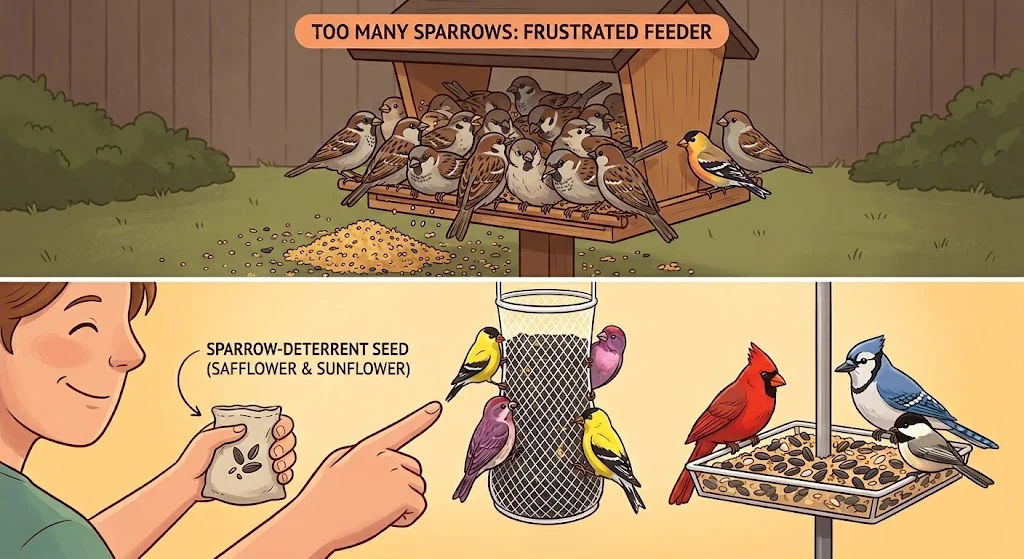
Figuring out how to attract birds but not sparrows gets complicated because the problem is usually House Sparrows, not every bird with “sparrow” in its name. When House Sparrows dominate a feeding station, I would work on two goals at the same time: make the main feeder less rewarding for them and give other species a food or feeder style that better matches how they feed. Changing everything at once makes it harder to tell which adjustment actually helped.
The fix is not necessarily to start from scratch. House Sparrows are social, adaptable feeder birds that readily use grains and seeds and can compete aggressively around food. Instead of trying to make the yard “sparrow-proof,” change the foods and access points that are helping them dominate, then watch whether other species gain more feeding opportunities.
The Critical Difference Between House and Native Sparrows
Before you start trying to keep house sparrows away, we need to make sure you are targeting the right bird. Not all sparrows are the problem. In fact, many of them are exactly the kind of birds you want in your yard, and they rarely cause trouble at a busy feeder.
The House Sparrow, Passer domesticus, is an Old World sparrow in the family Passeridae. It was introduced to North America in the nineteenth century and is now widespread around cities, suburbs, farms, and other places closely associated with people. Breeding males have a gray crown, chestnut on the sides of the head and neck, and a black throat or bib; females are much plainer brown. House Sparrows feed socially and can be aggressive around both feeders and nesting cavities.
Native sparrows such as White-throated, White-crowned, and Song Sparrows are different birds with different habits, and many feed on or near the ground. Some readily eat millet and sunflower around feeders. That creates an important tradeoff: removing a food that House Sparrows like can also reduce visits from native sparrows that use the same food. The goal here is to reduce House Sparrow dominance, not to eliminate every sparrow-shaped bird from the yard.
Start by Removing Millet From the Main Feeder
When someone described a feeder dominated by House Sparrows, one of the first things I would check was the seed mix. Cornell lists millet, corn, and sunflower among the foods House Sparrows readily eat, so a grain-heavy blend can support a large flock. The useful question is not whether a bag is cheap or premium, but how much of it is made up of foods the birds you want are actually using.
Field Note: A label such as “songbird blend” never told me enough by itself. When a customer said one species was emptying a feeder unusually fast, I wanted to see the ingredient list and what was accumulating on the ground. That usually gave us a better starting point than assuming the feeder hardware had suddenly become the problem.
House Sparrows readily eat white proso millet, and removing millet from an elevated feeder can reduce one food source that favors them. Do not expect that change to exclude them completely, though. House Sparrows also eat sunflower, corn, milo, and other feeder foods, and some native sparrows use millet too.
If House Sparrows are dominating an elevated feeder, removing white proso millet is a reasonable first experiment because it is one of the seeds they readily use. I would test that change for a while before rebuilding the whole station. If native ground-feeding sparrows also disappear, remember that the food change may be affecting them too rather than proving the deterrent is perfectly species-specific.
Here is what you should do instead of buying the mixed bag:
- Use black oil sunflower selectively: It attracts a broad range of seed-eating birds, but House Sparrows eat sunflower too. Use it because it fits many desirable feeder species, not because it excludes House Sparrows.
- Test safflower if your target birds use it: Cardinals and several other feeder birds eat safflower. House Sparrows may avoid it in some locations, but this is not reliable enough to treat as a guaranteed deterrent.
- Reduce broadcast feeding while troubleshooting: Ground-scattered grain is easy for House Sparrows to use. The tradeoff is that native ground-feeding sparrows may also lose access, so watch which species are affected.
Taking millet out of the main feeder may reduce House Sparrow traffic, but it does not force the flock to leave. If they continue using sunflower or other foods, the next step is to change feeder access and add more targeted feeding options rather than assuming one seed swap will solve the problem.

A premium safflower seed that attracts cardinals, chickadees, titmice, and grosbeaks while naturally deterring squirrels, grackles, and starlings. Its bitter taste keeps unwanted visitors away without any extra effort. Can be used alone or gradually mixed with other seed blends to transition your feeder to a more desirable bird-friendly environment.
Check on AmazonIf you click this link and buy, we earn a commission at no additional cost to you.
The Second Feeder Strategy for Variety
Changing every feeder and every food at the same time creates a troubleshooting problem because you no longer know which change altered the bird traffic. A second feeder is useful because it lets you target a different feeding niche while keeping the rest of the station familiar. That does not guarantee instant variety, but it gives finches, woodpeckers, and other birds another way to use the yard.
You can keep the current feeder in place while testing a simpler seed such as safflower if the birds you want are known to use it locally. For a deeper look at where safflower fits, I cover it in my guide on how to attract cardinals. Treat the change as a test rather than assuming House Sparrows will refuse the seed everywhere.
Then add a feeder aimed at a species group with different food preferences. A mesh sock or small-port feeder with nyjer is useful for finches, while a suet feeder can serve woodpeckers, nuthatches, chickadees, and other suet users. These feeders are not automatically House Sparrow-proof, but they can shift part of the station away from the large grain-feeding setup House Sparrows use so easily. You can read more about setting up for small finches in my guide on how to attract finches.
Splitting the station by food type gives different birds more ways to feed without depending on one crowded tray or hopper. Think of the second feeder as adding another feeding niche, not as exploiting a guaranteed physical weakness in House Sparrows.

Two 1-pound white mesh socks that attract finches fast, especially those that prefer socks over tube feeders. Strong stitching, durable fabric, easy to wash and refill with thistle. A portion of every purchase goes to bird habitat conservation.
Check on AmazonIf you click this link and buy, we earn a commission at no additional cost to you.
Feeder Design Tactics That Disadvantage Sparrows
Food choice is only half of the experiment. House Sparrows readily use platform, hopper, ground, and many tube feeders, so wide landing areas can support a lot of birds at once. Smaller access points and fewer broad perches may reduce how easily a flock crowds the feeder, but House Sparrows are adaptable and can learn to use many designs.
| Feeder Feature | Impact on House Sparrows | Impact on Songbirds |
|---|---|---|
| Large wooden hopper ledges | Highly attractive; allows flock feeding | Good, but invites competition |
| Shortened perches (under 1 inch) | May make access less comfortable, but does not reliably exclude them | Small clinging species may still use short perches, depending on feeder design |
| Mesh socks | Usually less attractive when paired with nyjer, but not completely inaccessible | Well suited to many finches and siskins when filled with nyjer |
| Halo wire / Monofilament | Community-reported deterrent; effectiveness varies | Must be installed carefully and monitored around all birds |
A tube feeder without a broad tray can reduce the amount of comfortable flock-feeding space compared with a large platform or hopper ledge. Some people also use shorter perches to make access less convenient for House Sparrows while retaining access for smaller clinging birds. I would treat perch modification as a feeder-specific experiment, not a universal one-inch rule, and avoid cutting or altering hardware in a way that creates sharp edges.
Pro Tips: Purpose-built halo or monofilament deterrents are reported by some House Sparrow managers to reduce access, but the response is not perfectly species-specific. Do not leave loose fishing line dangling where any bird can become entangled. If you try this approach, use an established design, keep the line taut, and watch how all feeder visitors respond.
If you’re dealing with a mix of larger pests right alongside the sparrows, you will find that understanding the broader picture of how to attract birds but not squirrels often involves these exact same principles of restricting flat landing zones.

Two-compartment iron suet feeder built for clinging birds like woodpeckers, nuthatches, chickadees, and titmice. Fill each side with different foods including suet cakes, nesting materials, or fruit. Rust-proof enclosure with protective roof keeps food fresh in any weather. Simple to open and refill.
Check on AmazonIf you click this link and buy, we earn a commission at no additional cost to you.
Protecting Your Nesting Boxes from Sparrow Takeovers
House Sparrow management becomes more serious when nest boxes are involved. Cornell NestWatch documents House Sparrows taking over cavities used by native birds and damaging eggs, nestlings, and sometimes adults. If you maintain nest boxes, feeder adjustments alone are not enough; the boxes need active monitoring throughout the nesting season.
House Sparrows are strongly associated with human structures, so NestWatch recommends placing nest boxes away from areas where they are prevalent when possible. That can reduce pressure, but no placement makes a bluebird or swallow box House Sparrow-proof. Follow species-specific nest-box placement guidance and monitor the box rather than assuming a move into open habitat automatically solves the problem.
Entrance size is not a reliable way to exclude House Sparrows from a box designed for bluebirds. NestWatch notes that House Sparrows can fit through openings as small as about 1.25 inches, so any entrance large enough for many native cavity nesters can remain vulnerable. Use the entrance dimensions recommended for the target native species rather than shrinking the hole as an improvised House Sparrow fix.
Key point: A sparrow spooker is one passive deterrent used by experienced bluebird monitors, but timing matters. Guidance from bluebird-monitoring resources recommends installing it only after the first native egg has been laid and removing it after fledging, because birds can react differently to a new object and House Sparrows can eventually habituate. It is a deterrent, not a guarantee, so the nest box still needs regular monitoring.

This reflective bird scare tape provides 262 feet of double-sided reflective ribbon for outdoor bird deterrence. The lightweight material flashes and moves in the breeze, making it suitable for creating reflective streamers around birdhouses or other areas where sparrows are unwanted. It can be cut to the required length for different installations and outdoor setups.
Check on AmazonIf you click this link and buy, we earn a commission at no additional cost to you.
When House Sparrows Still Visit
Even after you change seed and feeder access, some House Sparrows may continue to visit. They are highly adaptable and closely associated with people, so a perfectly House Sparrow-free feeding station is not a realistic promise in many neighborhoods. Measure success by whether one flock still monopolizes the food and whether the species you want have more opportunities to feed.
Removing millet or changing perch access may reduce House Sparrow pressure, but it does not force the remaining birds to behave differently. Keep watching the actual traffic. Also remember that native sparrows may use spilled millet and sunflower on the ground, so a strategy that reduces House Sparrows can change native sparrow activity at the same time.
The broader goal of learning how to attract birds is to provide useful food and habitat without letting one feeding setup favor a single species more than you want. Use food choice, feeder design, and cleanup as adjustable tools, then judge the result by what actually changes in your yard. There is no seed or feeder that automatically creates a balanced species mix.
Final Thoughts on Balancing Your Yard
If House Sparrows dominate your feeder, start with changes you can evaluate one at a time. Remove millet from the main elevated feeder, add a targeted feeder such as nyjer for finches or suet for appropriate species, and consider a feeder design with less broad landing space. If you also monitor nest boxes, follow nest-box-specific House Sparrow guidance rather than assuming feeder changes will protect an active nest.
Give each change enough time to see whether House Sparrow numbers, feeding duration, or crowding actually decrease. Some yards respond quickly and others do not because House Sparrows can use several common seeds and feeder styles. The practical win is not eliminating every House Sparrow; it is reducing monopolization while giving other birds more suitable ways to feed.

Weight-activated Seed Shield automatically closes feeding ports when squirrels climb on, while the Sure-Lock cap keeps the lid secure. Holds up to 4 lbs of seed with patented Flexports that are 4x more shake-resistant to reduce waste. Ladder-style perch pads welcome both small and large birds like cardinals and blue jays.
Check on AmazonIf you click this link and buy, we earn a commission at no additional cost to you.
FAQs
🐦 Do house sparrows attack other birds?
Yes. House Sparrows can compete aggressively around food and are well documented taking over nest cavities used by native species. Nest-box competition is more serious than ordinary feeder crowding, so active nest boxes should be monitored rather than treated as just another feeding issue.
🦅 Will a fake owl keep sparrows away?
A stationary fake owl is unlikely to provide dependable long-term control. Birds can habituate to deterrents that never change or pose a real threat. If you use any visual deterrent, judge it by continued results rather than assuming the first reaction will last.
🪶 Do house sparrows eat safflower seed?
Sometimes, but results vary. Safflower has a thick shell and House Sparrows may use it less readily in some yards, yet Cornell notes that species often described as avoiding safflower can develop a taste for it. Treat pure safflower as a trial, not a reliable exclusion method.
❄️ Should I stop feeding birds if sparrows take over?
You do not automatically need to stop feeding, but switching seed is not perfectly selective. House Sparrows also eat sunflower, and native sparrows may lose millet if you remove it. Start with targeted seed and feeder changes; if House Sparrow pressure remains severe, a temporary feeding pause is another non-harmful option.
🌳 Where do house sparrows sleep at night?
House Sparrows commonly roost and nest around buildings and can also use dense vegetation for cover. A hedge beside the feeder does not prove it is causing the flock, so I would not remove useful habitat solely for that reason. Focus first on the food and feeder access you can control directly.