The Truth About the “Missing” Females
Over the years, I heard plenty of people ask how to attract female Northern Cardinals because they regularly saw a bright red male but never noticed a mate. Seed and feeder placement were usually the first things they wanted to change. Often, the better first step was identification: a pale brown cardinal can disappear visually against branches and leaf litter in a way the male simply cannot.
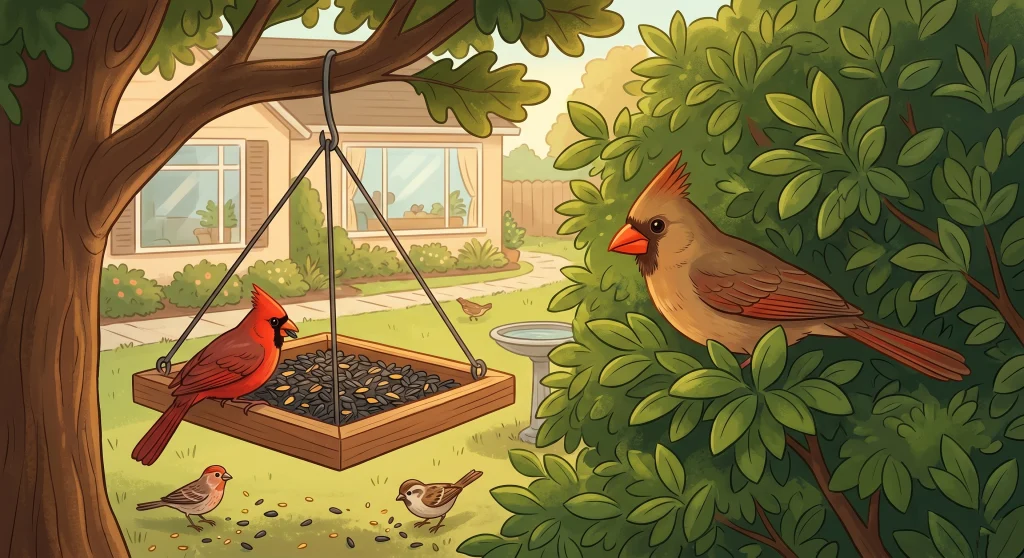
The most common beginner mistake is expecting the female to look like a faded red male. She is pale brown overall with warm reddish tinges in the wings, tail, and crest, plus a red-orange bill and dark face around the bill. Females use the same general foods and feeding areas as males, and breeding pairs commonly move around together. That makes identification much more useful than inventing a separate “female cardinal” feeding strategy.
Female Cardinal Identification Guide
Recognizing the female’s brown-and-red color pattern is the first step to noticing her around a feeder. She is much less visually conspicuous than a bright adult male, so shape and field marks matter more than looking for a flash of red. Focus on the heavy bill, prominent crest, long tail, dark face, and reddish accents. Once those features become familiar, a female cardinal is much harder to mistake for a generic brown bird.
The easiest way to identify a female Northern Cardinal is to combine shape with color rather than relying on one feature. Like the male, she is a fairly large, long-tailed songbird with a short, very thick bill and a prominent crest. Crest position changes with the bird’s posture and level of agitation, so I would not use crest height by itself to determine sex. The overall cardinal silhouette plus the bill and reddish accents is a much stronger combination.
- The bill: Look for a short, very thick red-orange bill. Juveniles are the important exception because their bills are gray to black.
- The body color: Adult females are pale brown overall rather than bright red.
- The red accents: Warm reddish tinges show in the wings, tail, and crest.
- The face: Females still show a dark face around the bill, although the contrast is usually less dramatic than on a bright red male.
Is That a Female or a Juvenile Male?
Young Northern Cardinals are the main identification curveball because juveniles resemble adult females much more than adult males. A juvenile can look brown overall with a crest and cardinal shape before adult plumage is fully apparent. That is why the bill is such a useful clue when you are looking at a brown cardinal late in the breeding season.
Look closely at the bill. Cornell describes juveniles as similar to females but with a gray to black bill, while an adult female has a red-orange bill. That lets you separate an adult female from a juvenile more reliably than trying to judge how much red is showing in the feathers. A brown cardinal with a dark bill is a youngster, although the juvenile may be either sex.
Field Note: A very familiar store conversation started with a blurry phone photo of a “weird brown finch” that looked too large and heavy-billed to be a finch. Pointing out the cardinal-shaped bill, crest, long tail, and reddish accents often solved the mystery immediately. That kind of identification check is more useful than assuming a missing female needs a different feeder.
Warning: A female House Finch is smaller, lacks the cardinal’s prominent crest, shows heavy brown streaking below, and has a much slimmer grayish bill. A female Northern Cardinal is larger, mostly unstreaked, crested, long-tailed, and has a thick red-orange bill.
Do Males and Females Feed at the Same Time?
Male and female cardinals can use the same feeder and may forage in the same area, especially because pairs commonly move around together during the breeding season. There is no reliable rule that says they must alternate feeder visits or avoid feeding at the same time. Cornell does note a social difference during foraging: females tend to give way to males. That can create spacing at a feeder without requiring a fixed male-first, female-second routine.
I have certainly watched pairs arrive in sequence, with one bird feeding while the other remained nearby, but I would not turn that observation into a rule. On another visit, both birds may forage close together or one may appear without the other. If a female hangs back while a male occupies the feeder, ordinary dominance can explain part of that pattern. There is no need to invent a coordinated predator-watch schedule to make sense of it.
One breeding-season behavior that really is distinctive is mate-feeding. Northern Cardinals use mate-feeding during courtship, and you may see a male pass food directly to a female. If you clearly watch an adult red male feed an adult brown cardinal with a red-orange bill, that is a strong female identification moment. It is a courtship behavior, though, not an exception to a supposed rule that the pair normally takes turns at the feeder.

Black oil sunflower seed with high oil content for energy and thin hulls that are easy for birds to crack. Attracts the widest variety of wild birds, especially smaller songbirds.
Check on AmazonIf you click this link and buy, we earn a commission at no additional cost to you.
No Special Female Cardinal Setup Is Needed
You do not need a separate menu or a feeder marketed specifically for female cardinals. Do female cardinals come to feeders? Yes. Males and females belong to the same species and use the same general foods and habitat. If your current feeder already serves cardinals comfortably, changing equipment solely because the bird is female makes no sense. The question is whether female cardinals are present locally and whether you are recognizing them when they visit.
Black oil sunflower is the most dependable feeder food I would start with for Northern Cardinals, and safflower is another food they readily use. Tray and hopper feeders provide comfortable landing space, but Cornell notes that nearly any feeder can attract cardinals when the birds can use it and suitable food is available. A cramped tube with very short perches may be less convenient, but it is not a sex-specific limitation and it does not mean cardinals are physically unable to use tube feeders.
The broader principles of backyard feeding apply here regardless of sex. If you want to understand how to attract birds consistently, reliable food, clean water, useful vegetation, and a safe feeding location matter far more than a male-versus-female trick. Northern Cardinals naturally use shrubby edges, dense tangles, and low vegetation, so keeping that habitat in or around the yard can make the property more useful to them.
If neither male nor female cardinals are visiting, check whether Northern Cardinals are present in your area, whether the food is fresh, whether the feeder is comfortable to use, and whether the yard offers the shrubby habitat they favor. An exposed feeder is not automatically unusable, but a yard with no nearby cover offers less of the habitat cardinals normally occupy. My main guide on how to attract cardinals covers those broader setup choices.

Spinning top sends squirrels flying off while birds feed in peace. Adjustable height controls which size birds can visit. Rust-proof metal base stays stable in windy weather. Multiple compartments with drainage holes keep different seed types fresh. A great backyard gift!
Check on AmazonIf you click this link and buy, we earn a commission at no additional cost to you.
Why Female Cardinals Are Easy to Overlook
The female’s pale brown plumage makes her far less conspicuous to a casual observer than the brilliant red male. She also performs the incubation, and cardinal nests are usually hidden in dense foliage, but I would not turn that into a simple claim that female coloration exists solely to hide the nest from predators. For feeder watching, the practical point is visual: brown plumage can disappear against branches, leaves, and shadow while the red male catches your eye immediately.
There is no good reason to assume the female follows a uniquely secretive route to the feeder while the male flies boldly across open space. Both sexes are Northern Cardinals, and Cornell describes the species as tending to sit low in shrubs and trees and forage on or near the ground. What changes your perception is the plumage: a brown bird moving through low cover is simply easier to miss. Watch the same shrubs and ground beneath the feeder instead of assigning a different approach strategy to the female.
| Behavior | Male Cardinal | Female Cardinal |
|---|---|---|
| Appearance | Brilliant red overall with a black face around the bill. | Pale brown overall with warm reddish tinges in the wings, tail, and crest. |
| Foraging | Uses feeders and forages on or near the ground. | Uses the same general feeding areas; during foraging, females may give way to males. |
| Song | Sings the familiar clear cardinal whistles. | Also sings, both alone and in duet with the male, and may sing while sitting on the nest. |
Confirming Her Presence by Sound
Female Northern Cardinals really do sing, which makes the species unusual among familiar North American backyard birds. Both sexes produce the clear whistled cardinal song, and females can sing alone or in duet with males. That is useful knowledge because hearing a cardinal from dense cover does not mean the singer must be male. Sound can confirm a cardinal is nearby, but without seeing the bird you usually cannot use the song alone to prove the singer is female.
Cornell notes that a female may sing while sitting on the nest, and that the song may give the male information about when to bring food. Mated pairs also share song phrases, and the female’s song may be longer and slightly more complex. That is enough explanation without assigning every nest song a specific message about hunger or predators. The familiar whistles can sound like “cheer, cheer, cheer” or “birdie, birdie, birdie” from either sex.
If you hear a cardinal singing from deep cover, use the sound to locate the bird rather than assuming the hidden singer is female. Watch for movement, then confirm sex visually from plumage and bill color if the bird appears. The strongest lesson here is simply that female cardinals have a voice of their own, so a singing cardinal is not automatically a male.

Wagner's Four Season Sunflower Seed is 100% black oil sunflower seed. Sunflower seed is the favorite seed of most wild birds. It is high in energy and has a thin shell making it easy for all birds to consume. Use tray feeders or hopper feeders to attract sunflower loving songbirds. Cardinals, Chickadees, Finches, Nuthatches, Woodpeckers and much more. Trust your backyard birds to the experts at Wagner’s.
Check on AmazonIf you click this link and buy, we earn a commission at no additional cost to you.
Final Thoughts: Stop Looking for Red
You do not need a special trick, secret seed recipe, or female-only feeder. If Northern Cardinals are already using your yard, the female has the same basic food and habitat requirements as the male. During the breeding season a female may be nearby when you see a male, but do not assume she must already be eating at the feeder. Start by changing what you look for, not by rebuilding a setup that is already attracting cardinals.
The next time a male appears, scan the surrounding shrubs, low branches, and ground for another cardinal-shaped bird instead of looking only for red. Look for the thick red-orange bill, prominent crest, long tail, dark face, and warm reddish accents on a pale brown body. You may discover that a female has been easy to overlook. If she is not there, the solution is still the same one you would use for any cardinal: suitable food, usable feeder access, and good habitat.
FAQs
🪶 Do female cardinals ever turn red?
Adult female Northern Cardinals remain pale brown overall with warm reddish tinges in the wings, tail, and crest rather than developing the brilliant red plumage of an adult male. Normal molt replaces feathers, but it does not turn an adult female into the male color pattern.
🐦 Will a female cardinal come to a feeder alone?
Yes. A female can use a feeder by herself, and there is no rule requiring the male to be beside her. Cardinals commonly move around in pairs during the breeding season, but individual feeder visits can still occur separately.
🌻 What is the best bird seed for a female cardinal?
Female cardinals eat the same general foods as males. Black oil sunflower is the most dependable feeder seed to start with, and safflower is another option cardinals use. Tray and hopper feeders are comfortable choices, but a female does not need a sex-specific feeder.
🏡 Where do female cardinals build their nests?
Northern Cardinals usually place nests in dense foliage in saplings, shrubs, or vine tangles. Cornell reports nest heights from about 1 to 15 feet, so there is no useful three-to-ten-foot rule. Dense vegetation matters more than targeting one exact height.