
The Reality of the Smart Feeder Choice
If you are looking at upgrading your backyard setup, you have likely narrowed your choices down to two main brands. Bird Buddy and Birdfy are both excellent devices, but they are excellent at completely different things. Unfortunately, most people buy the wrong one for their specific priorities.
I watched this pattern play out constantly at the store. A customer would come in frustrated because they bought a premium camera feeder, only to realize the battery died too quickly in their cold climate. Or they would buy a rugged model, but feel disappointed that the app interface did not feel as fun and interactive as the one their friend had. The hardware is only half the equation.
If you are doing a deep bird feeder camera comparison, you need to look past the promotional highlight reels. You have to understand how these devices actually operate day-to-day, how often you will need to charge them, and what happens when the seasons change.
Quick Specs: How They Stack Up
Before diving into the user experience, it helps to look at the baseline hardware. While both companies frequently release minor updates, the core functional differences between their standard models remain very consistent over time.
| Feature | Bird Buddy (Standard) | Birdfy (Standard) |
|---|---|---|
| Camera Resolution | 5 Megapixels (Stunning clarity) | 1080p (Good security-style clarity) |
| Field of View | 120 degrees | 135 degrees |
| Battery Capacity | 4000 mAh | 5200 mAh (Noticeably longer life) |
| App Experience | Gamified, community-focused | Utilitarian, folder-based |
| Modularity | Basic add-ons available | Highly modular (suet, nectar extensions) |
Specs only tell you what the machine is capable of on a test bench. To decide whether it is Bird Buddy or Birdfy that belongs in your yard, we need to look at how you actually plan to use it.
When Bird Buddy Wins: The App and Photography Experience
If your absolute top priority is getting the clearest, most shareable photos of visiting birds, Bird Buddy is the clear winner. The camera quality is exceptional, capturing fine feather details that other models simply miss. It is essentially an automated wildlife photography studio.
The other major advantage of Bird Buddy is the software experience. The app is designed to feel almost like a game, powered by a massive species identification database. When a bird arrives, you get a notification that feels like opening a digital postcard. The UI encourages you to collect different bird species, build out your digital profile, and share footage with a highly active social community. It is incredibly engaging, especially if you have kids or grandkids who want to learn about the birds in your neighborhood.
Note: The trade-off for this high-resolution camera and active processing is battery life. The 4000 mAh battery drains relatively fast, especially if your feeder sees heavy traffic. You will likely find yourself bringing it inside to charge more often than you would expect.

This solar-powered feeder includes both a food and water bowl, with a 2K camera that sends automatic alerts whenever a bird or unwanted animal approaches. Two-way audio lets you listen to birdsong and speak through the feeder to shoo away squirrels or raccoons. Live footage streams wirelessly to your phone and can be shared with over 10 accounts, making every backyard visit a connected experience.
Check on AmazonIf you click this link and buy, we earn a commission at no additional cost to you.
When Birdfy Wins: Battery Life and Cold Weather
On the other hand, practical, hands-on birders usually lean toward Birdfy. Anyone trying to decide which of these two is actually better for their situation will notice that Birdfy is built more like a rugged security camera wrapped in a bird feeder.
The photo quality is a slight step down from Bird Buddy. It is still very good 1080p high definition, but it lacks the polished, artistic flair of its rival. However, what it lacks in photography tools, it makes up for in pure endurance. The larger battery capacity means it stays outside working for much longer stretches between charges.
This becomes critical in the winter. When temperatures drop below freezing, lithium-ion batteries naturally lose 20% to 30% of their efficiency. In those sub-zero weeks, Birdfy’s 5200 mAh battery provides a crucial multi-day buffer that smaller units lack.
Field Note: From what I have seen, the frustration with smart feeders always comes back to maintenance. Customers would frequently tell me they loved their premium camera feeders but hated trudging out in the snow every five days to charge them. The people who bought Birdfy generally had fewer complaints about battery anxiety, even in the middle of January.

Powered by a 5,200mAh battery and solar panel delivering 3 to 6 months per charge, this weather-resistant feeder captures full-color day and night footage with automatic phone alerts. Proprietary AI identifies over 99 percent of the world's 11,000 known bird species in real time. The Birdfy app connects you to 650,000 bird lovers across 174 countries, with a built-in bird expert available around the clock.
Check on AmazonIf you click this link and buy, we earn a commission at no additional cost to you.
The Solar Panel Reality Check
Both brands offer solar panel add-ons, and they are usually worth the extra cost, but only if you understand your regional weather. If you live in the sunny Southwest, a solar roof on either feeder will practically eliminate the need to charge them manually.
However, if you live in the Pacific Northwest or areas with long stretches of overcast winter days, solar panels struggle to keep up. This is where Birdfy pulls ahead again. Its larger internal battery can coast through a week of cloudy weather, whereas the Bird Buddy often requires you to bring it inside for a wall charge until the sun comes back out.
The All-In-One Setup: Birdfy’s Modular Accessories
One of the biggest limitations of standard camera feeders is that they usually only dispense mixed seed or sunflower seeds. This restricts the types of birds you will catch on camera. Birdfy solved this brilliantly with a highly modular design.
You can purchase add-ons like the Pro Perch, which holds a suet block to bring in woodpeckers, or the Hummee extension, which converts the station to dispense nectar for hummingbirds. If you want a single camera system that can adapt to different seasons and diets, Birdfy is currently the only option that does this well natively.
Understanding how different foods require different presentations is key to a lively yard. You can explore how standard setups differ from camera setups in my broader guide on the different bird feeder types.
The Birdfy Duo Caveat
Any modern smart bird feeder comparison has to mention a relatively new variable: the Birdfy Duo. Standard models from both brands use a single fixed lens. You see the bird right in front of the camera, but you miss everything happening on the sides or on the ground below.
The Birdfy Duo features an advanced 3-camera setup. It includes a rotating main 2K camera, a wide-angle 1080p lens, and a side-facing high-definition lens. This changes the math entirely if you have the budget for it. It allows you to monitor an entire feeding station environment rather than just a single perch.
If you have a busy yard with multiple species flocking at once, the Duo captures dynamics that standard models miss. It comes with a premium price tag, but if you are setting up a multi-feeder yard and want full coverage without blind spots, the Duo is absolutely worth the investment.
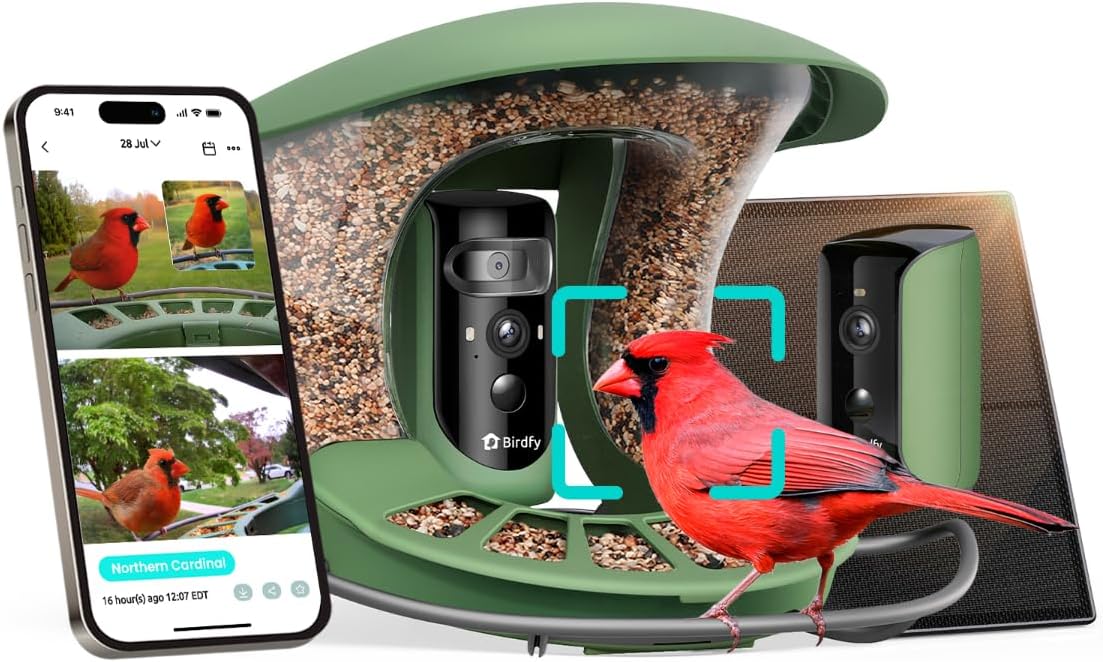
This dual-camera, triple-lens feeder delivers wide-angle flock shots, 2K close-ups, and side-angle footage simultaneously, with a portrait lens that auto-tracks birds and captures slow-motion playback. AI instantly identifies over 6,000 species with real-time alerts, while wire-free installation works anywhere on 2.4GHz WiFi. Share the live feed with over 20 guests and join a community of 400,000 bird lovers worldwide.
Check on AmazonIf you click this link and buy, we earn a commission at no additional cost to you.
The Subscription Reality Check
There is one final factor you must consider before buying either brand. Running artificial intelligence to identify a House Finch from a Purple Finch requires server power, and neither company gives that away for free long-term.
- Basic Use: Both feeders will send you motion alerts and let you view the live feed without a monthly fee.
- Premium AI: If you want the app to automatically identify the bird species, organize your collection, and provide advanced video storage, expect to pay for a premium subscription tier. These typically run between $30 and $60 annually, depending on the plan you choose.
The AI on both platforms is impressive but not flawless. Both will occasionally misidentify a bird, but both apps allow you to correct the identification to help the system learn. To avoid any surprises, always calculate your total two-year cost (hardware plus subscription) before you head to checkout.
Making Your Choice: The Quick Decision
You do not need to overthink this. Ask yourself what you want out of the experience.
If you want a highly social, gamified app experience to share with your family and friends, get the Bird Buddy. If you live in a climate with harsh winters, or if you want to experiment with feeding suet and nectar from the same station, the Birdfy is the smarter purchase.

19 inch diameter design makes this squirrel stopper more effective than other sizes. Larger sizes have greater jitter, no matter if rodents fly up or climb up, they will not be able to stand stably on the baffle. Anything smaller than 19 inches cannot step over this baffle easily, which means that the foods in your bird feeder can be specially provided to feathery friends instead of greedy squirrels or raccoons.
Check on AmazonIf you click this link and buy, we earn a commission at no additional cost to you.
FAQs
📶 Do Bird Buddy and Birdfy require Wi-Fi?
Yes. Both cameras require a stable 2.4GHz Wi-Fi connection at the location where the feeder hangs to send notifications and save video clips.
🔋 Can I add a solar panel to these feeders?
Yes. Both Bird Buddy and Birdfy offer optional solar panel attachments. In areas with decent sun exposure, a solar panel can drastically reduce or eliminate the need for manual charging.
🦅 Which camera is better for taking pictures?
Bird Buddy has a superior 5-megapixel camera that takes clearer, more vibrant close-up photos compared to the standard 1080p resolution on the base Birdfy model.
🐿️ Are these smart feeders squirrel-proof?
Neither the base Bird Buddy nor the base Birdfy are mechanically squirrel-proof. You will still need to use proper pole placement and a pole baffle to keep squirrels from draining the seed.
🥶 How do they perform in the winter?
Both have weather-resistant housings that protect them from snow and rain. However, freezing temperatures will cause the lithium-ion batteries in both models to drain faster than they do in the summer, typically losing 20% to 30% of their rated capacity in sub-zero conditions.