
What Actually Changes in Winter Bird Feeder Care
A feeder that works well in summer may need adjustments once snow, ice, and repeated freeze-thaw cycles arrive. The useful changes are practical ones: keeping seed dry, making sure ports stay open, checking that snow is not overloading a cover or hanger, and choosing a location you can still reach safely after a storm.
What does not change is the basic safety framework. Window collisions, cats, disease, squirrels, and spoiled food do not disappear in January. Winter weather adds new constraints, but it does not erase the old ones.
I also would not frame a backyard feeder as the only thing standing between local birds and starvation. Cornell’s Project FeederWatch describes feeders as supplemental food sources in normal conditions. During a severe snow event or unusually hard cold snap, however, reliable feeder food can make a more meaningful difference because natural food may be harder to reach and birds are spending more energy staying warm.
That distinction matters for maintenance. You want the station to be dependable during difficult weather without turning every empty feeder into an emergency. Keep food accessible, watch conditions, and fix real winter problems as they appear instead of following a rigid seasonal script.
Use Shelter Without Creating a New Safety Problem
Winter shelter can make a feeding station easier for birds to use. Trees, shrubs, evergreens, a fence, or part of the house can reduce direct exposure to wind and give small birds a nearby place to perch or retreat between feeding visits.
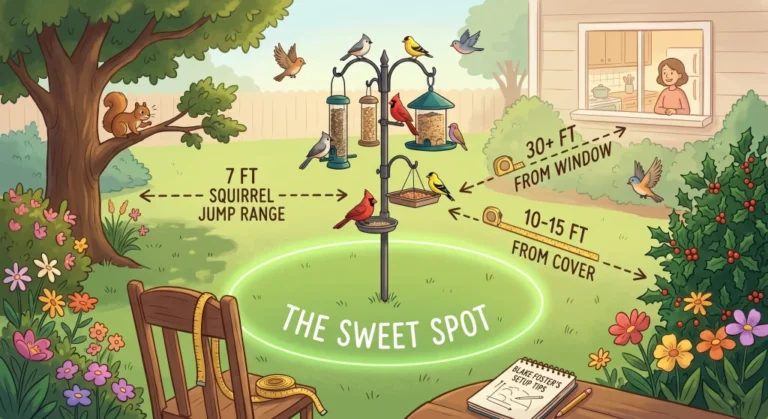
That does not mean the feeder should automatically move into dense cover. Thick vegetation immediately beside a feeder can conceal a cat, and moving a station closer to the house can create a window-collision problem if the glass is not addressed. Penn State’s winter-feeding guidance recommends protective cover nearby while still accounting for predators.
Instead of assuming the south or east side of every house is the correct winter location, watch how wind actually moves through your property. Buildings, slopes, trees, fences, and neighboring structures can change the local pattern. A useful winter spot is one that is noticeably calmer during your common storms, remains safe around windows and cats, and is still practical for you to reach.
Field Note: One pattern I saw in store troubleshooting was an exposed feeder becoming difficult to use after wind-driven snow repeatedly packed around the ports. Moving the station to a more sheltered part of the same yard sometimes solved the weather problem without changing the food at all. I treated that as a placement test, not a promise that one particular side of the house would work everywhere.
Check the Feeder for Snow, Ice, and Cold-Weather Wear
Cold weather can expose weak points in a feeder, but material labels alone do not tell you exactly how a product will behave below freezing. Plastic formulation, thickness, age, UV exposure, fasteners, joints, and previous damage all matter. I would not assume that every acrylic feeder becomes brittle or that every polycarbonate or metal feeder is automatically winter-proof.
The more useful inspection is physical. Before the hardest weather arrives, check for hairline cracks, loose hanging hardware, lids that no longer seat correctly, drainage holes blocked by debris, and lightweight covers that could collect wet snow. After a storm, remove heavy accumulation before it distorts a roof, dome, hanger, or pole.
Simple feeders often have an advantage because there are fewer moving parts to freeze or jam. Wire suet cages, sturdy hopper feeders, and tube feeders with good drainage can all work in winter when they are in sound condition and appropriate for the food being offered. The important feature is not a particular material. It is whether the feeder keeps food reasonably dry, remains stable under weather load, and can still be opened and cleaned.
Gloves matter too. A tiny latch that is easy to operate in July can become frustrating when it is iced over and you are wearing insulated gloves. If a feeder repeatedly requires force to open in winter, bring it into a sheltered area to thaw rather than twisting cold plastic or hardware until something breaks.

Taller grid design gives woodpeckers and small birds plenty of room to grip and perch comfortably. Bottom board with drainage hole catches falling crumbs to keep your garden clean and reduce waste. Flip-top lid refills in seconds with one hand, no need to take the feeder down. Available in copper, black, brown, and green.
Check on AmazonIf you click this link and buy, we earn a commission at no additional cost to you.
When Seed Clumps or Freezes, Moisture Is the First Thing to Check
Dry seed does not normally turn into a solid block simply because the night is cold. The trouble starts when moisture reaches the food. Blowing snow, rain, melting frost, thawing ice, poor drainage, or damp seed added during a refill can create clumps that later freeze together or begin to spoil.
That is why a feeder can look full while birds cannot actually reach usable food. Check the ports and the bottom of the feeder, not just the seed level visible through the tube. If seed is stuck together, wet, musty, or moldy, discard it rather than waiting for birds to work through the problem.
A weather guard can reduce direct precipitation, but it cannot solve every moisture issue. Wind can drive snow sideways, and ambient humidity or repeated thawing can still leave food damp. Good drainage and smaller fills are often more useful than simply putting a larger roof over a feeder.
During periods of wet snow or repeated freeze-thaw weather, put out an amount the birds are likely to use while it is still dry and check the feeder more often. Penn State specifically recommends only a day’s worth of food at a time for exposed tray and platform feeders. For protected tube or hopper feeders, you can adjust the amount according to actual use and how well the design keeps seed dry.
If a block has frozen inside a feeder, bring the feeder somewhere protected and let the ice release without forcing the cold parts. Then empty the wet seed, clean and dry the feeder as needed, and refill with dry food. Thawing the same soaked seed and putting it back outside only resets the moisture problem.

This squirrel-resistant hanging bird feeder holds up to 2.4 pounds of seed and provides four feeding ports for backyard birds. Its weight-activated shroud closes access to the seed ports when a squirrel climbs onto the feeder, while the wire exterior gives clinging birds additional feeding access. Chew-resistant materials, seed ventilation, and tool-free component removal help make routine filling and cleaning more manageable.
Check on AmazonIf you click this link and buy, we earn a commission at no additional cost to you.
Providing Liquid Water in Freezing Weather
Fresh water can attract birds in winter because many natural sources are frozen or temporarily inaccessible. Birds use water for both drinking and bathing, and healthy birds can bathe safely in cold weather. What I would not say is that every bird must have a heated backyard bath to survive. Cornell notes that keeping a birdbath ice-free is useful but not critical because birds can also obtain water from snow, dripping ice, and other natural sources.
If you want to keep water available, a thermostatically controlled heated bath or an immersion heater designed for birdbaths is a practical option. The goal is to keep some water liquid, not to make it warm. Cornell recommends plugging a heater into a ground-fault-interrupted circuit to reduce electric-shock risk and following the heater manufacturer’s instructions for the basin material and water level.
Adding antifreeze, glycerin, salt, or another chemical to stop the bath from freezing. Antifreeze is poisonous, and Cornell specifically warns that glycerin can saturate and mat feathers, increasing the risk of hypothermia.
Using plain fresh water and, if you choose to heat it, an outdoor birdbath heater or heated bath installed according to its instructions on a GFCI-protected circuit.
Do not assume every basin can take freeze-thaw stress or every heater is approved for every material. Cornell notes that concrete can crack below freezing, while heater manufacturers vary in what they allow for plastic, metal, stone, glass, or other basins. Match the heater to the bath rather than applying one blanket material rule.
Keep the bath shallow, clean it regularly, and change the water frequently. If you do not want to run a heater, Cornell also suggests a simple alternative: put out a sturdy plastic bowl of fresh water at a consistent time and bring it in when it freezes.

This thermostatically controlled 50W heater keeps birdbaths ice-free in winter without warming the water, running only when needed to save electricity. Built from heavy-duty cast aluminum, it resists rust, calcification, and staining while protecting birds from direct contact with the heating element. Compatible with metal, plastic, stone, and glass birdbaths, it comes with a 25-inch PVC cord and stays weighted in place without drifting.
Check on AmazonIf you click this link and buy, we earn a commission at no additional cost to you.
Managing Ground-Level Food After Snow
Just as with general bird feeder tips, winter maintenance includes what is happening below the hanging feeders. Juncos, doves, and several sparrow species commonly feed on or near the ground, and snow can cover seed they would otherwise find there.
You do not need to excavate a large circle down to bare soil after every storm. A cleaner option is to clear a manageable patch, use a low tray or platform where appropriate, or put out a modest amount of fresh seed where ground-feeding birds can reach it. A raised screen-bottom tray can help keep food above wet ground and improve drainage.
Avoid turning the cleared area into a permanent pile of old seed and droppings. Rotate or clean ground-feeding spots, remove wet or spoiled food, and rake up accumulated hulls and waste. Penn State specifically recommends rotating ground-feeding areas and removing debris to reduce disease risk.
Snow cover changes where birds can forage, but it does not mean every natural food source has disappeared. Treat ground feeding as another supplemental option and keep the amount small enough that it stays fresh.
Final Thoughts: Make the Feeder Reliable, Not Indispensable
The most useful winter routine is consistent maintenance rather than constant refilling at all costs. During severe cold or heavy snow, feeder food can be especially valuable because natural food is harder to reach and birds have higher energy demands. Outside those extremes, birds still use multiple food sources and are generally not dependent on one backyard station.
That means you can focus on making your feeder work well when it is available: keep seed dry, clear blocked ports, remove spoiled food, inspect snow and ice loads, and place the station near useful shelter without ignoring windows or predators.
If you know a major storm is coming, checking and refilling beforehand is sensible. If you need to stop feeding or leave town, you do not need to assume the local flock will automatically die because one feeder went empty. Cornell’s Project FeederWatch specifically notes that feeder birds normally use multiple food sources, with severe snow and cold snaps being the situations where supplemental food can matter most.
A winter-ready station is therefore a reliable supplement, not a survival contract. Keep it clean, accessible, and weather-resistant, and let the actual conditions in your yard determine how much extra maintenance it needs.

Each 10.5-ounce cake measures roughly 5 by 5 by 1 inch and features a melt-resistant formula made from rendered beef suet, cracked corn, black oil sunflower, and processed grain. The blend attracts a wide variety of birds including woodpeckers, cardinals, chickadees, nuthatches, and blue jays. Packaged in easy-open, fully recyclable wrapping and made in the USA.
Check on AmazonIf you click this link and buy, we earn a commission at no additional cost to you.
Specific Winter Feeder Adjustments
Different winter problems need different fixes. Frozen nectar, heavy snow load, and wet or inaccessible seed are separate maintenance issues, so use the page that matches what is actually failing in your setup.
| Winter Setup Guide | What It Covers |
|---|---|
| How to Keep Nectar from Freezing | Ways to keep standard hummingbird nectar available during freezing weather without improvising unsafe additives or unsupported formula changes. |
| Heavy Snow Protection | How to reduce snow accumulation, inspect structural load, and keep feeder access open during and after storms. |
| The Winter Feeding Schedule | How to adjust refill amounts and timing around bird activity, wet weather, and seed that is clumping or freezing. |
Use these as troubleshooting paths rather than rigid seasonal rules. A protected hopper in dry cold may need very little adjustment, while an exposed tray during wet snow may need attention several times in the same day.
FAQs
❄️ Will birds freeze to death if I stop feeding them in winter?
Usually not. Cornell’s Project FeederWatch says feeder birds normally use multiple food sources rather than depending on one feeder. Supplemental food can matter more during a severe snowstorm or exceptional cold snap, so keeping a feeder available during those periods can be especially helpful if you are able to do so.
🧊 How do I unfreeze a block of seed in my tube feeder?
Bring the feeder into a protected place and let the ice release without forcing cold plastic or hardware. Discard wet or spoiled seed, clean and dry the feeder if needed, then refill with dry food. Also check where the moisture entered so the same problem does not repeat the next night.
🦅 Do I need to worry about hawks more in the winter?
Raptors can hunt around feeders in any season, and leafless vegetation may change visibility in winter. Keep useful escape cover nearby, but do not push a feeder so deep into dense vegetation that cats gain an ambush point. If a hawk repeatedly hunts the station, temporarily taking feeders down can disperse the concentration of prey.
💧 Is it safe for birds to bathe in freezing temperatures?
Healthy birds can bathe in cold weather, and open water is useful for both drinking and bathing. Keep the water shallow and clean, never add antifreeze or glycerin, and use a heater only as directed. A heated bath is helpful, but Cornell notes that keeping water ice-free is not essential because birds can also obtain water from natural winter sources.