Why Sugar Concentration Is Not Your Main Freeze-Control Tool
When the first hard freeze arrives, it is tempting to keep adding sugar until the feeder stays liquid. That is the wrong way to think about winter nectar. Sugar does lower the freezing point of water, but a hummingbird feeder is still a food source, not a container of antifreeze.
The standard recipe used by Audubon, Oregon State University Extension, Bird Alliance of Oregon, and many other bird organizations is one part refined white sugar to four parts water. Cornell Lab takes a somewhat broader position and says that during cold, rainy conditions, a mixture as strong as about one-third cup sugar per cup of water can be acceptable. The International Hummingbird Society likewise allows three parts water to one part sugar in winter.
That means I would not repeat the claim that a 1:3 mix is lethal, destroys hummingbird kidneys, or causes birds to dehydrate to death. I could not support those statements with the bird-health sources I checked. The practical takeaway is simpler: use 1:4 as the dependable default, and do not keep concentrating the solution beyond established recommendations just to chase a lower freezing point.
Warning: Use plain refined white sugar and water only. Do not use honey, brown sugar, molasses, artificial sweetener, or red dye. If freezing is the problem, solve most of that problem with feeder management rather than continually increasing the sugar concentration.
If you prefer one rule you never have to reconsider, staying with 1:4 all winter is a sound choice and matches current Oregon State and Bird Alliance of Oregon recommendations.
Freezing Temperature, Wind, and Feeder Placement
Hummingbird sugar water freezes at a lower temperature than plain water, but I would not promise one exact number such as 27 degrees Fahrenheit for every feeder. The freezing behavior changes with sugar concentration, and the feeder itself is affected by sun, shelter, reservoir size, and how quickly the surrounding air removes heat.
Wind matters because it can make an exposed feeder lose stored heat faster. It does not magically cool the nectar below the actual air temperature. If the air is below the solution’s freezing point, though, a windy exposed feeder can reach that cold condition faster than a feeder tucked into a sheltered spot.
That makes placement useful even though it cannot defeat a deep freeze. Hang the feeder where it is protected from prevailing wind and severe exposure while still remaining visible and accessible to the birds. A porch, eave, or sheltered side of the house can slow heat loss and make rotation or heating easier to manage.
Audubon’s current hummingbird feeding information also notes that cold nectar itself does not appear to cold-stun hummingbirds. The problem you need to solve is loss of access when the nectar freezes or the feeding ports ice over.
The Two-Feeder Rotation Method
If temperatures are cold enough to freeze the feeder during the day, rotating two feeders is one of the simplest solutions. Bird Alliance of Oregon and Oregon State Extension both recommend bringing feeders inside to thaw or swapping feeders when freezing becomes a problem.
Fill both with fresh nectar made to the recipe you have chosen. Keep one indoors and hang the other outside. When ice starts forming or the ports begin to freeze, replace the outdoor feeder with the thawed one and bring the cold feeder inside. Let it thaw at room temperature rather than shocking a cold glass reservoir with very hot water.
Field Note: When someone wanted a winter setup without cords or a heater, the two-feeder rotation was the practical option I pointed them toward. It does require attention, but it separates the food problem from the weather problem: the nectar recipe stays normal while the house does the thawing.
The most important timing is early morning. Hummingbirds coming out of nighttime torpor need access to energy, so if you bring a feeder indoors overnight, put a liquid feeder back outside around first light. During a prolonged daytime freeze, check it often enough that the feeding ports do not stay iced shut for hours.
Two identical feeders make the routine easier because the birds see the same port layout each time and both units clean the same way. Saucer-style feeders are also easy to open, inspect, and wash during repeated winter swaps.

Dish-style feeder with 5 feeding ports and 360-degree perch lets multiple hummingbirds feed at once. Built-in ant moat and 2mm bee-proof ports keep nectar clean. Clear reservoir with measurement markings for easy monitoring and one-step refill. Fully disassembles for quick cleaning, dishwasher safe up to 176F.
Check on AmazonIf you click this link and buy, we earn a commission at no additional cost to you.
Using Supplemental Heat Carefully
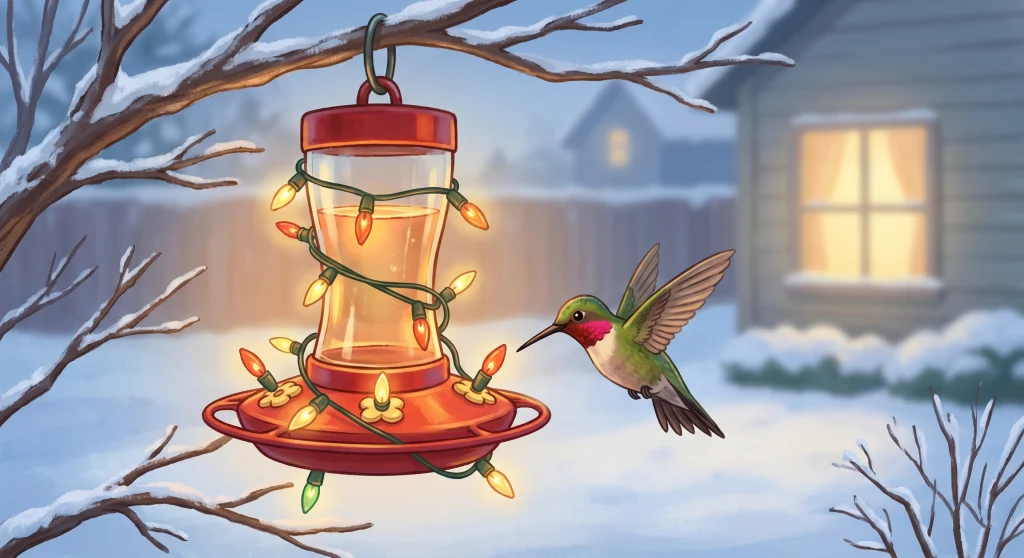
Audubon and Bird Alliance of Oregon both mention incandescent lights as one possible way to add warmth near a hummingbird feeder. The important word is incandescent. Traditional incandescent bulbs release much more of their electrical energy as heat than modern LEDs.
I would not assume that any string of decorative lights will keep a feeder thawed. LED strings are designed to run relatively cool and should not be purchased as a feeder-heating solution. Even with incandescent lights, the amount of heat reaching the nectar depends on bulb output, spacing, wind, air temperature, and feeder design.
Do not wrap a hot bulb tightly against plastic or improvised insulation where heat can become trapped. Bird Alliance of Oregon specifically cautions against placing holiday lights so close that they may damage the feeder. If electricity is used outdoors, every component should be rated for outdoor use and connected through appropriate ground-fault protection.
For that reason, I see holiday lights as a monitored DIY option for modest cold, not the first choice for an unattended deep-freeze setup. A purpose-built feeder warmer is easier to evaluate because it comes with compatibility and operating instructions.

Each 33-foot strand features 150 red mini bulbs spaced 2.5 inches apart, with a built-in 3A fuse and UL certification for safe indoor and outdoor use. Bulbs are molded directly into their sockets for a secure, long-lasting fit, and end-to-end connectable plugs let you chain up to 4 sets for a total of 600 lights across 132 feet. Includes a spare fuse and 4 replacement bulbs.
Check on AmazonIf you click this link and buy, we earn a commission at no additional cost to you.
Choosing a Hummingbird Feeder Heater
A commercial feeder heater can make winter maintenance easier when manual rotation is not practical, but it is not truly a set-it-and-forget-it device. You still need to confirm that the nectar remains liquid, that the heater is attached correctly, and that warming the feeder is not allowing old nectar to sit too long.
I would not choose a heater by an unsupported rule such as seven watts for one temperature range and fifteen watts for another. Instead, check the manufacturer’s stated feeder compatibility, outdoor rating, installation method, and claimed operating temperature range. A heater that fits poorly may transfer heat inefficiently or interfere with the feeder.
Electrical safety matters too. Use only equipment intended for outdoor conditions, protect connections from water and snow, and follow the heater and extension-cord instructions. If the manufacturer requires a GFCI-protected outlet, treat that as part of the installation rather than an optional extra.
One maintenance detail is easy to miss: warming nectar removes some of the preservative effect of cold winter air. Bird Alliance of Oregon specifically notes that a heated feeder may need more frequent cleaning than an unheated feeder in the same weather.
| Heating Solution | Cost | Best Use Case |
|---|---|---|
| Two-feeder rotation | Low | Someone who can check and swap feeders during freezing periods. |
| Incandescent light used with care | Low | A monitored, sheltered setup where a small amount of supplemental warmth is enough. |
| Purpose-built feeder heater | Medium | Repeated freezing conditions when frequent manual rotation is impractical. |
Whichever method you choose, check the actual feeder rather than trusting the method in theory. A heater or light that worked at one temperature may not keep up during a colder, windier event.

Made in the USA, this outdoor-rated heater attaches to most flat-bottom hummingbird feeders with a ring-style perch, keeping nectar thawed down to around 15 degrees Fahrenheit. Note that the feeder itself is not included. Beware of similar imports that may not meet electrical safety standards.
Check on AmazonIf you click this link and buy, we earn a commission at no additional cost to you.
How Many Winter Feeders Should You Keep Active?
It makes sense to reduce the number of feeders if maintaining several of them through a freeze becomes unrealistic. One or two feeders that stay liquid and clean are more useful than five reservoirs that are frozen or neglected. The broader maintenance principles in my bird feeder tips still apply here: simplify the setup if that helps you maintain it correctly.
I would not, however, group every active feeder tightly together and assume hummingbirds will happily share. Anna’s Hummingbirds can be intensely territorial in winter. Bird Alliance of Oregon recommends placing a second feeder out of sight of the first when you want to support more than one bird, because a dominant individual may guard a visible food source aggressively.
So consolidate your maintenance, not necessarily the birds. Keep only as many winter feeders as you can reliably thaw, heat, clean, and refill. If more than one hummingbird is present, separating the feeders visually may give subordinate birds a better chance to feed.

Two 16 oz saucer feeders each with 6 flower-shaped ports and raised petals to keep rainwater out. Built-in ant moat blocks insects from reaching the nectar. Clear reservoir with fill markings for easy monitoring. Hang with included brass rod or pole mount on a 5/8 inch dowel or 1/2 inch copper pole.
Check on AmazonIf you click this link and buy, we earn a commission at no additional cost to you.
Final Thoughts: Keep the Nectar Available, Not Overengineered
The main winter problem is straightforward: hummingbirds cannot drink from a feeder whose nectar or ports are frozen. You do not need a dramatic recipe change to solve that problem, and the evidence does not support calling a 1:3 winter mixture poisonous or lethal.
I use 1:4 as the simple default. If you follow Cornell or International Hummingbird Society advice that allows a modestly stronger mixture during cold conditions, keep it within that established range rather than treating extra sugar as an unlimited freeze-control tool. For hard freezes, feeder rotation, shelter, or a properly used heater does the real work.
Keep the feeder available around first light, check it during extended freezes, and continue cleaning it even in winter. For the rest of the cold-weather setup, see winter bird feeder care.
FAQs
🥶 At what temperature does hummingbird nectar freeze?
Sugar water freezes below the freezing point of plain water, but I would not use one exact temperature for every feeder. The actual point depends on sugar concentration, while sun, wind, shelter, and feeder design affect how quickly the nectar reaches that temperature. If overnight temperatures are expected to remain below freezing, plan for rotation or supplemental heat instead of relying on a single number.
🧊 Can hummingbirds drink cold nectar safely?
Yes. Audubon’s current hummingbird feeding information says cold nectar does not appear to cold-stun hummingbirds. The practical danger is that frozen nectar or iced feeding ports become inaccessible, so focus on keeping the feeder liquid and open.
💡 Will LED Christmas lights keep my feeder from freezing?
Do not rely on them. LED strings are designed to produce relatively little heat, so they are poor choices when heat is the entire purpose. Some bird organizations mention incandescent lights as a winter option, but even those need careful placement and outdoor electrical safety.
🩸 Should I use red food coloring so they can find the feeder in the snow?
No. Red dye is unnecessary. Audubon, Cornell, and other bird organizations recommend clear sugar water made with plain white sugar, while the colored feeder parts themselves provide enough visual attraction.
🍯 Can I use honey instead of white sugar in the winter?
No. Use refined plain white sugar. Cornell warns that when honey is diluted with water, bacteria and fungus can thrive in it, so honey is not a safe substitute for feeder nectar.