The Setup That Balances Everything
If you are wondering where to place a bird feeder, you are usually balancing three different concerns at once. You want a good view, you want birds to have nearby cover, and you do not want to hand squirrels an easy launch point. The tricky part is that the useful distances for those goals do not always line up neatly in a real yard.
In my experience, placement problems are easier to solve when you stop looking for one magical measurement and start working through the risks in order. Window collisions are a bird-safety issue. Squirrel access is mostly a seed-loss problem. Nearby shrubs and trees can provide birds with resting and escape cover, but cover that is too close can also help cats hide and squirrels jump. A good location balances those tradeoffs instead of pretending one number solves all of them.
The Three Placement Constraints to Balance
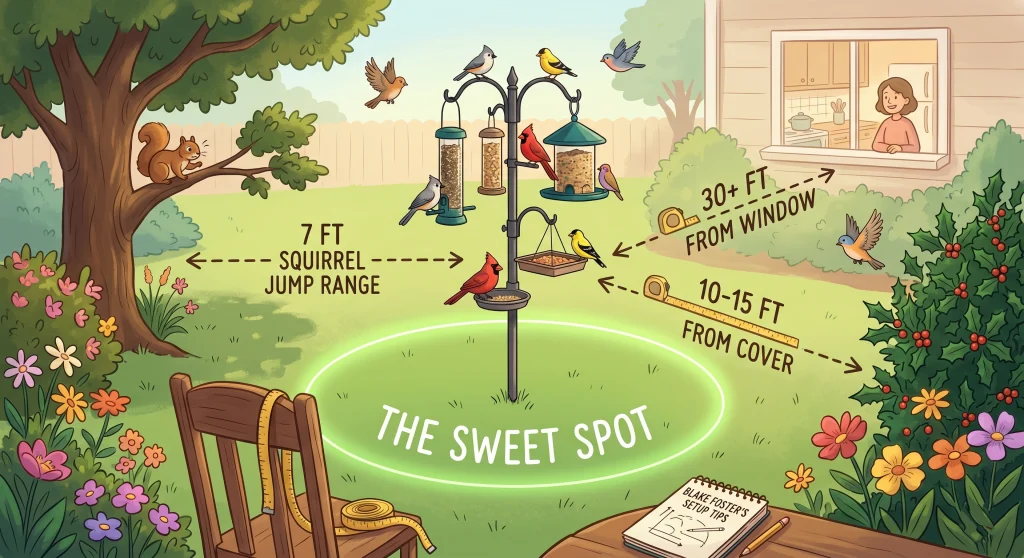
I use three measurements as starting points, not as laws of bird behavior. The window guideline has the strongest safety reason behind it. The squirrel and cover distances are practical setup ranges that depend on the feeder, the surrounding structures, and what animals are actually using your yard.
| The Rule | The Measurement | What It Helps With |
|---|---|---|
| The Window Rule | Within 3 feet of the glass, or roughly 30 feet or more away | Reducing the risk of high-speed window collisions |
| The Squirrel Rule | For a baffled pole, about 8 to 10 feet from solid launch points, with the baffle roughly 4 to 5 feet high | Making it harder for squirrels to jump past the baffle |
| The Cover Rule | About 10 feet from shrubs or trees as a practical starting point | Giving birds nearby refuge without putting the feeder directly against ambush or jump cover |
The window guideline deserves first priority because collisions can seriously injure or kill birds. Cornell recommends placing feeders very close to windows, generally within three feet, because birds leaving the feeder have less room to build speed before a possible strike. Thirty feet or more is also commonly used as the far-side guideline, but distance is not a substitute for making dangerous glass visible with effective exterior treatments when collisions are occurring.
For squirrels, I would not treat the popular five-seven-nine numbers as exact jumping limits. Squirrel performance varies, and a determined squirrel can exploit fences, roofs, branches, poles, and even feeder hardware in ways a simple diagram misses. A more useful setup is an isolated pole with a properly fitted baffle, positioned roughly eight to ten feet from solid launch points when your yard allows it. If you hang a feeder directly from a tree, assume squirrels have a much easier route to the food.
Cover is a different tradeoff. Cornell describes about ten feet from shrubs or trees as a reasonable compromise: close enough to give birds a resting place and quick refuge, but not so close that branches become easy squirrel launch points or dense vegetation becomes an ambush spot for outdoor cats. It is not a guarantee against hawks, and the safest solution to cat predation is keeping cats indoors or otherwise away from the feeding area.

Unlike flimsy bird feeder pole squirrel proof, our bird feeder poles for outdoors heavy duty is constructed with 1.5 inch diameter rust resistant powder coated steel, which is thicker and stronger than other birdhouse poles and coated with black anti rust coating, providing a sturdy outdoor pole that supports multiple feeders without bending or breaking. Solid steel construction eliminates swaying, ensuring stability and reliability for your bird feeders.
Check on AmazonIf you click this link and buy, we earn a commission at no additional cost to you.
Finding the Sweet Spot in Your Yard
Finding a location that balances all three concerns takes a little planning, but it does not require surveying the yard like a construction site. I like to start at the window I will actually watch from, identify any obvious squirrel launch points, then look for nearby cover. In many yards, a pole-mounted feeder makes those variables easier to control than a feeder hanging from a branch.
When you map out the space, measure the few distances that can change the decision rather than guessing them. A tape measure is especially useful for window clearance and squirrel launch points.
- Measure from the feeder to the nearest untreated viewing window. If possible, keep the feeder within three feet of the glass or roughly thirty feet or more away, and address any window that has a history of strikes.
- For a pole setup, look for trees, fences, roofs, railings, and other solid surfaces within roughly eight to ten feet that could give squirrels a launch point.
- Look for useful shrub or tree cover nearby. About ten feet is a practical starting point, then adjust if cats, squirrels, or exposed conditions make that particular spot less safe.
- Check what is directly under the feeder. Seed hulls, spilled food, and droppings are easier to manage over a surface you can clean regularly.
One of the most common placement problems I saw was not a wildly bad setup. It was a feeder that looked isolated until you measured the nearest fence, low branch, or roof edge. People tend to underestimate those distances, especially when looking across a yard from indoors. Measuring once can tell you whether moving the pole will actually help or whether you are better off adding a baffle or changing feeder design.
Field Note: When someone described an “impossible” squirrel problem at the store, I usually asked what was within jumping distance before talking about seed or repellents. Very often there was a fence, branch, or eave closer than they realized. Sometimes moving the feeder helped. Other times the yard was simply too tight, and hardware was the better answer.

This clear acrylic window bird feeder attaches directly to glass with five strong suction cups for close-up backyard bird watching. The transparent design keeps the feeding area easy to see from indoors, while the removable tray makes refilling and routine cleaning more convenient. Its covered structure helps shelter seed, and the open feeding area provides space for common wild birds such as cardinals and finches.
Check on AmazonIf you click this link and buy, we earn a commission at no additional cost to you.
When You Cannot Follow Every Rule
Real yards rarely give you a perfect circle of open space around a feeder. A small property may have a window on one side, a fence on another, and the only useful shrub cover in the same area. When those constraints conflict, I put bird safety ahead of squirrel convenience.
That means window risk comes first. If one location puts active feeder traffic in front of untreated glass at an awkward intermediate distance, I would rather move the feeder very close to the window or substantially farther away and deal with squirrels another way. Squirrel loss is frustrating, but it can often be reduced with a baffle, a cage-style design, or a weight-activated feeder. A dangerous window needs its own solution.
Choosing an intermediate spot near untreated glass only because it happens to be farther from a tree or fence.
Prioritizing window safety first, then using placement, a pole baffle, or a squirrel-resistant feeder to solve the squirrel problem separately.
This hierarchy also keeps the placement process realistic. You do not need one location that performs every job perfectly. You need a location that avoids the serious safety problem first, gives birds reasonable access to cover, and uses the right hardware for whatever squirrel pressure remains.
Making It Work in a Small Space
If you have a small yard, you may not be able to create eight or ten feet of clearance from every fence, branch, roof edge, or railing. In that situation, I stop trying to solve the squirrel problem with distance alone. Hardware becomes part of the placement plan.
Key point: If your yard cannot provide good squirrel clearance, prioritize bird safety and use a feeder or pole system designed to make squirrel access harder.
A properly installed pole baffle can work very well when you have enough open space around the pole. Where that clearance is impossible, a weight-activated feeder can reduce squirrel access by closing or blocking feeding ports under heavier weight. A surrounding cage is another option, although cages can also exclude larger birds you may want to feed.
This hardware-first approach is the advice I use when someone is learning how to set up a bird feeder in a tight yard or townhouse space. It does not mean you can ignore nearby fences, gutters, or branches completely. Squirrels can still reach or manipulate poorly placed feeders. It simply gives you more flexibility than trying to create a wide open exclusion zone that the property cannot provide.

This squirrel proof bird feeder features a weight-sensitive spinning perch that gently removes squirrels when they attempt to access seed, allowing the birds to feed undisturbed.
Check on AmazonIf you click this link and buy, we earn a commission at no additional cost to you.
Final Thoughts: Placement Is a Starting Point, Not a Final Answer
A feeder location that looks good on paper still has to work in the actual yard. Watch for window strikes, outdoor cats, persistent squirrel routes, wet seed, and whether birds seem comfortable moving between the feeder and nearby cover. If something keeps going wrong, change the part of the setup causing the problem instead of assuming the original measurements must be correct.
Small adjustments can matter, but they do not have to be arbitrary. Move a pole because a fence is acting as a launch point. Treat a window because birds are striking it. Shift a feeder because the seed stays wet or the site is too exposed. For the rest of the setup decisions, my comprehensive bird feeder tips covers the maintenance and troubleshooting issues that placement alone cannot solve.

Nature’s Hangout’s window bird feeders for viewing is made of ¼ inch premium grade cast acrylic, the thickest and strongest you can find. Built to withstand the elements, it ensures years of birdwatching enjoyment, right out of the box.
Check on AmazonIf you click this link and buy, we earn a commission at no additional cost to you.
FAQs
🌳 How close to a tree should a bird feeder be?
About ten feet from shrubs or trees is a useful starting point because it gives birds nearby cover without putting the feeder directly against branches or dense hiding cover. If squirrels are your main problem, a baffled pole may need roughly eight to ten feet of clearance from trees and other solid launch points. Adjust for the actual layout of your yard rather than treating either distance as exact.
🪟 Can I put a bird feeder right next to my window?
Yes. Placing a feeder on the window or within about three feet is one of the recommended ways to reduce the severity of feeder-related window collisions because birds have less room to build speed. If you have had strikes at that window, also make the exterior glass more visible with an effective collision treatment rather than relying on feeder distance alone.
🐿️ Does hanging a feeder higher stop squirrels?
Not by itself. Squirrels can reach feeders from trees, fences, roofs, and other structures, so horizontal clearance and a properly installed baffle often matter more than simply adding height. In a tight space, a weight-activated or caged feeder may be more practical.
🦅 Where is the best spot to hide a feeder from hawks?
You cannot reliably hide a feeder from hawks. Nearby shrubs or trees can give small birds a quick refuge, and about ten feet is a reasonable starting point for that cover. Avoid placing the feeder directly against dense vegetation that could conceal an outdoor cat, and keep cats away from the feeding area.