Why Placement Matters More Than Anything Else
If you are trying to figure out how to set up a bird feeder for the first time, it is easy to focus entirely on the hardware. People compare tube, hopper, and platform designs, then spend just as much time deciding what seed to put inside them. Those choices matter, but they cannot compensate for a location that is exposed, hard to maintain, or unsafe around glass.
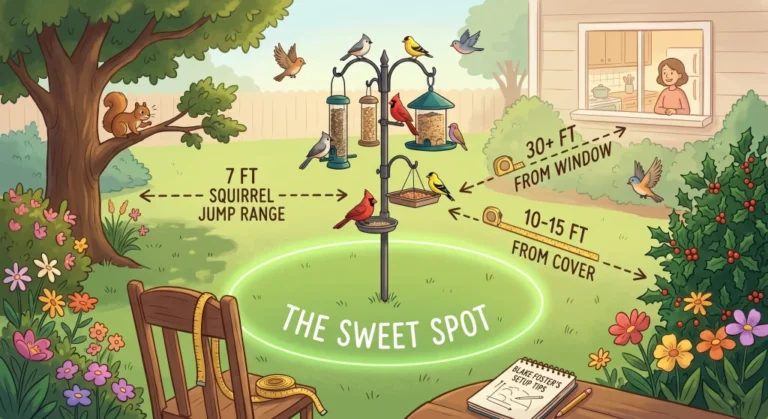
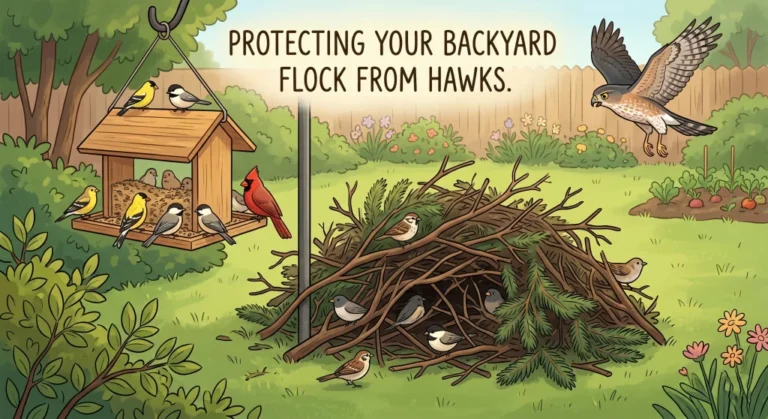
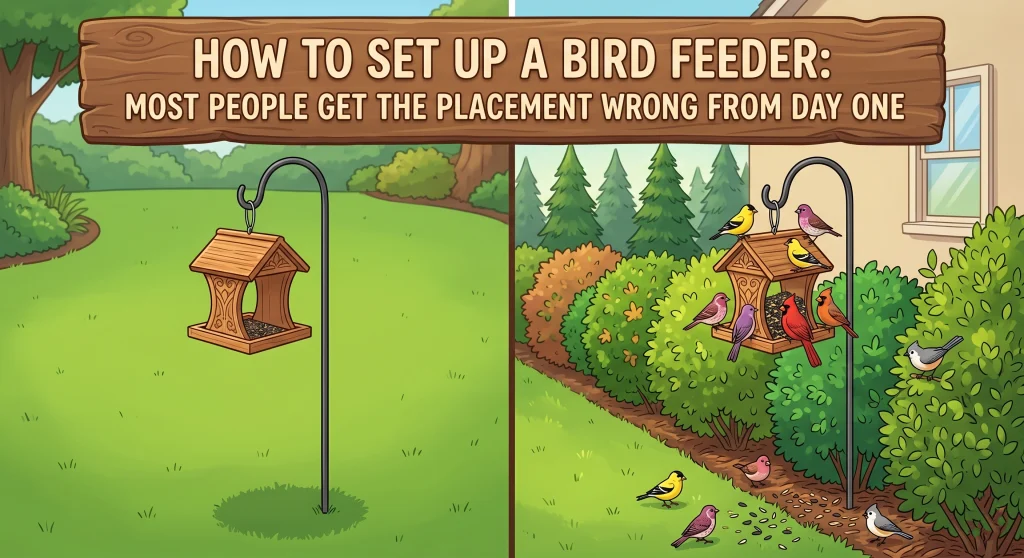
When I worked in a specialty bird store, placement was one of the first things I asked about when someone had a feeder that was getting little activity. Birds need a usable place to approach, perch, feed, and retreat, and nearby vegetation can provide resting cover between visits. At the same time, dense cover immediately beside a feeder can give cats or squirrels an advantage, so the useful spot is usually a compromise rather than the deepest shrub or the widest patch of lawn.
Field Note: One pattern I saw repeatedly was a feeder placed in the visually perfect part of an open lawn because it looked good from the house. Moving that same setup closer to usable tree or shrub cover often made the station easier for birds to approach. I would treat that as a troubleshooting move, not a guarantee, because local species and yard layout still matter.
A successful bird feeder installation is therefore less about finding one magic measurement and more about solving several constraints in the right order. Start with window safety and predator exposure, then deal with squirrels, viewing angle, and mounting convenience. That sequence prevents a convenience rule from overruling a genuine safety problem.
How Birds Actually Find a New Feeder
Birds discover a new feeder while moving through the habitat they already use. Trees, shrubs, brush, and other vegetation give many feeder birds places to perch, wait, and retreat, which is one reason a feeder beside a completely empty lawn can take longer to gain attention than one near established cover. That does not mean birds follow a fixed patrol route or that every hedge functions as a predictable flight corridor.
The practical test is simple: look at where birds already spend time in your yard. If chickadees, sparrows, finches, or other local species regularly use a nearby tree or shrub, placing the feeder within sight of that activity gives them a better chance of encountering it. New feeders can still take several days or longer to gain regular visitors, so if nothing happens immediately, keep the food fresh and give the setup time before making repeated moves.
If birds are present nearby but the feeder remains quiet, a small amount of seed on the ground near the station can make the food source easier to notice. Do not keep adding ground seed if it remains uneaten, gets wet, or begins attracting rodents. The point is to make a new feeding location easier to discover, not to create a second unmanaged food pile.
Window Safety: Why the Old 3-30 Rule Is Not Enough
Window safety should be solved before viewing convenience or squirrel control. Birds hit glass because reflections of sky and vegetation can look like open habitat, and feeders increase bird activity around the windows closest to the feeding station. A large reflective pane can therefore remain hazardous even when the feeder appears to fit a familiar distance rule.
For years, backyard feeding advice often used a simple 3-30 rule: put the feeder very close to the window, usually within about three feet, or move it far away. Close placement can reduce the speed of a bird leaving the feeder, which is why window-mounted feeders and very close feeders are still commonly used. The problem is treating the far-distance half of that rule as proof that an untreated window is safe.
Current collision guidance puts the emphasis on the glass itself. If a window reflects trees, sky, or vegetation near an active feeder, make that glass visible to birds with an effective exterior treatment such as a screen, cords, film, or a dense pattern of exterior markers. Pay particular attention to large panes, paired windows at corners, and any window where a strike has already happened.
Warning: Do not treat three feet or thirty feet as a safety guarantee. If your feeding station is near reflective glass, review how to prevent bird feeder window strikes and address the problem window itself rather than relying on distance alone.

Hummingbird anti-collision window clings are ideal for sliding doors, glass balconies, large windows, offices, and storefronts to prevent dangerous and frustrating recurring bird strikes. Their beautiful, realistic images and colors complement any decor.
Check on AmazonIf you click this link and buy, we earn a commission at no additional cost to you.
The 5-7-9 Squirrel Rule Is a Starting Point, Not a Guarantee
Once window safety is handled, squirrel control becomes a layout problem. The popular 5-7-9 rule is useful because it forces you to check the three obvious approaches: from the ground, from the side, and from above. What I would not do is treat those numbers as hard limits on what every squirrel can or cannot reach.
Project FeederWatch uses about ten feet from trees or buildings as a practical guideline because squirrels can jump onto feeders from nearby launch points. That is a good reminder that seven feet of side clearance may still be too little in some yards. I use 5-7-9 as a quick first pass, then step back and look for the actual route the squirrels are using.
- 5 feet up: Keeping the feeder well above the ground can make a direct jump harder, but pole height alone does not stop a squirrel that can climb the support.
- 7 feet across: Treat this as a minimum screening check, not a promise. If a tree, railing, roof edge, or fence remains within easy jumping range, increase the clearance where the yard allows it.
- 9 feet below: Look above the feeder for branches, wires, pergolas, and rooflines that let a squirrel bypass the pole completely.
A baffle is usually what makes a free-standing pole setup much more dependable. Achieving useful clearance often requires a sturdy metal pole, but the pole still has to be stable and positioned so nearby launch points do not defeat the baffle. If you are going this route, follow proper bird feeder pole setup and adjust the layout based on what the squirrels in your yard actually do.

The unique 7 prongs design of bottom enables the garden hanging stake to stand more firmly on the ground. Even in bad weather, the shepard hooks can still stand upright and is not easy to fall. Compared with ordinary 2 prongs products, it has higher stability and firmness.
Check on AmazonIf you click this link and buy, we earn a commission at no additional cost to you.
When Window Safety and Squirrel Control Conflict
In a large yard, you may be able to put a feeder near useful bird cover, well away from squirrel launch points, and nowhere near problematic glass. Smaller yards rarely cooperate that neatly. Moving a pole away from one hazard can place it closer to another, which is why stacking several distance rules on top of each other can become impossible.
When those constraints conflict, I put bird safety ahead of keeping squirrels out. That means dealing directly with collision-prone glass and predator exposure first, then using a baffle, feeder design, or other hardware to manage squirrels. Seed loss is frustrating, but it is a problem you can solve without accepting a higher collision risk.
If your yard forces a compromise, finding where to place a bird feeder is really an exercise in ranking risks. Solve the hazards that can injure birds first, then optimize convenience, squirrel resistance, and the view from your window.

This squirrel protector has a so slippery surface that the squirrels have no grip to climb on the bird feeder. What’s more, the dirt on the baffle that placed in outdoors for a long time can be easily cleaned because of the glazed surface. Unlike other metal baffles, our PP baffle won’t rust with a terrible look in your garden. We are committed to providing you with an elegant and neat gardens, patios, porches or yards.
Check on AmazonIf you click this link and buy, we earn a commission at no additional cost to you.
Getting the Height Right for Specific Birds
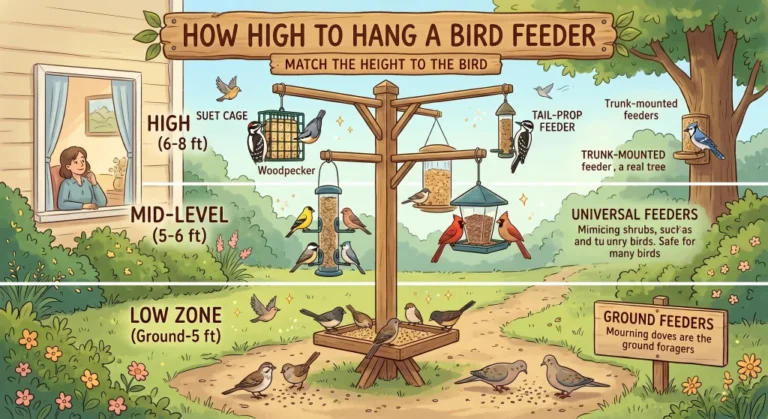
Different birds use different parts of a feeding station, but feeder style and normal foraging behavior matter more than a rigid height chart. A Mourning Dove or Dark-eyed Junco is naturally comfortable feeding on or near the ground, while chickadees and finches readily use elevated feeders. That does not mean every species has one correct number of feet above the lawn.
Use vertical placement to create different feeding opportunities. A low platform can serve birds that spend much of their time foraging below hanging feeders, while ordinary pole or hanging positions work for many familiar songbirds. Higher mounting can also work, but only when the feeder remains safe around windows, practical to refill, and compatible with the birds you are trying to attract.
| Feeding Position | Typical Visitors | Useful Equipment Type |
|---|---|---|
| Ground or very low | Mourning Doves, Dark-eyed Juncos, many Sparrows, Towhees | Low platform tray or a small controlled ground offering where rodents are not a problem |
| Typical elevated feeder position | Chickadees, Titmice, Finches, Northern Cardinals, Grosbeaks | Tube, hopper, platform, or suet feeder matched to the species and food |
| Higher stable mount when practical | Woodpeckers, Nuthatches, Blue Jays, and other birds comfortable on elevated feeders | Suet feeders, hoppers, or other stable mounts with safe refill access |
Note on Ground Feeding: Low trays are especially useful for juncos, doves, and sparrows, but spilled seed can also attract rodents and turn moldy when it stays wet. Offer modest amounts on an easy-to-clean surface and remove wet seed and accumulated hulls instead of letting a permanent pile build underneath.
If you are struggling to attract a particular bird, changing the feeding position can be worth testing after you confirm that the food and feeder style actually suit that species. The deeper breakdown of how high to hang a bird feeder is best used as a practical setup framework, not a promise that moving a feeder by a few feet will produce a specific visitor.
The Missing Piece: Your Own Viewing Experience
A feeder should work for the person maintaining it as well as for the birds using it. If you cannot see the station from the place where you normally sit, or refilling it requires an awkward reach every time, the setup becomes harder to enjoy and easier to neglect. Viewing convenience belongs in the decision, just not ahead of window safety or predator exposure.
The simplest way to test the view is from inside the house before you commit to a permanent mount. Sit where you expect to watch the feeder and have someone mark the proposed location outside with a pole, broom handle, or other visible reference. Check window frames, screens, glare, nearby glass, and whether the feeder will still be easy to reach for routine refilling and cleaning.
Pro Tips: Do not chase one exact “eye-level” measurement. Adjust the feeder or your viewing position until the feeding area is comfortably visible while the outdoor location still satisfies the safety constraints you already checked. A setup you can see and maintain easily is usually more enjoyable than one hung as high as possible simply because the hardware allows it.
Spacing Multiple Feeders
One feeder often becomes two or three once you start offering different foods. A suet feeder, seed tube, hopper, and platform can draw overlapping but different groups of birds, yet hanging every option from one compact pole also concentrates competition and seed debris in the same small space. Whether that matters depends on what you actually see at the station.
Dominance interactions at feeders are real. Larger or more assertive birds can displace other species from a perch or food source, but that does not create a universal six-foot or ten-foot spacing rule for every yard. The useful signal is repeated exclusion: one group arrives and the other birds consistently cannot get access.
If that happens, create a second feeding opportunity rather than chasing an exact distance. Move one feeder far enough away that a bird displaced from the first station can use the second without immediately entering the same crowd. In a small yard that may be a modest separation, while a larger property may support distinct stations with different foods, feeder styles, and nearby cover.
Seasonal Placement Adjustments
Placement is not necessarily a one-time decision, but I would change it in response to a real change in the yard rather than moving feeders automatically with the calendar. Leaves fill in or disappear, branches grow into squirrel-launch range, storm exposure changes, and a window that looked dull in one season can become strongly reflective in another. Those are useful reasons to recheck the station.
Winter is a good example because evergreen trees and shrubs can buffer wind and provide year-round cover. If a feeder sits in a completely exposed spot, moving it toward usable shelter can help, provided the new location does not put the birds beside untreated glass or right over a hiding place for a cat. The goal is nearby refuge, not burying the feeder inside dense vegetation.
When warm weather returns, inspect the same constraints again. Check whether new growth has created squirrel access, whether low cover has changed predator visibility, whether the feeder is now in stronger sun, and whether nearby glass reflects more vegetation. Seasonal adjustment works best as a safety and usability audit, not a fixed rule that the feeder must move in spring and move back in winter.
Final Thoughts: Watch and Adjust
Placement rules are useful starting points, but your yard will tell you whether the station actually works. Watch where birds wait before landing, whether one species controls the only feeding spot, where squirrels launch from, how cats approach the area, and what the nearby windows reflect at different times of day. Those observations are more useful than forcing every yard into the same diagram.
If a safe, freshly stocked feeder stays quiet, make one change at a time. You might move it closer to usable cover, separate a crowded second feeder, or correct a window or squirrel problem before changing anything else. Give each adjustment enough time to show you something, keep the food fresh, and let the birds’ actual use of the yard guide the next move.

Squirrel-Proof: The weight-activated system detects visitor weight to activate protection mechanism. When a squirrel climbs on, its weight forces the protective shroud downward, closing all feeding ports
Check on AmazonIf you click this link and buy, we earn a commission at no additional cost to you.
FAQs
📏 How close to a window should I put my bird feeder?
Do not rely on one feeder-to-window distance as a complete collision solution. A feeder mounted on the window or very close to it can reduce the speed of some feeder-related strikes, but current guidance still recommends treating reflective glass near feeding activity with effective exterior collision deterrents.
🐿️ How far does a feeder need to be from a tree to stop squirrels?
There is no distance that guarantees squirrels will stay off a feeder. Around ten feet from strong launch points is a useful starting guideline where the yard allows it, but a well-fitted baffle and removal of easy overhead routes are usually more dependable than distance alone.
🌳 Do birds prefer feeders in the sun or the shade?
There is no universal sun-or-shade preference for all feeder birds. Choose a location that provides safe approach cover and good visibility, then use partial shade when it helps protect food or nectar from intense heat without creating a hidden approach for predators.
🐦 Can I put two different feeders on the exact same pole?
Yes. If both feeders stay busy without one species repeatedly displacing the others, there may be no reason to separate them. If one group monopolizes the pole, moving one feeder far enough away to create a second feeding opportunity can improve access for other birds.
❄️ Should I move my setup in the winter?
Only if the seasonal change creates a real reason to move it. Nearby evergreen cover can provide shelter from winter wind, but keep window safety, predator exposure, and squirrel access in the decision rather than moving the feeder automatically just because the temperature drops.