The Refilling Convenience vs. Bird Attraction Tradeoff
If you ask ten different people how high to hang a bird feeder, you will usually get the exact same answer. Most people will tell you to hang it somewhere around five and a half feet off the ground. There is a very simple reason for this. That happens to be the average height of a person reaching out with their arms to refill a tube of seed.
You can buy the perfect feeder and fill it with premium seed. But if you put it at the wrong vertical level, the birds you want might ignore it completely. We tend to hang feeders at whatever height makes our lives easier. We want to be able to lift the lid, pour the seed in, and walk away without stretching or bending down. The problem is that birds do not care about your convenience. They care about their natural instincts.
Every species of backyard bird has a preferred vertical zone where they feel the most comfortable eating. When you force a ground-feeding bird to eat high up in the air, or force a tree-clinging bird to eat near the ground, they feel exposed to predators. They will often choose to skip your yard and find a setup that feels safer.
Key point: The right height depends on which birds you want to see. If your feeder is perfectly clean and full of fresh seed but sitting empty, the height is the very first thing you should adjust.
Finding the Right Bird Feeder Height by Species
To get this right, you need to think about how birds find food in the wild. Some birds naturally hop around in the dirt looking for fallen seeds and insects. Others spend their entire lives clinging to the bark of tall tree trunks. You need to replicate those natural zones in your yard.
When you are trying to figure out what height for bird feeder placement makes the most sense, start by identifying the birds you actually have in your neighborhood. Once you know who is visiting, you can adjust your setup to match their preferred zones.
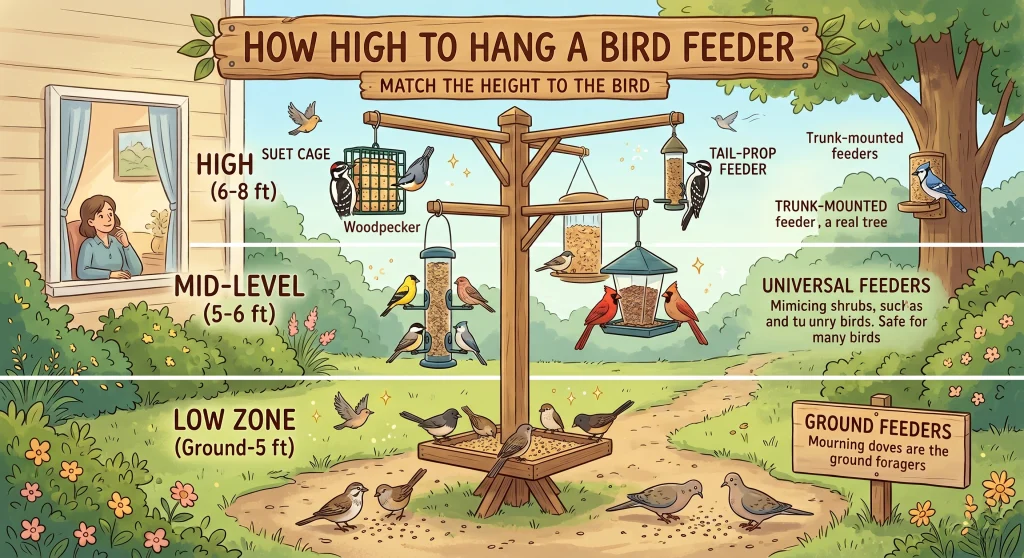
| Feeding Zone Height | Target Bird Species | Best Feeder Types |
|---|---|---|
| 1 to 5 feet (Low) | Mourning Doves, Juncos, Sparrows, Towhees, Quail | Platform trays, low hopper feeders, ground trays |
| 5 to 6 feet (Mid-Level) | Cardinals, Finches, Chickadees, Titmice, Grosbeaks | Tube feeders, hopper feeders, window feeders |
| 6 to 8 feet (High) | Woodpeckers, Blue Jays, Nuthatches | Suet cages, peanut wreaths, trunk-mounted feeders |
The Low Zone: Ground to 5 Feet
Ground feeders are incredibly common in most backyards. Juncos, Sparrows, and Mourning Doves naturally forage by walking on the ground and kicking up leaf litter. If you hang a feeder high up in the air, these birds will only eat the scraps that fall to the grass below. If you want them to actually use the feeder, you need to bring it down to their level. A platform feeder set at about three feet off the ground is highly effective for these species.
Field Note: One of the most common things I heard at the store was people complaining that their new platform feeder was completely ignored by the birds. Nine times out of ten, they had it mounted on a tall eight-foot pole. They were filling it with millet to attract Mourning Doves. These birds are ground foragers. They simply will not fly up eight feet to balance on a tray. We lowered the platform to four feet. The birds found it the very next morning.

Handcrafted in the USA, the WoodLink 3-in-1 Platform Feeder (Hang, Pole Mount, or Ground) is one of the most popular platforms around. The versatile design of this natural cedar feeder attracts large and small wild birds and lets you choose how to set it up.
Buy on AmazonIf you click this link and buy, we earn a commission at no additional cost to you.
The Mid-Level and High Zones
The mid-level zone of five to six feet is the most universal height. This mimics the height of small shrubs and lower tree branches. This is exactly where Northern Cardinals, Chickadees, and Finches feel right at home. It provides them with enough altitude to watch for neighborhood cats while remaining low enough to quickly dive into nearby bushes if a hawk flies over.
The high zone is reserved for larger, bolder birds and tree-clingers. Woodpeckers and Nuthatches spend their days climbing up and down the trunks of mature trees. They prefer their food sources to be high off the ground. If you are setting up a suet cage for Woodpeckers—especially a tail-prop suet feeder designed for larger species to brace against—getting it up to seven or eight feet will yield much better results than leaving it at eye level.

This bird suet feeder with tail prop holds 2 suet cakes, providing high-energy food for birds. The tail prop gives woodpeckers a sturdy place to rest while feeding. The hanging cable makes it simple to set up in your yard or garden.
Buy on AmazonIf you click this link and buy, we earn a commission at no additional cost to you.
How to Solve the Pole Height Problem
Once you understand the zones, you run into a practical physical problem. Finding the optimal bird feeder pole height is tricky if you want to attract high-zone birds. If you need a feeder at eight feet in the air to make the Woodpeckers comfortable, how are you supposed to refill it every few days without dragging a stepladder into the yard?
This is where the standard hardware you find at big box stores fails. A standard shepherd’s hook is usually pushed about a foot into the soil to stay stable. That leaves the actual hanging hook at roughly four to five feet off the ground. That limits your options immediately.
The solution is a heavy-duty telescoping pole system. When looking for one, do not just grab the cheapest option on the shelf. You want a pole that extends to at least eight feet, features a secure locking mechanism (pin-locks are far more reliable than twist-locks, which tend to slip downward under the weight of a full feeder), and has a sturdy auger base to support the extra height.
Buying a cheap, fixed-height pole, sticking it in the ground, and hoping the birds adapt to whatever height it happens to be.
Using a telescoping pole or a pulley system. You can easily drop the feeder down to chest height to clean it and refill it. When you are done, you simply raise it back up to the seven or eight-foot mark where the Woodpeckers and Blue Jays want it.
This simple hardware upgrade completely eliminates the tradeoff between your convenience and the natural habits of the birds. Getting the height right is just one part of the puzzle. If you want to avoid the most common mistakes that keep birds away, reviewing foundational bird feeder tips will save you a lot of time and wasted seed over the seasons.

Place three of your favorite hanging items in one convenient viewing spot using this Erva Black Five Piece Pole Kit with Extended Arms. The generous size, robust steel construction, and classic design of this kit create an ideal way to display hanging items in a yard where space is limited.
Buy on AmazonIf you click this link and buy, we earn a commission at no additional cost to you.
Setting Up for the Best Viewing Experience
There is one rule of height that almost everyone forgets. You are doing all of this work so that you can watch the birds. The single best piece of advice I can give you regarding how high should bird feeder be placed involves going inside your house.
Before you mount a permanent pole or screw a bracket into a wooden post, go sit in the chair where you plan to watch the birds. Look out the window. Have someone else go outside and hold the feeder up in the air. You will quickly realize that the slope of your yard and the angle of your window change everything.
Here are a few things that usually happen when people do the indoor viewing test:
- They realize the window sash completely blocks their view of the feeding ports at five feet.
- They notice that hanging the feeder higher puts the birds silhouetted against the bright sky, making it hard to see their colors.
- They discover that lowering the feeder by just ten inches frames the birds perfectly against the green backdrop of the lawn.
Setting the base of the feeder at your indoor eye-level from your favorite watching spot creates the best possible experience. Once you lock in that perfect viewing height, you can choose a style of feeder that matches the bird species that naturally feed in that zone.
Finding the right vertical height is crucial, but you still need to figure out the exact horizontal location in your yard to keep the birds safe. I cover how to balance windows, trees, and safety in my main guide on how to set up a bird feeder.
Making the Final Height Adjustments
Do not be afraid to experiment with your vertical spacing. Birds will absolutely notice if you raise or lower a feeder. If you have had a tube feeder hanging from a low branch at eye level for months with very few visitors, try raising it just two feet higher to reach that upper zone. I have seen a minor vertical adjustment bring a dead feeding station back to life in a matter of hours.
Pay attention to what the birds are telling you. If the seed is staying dry and clean, but the birds are avoiding it, your vertical height is likely the issue. Give them a height that matches their natural foraging zone, and they will do the rest.

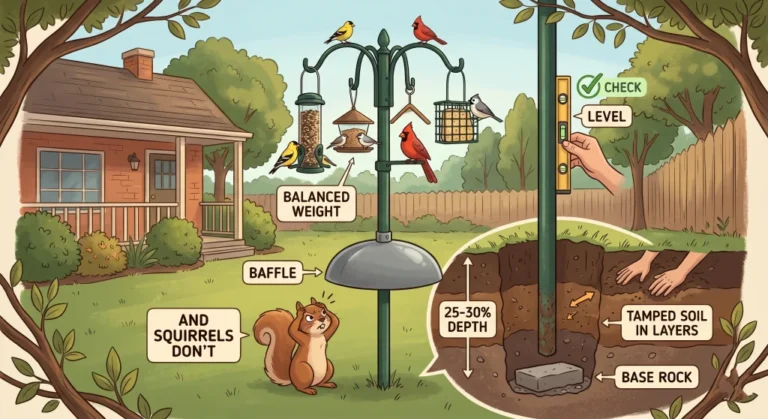
19 inch diameter design makes this squirrel stopper more effective than other sizes. Larger sizes have greater jitter, no matter if rodents fly up or climb up, they will not be able to stand stably on the baffle. Anything smaller than 19 inches cannot step over this baffle easily, which means that the foods in your bird feeder can be specially provided to feathery friends instead of greedy squirrels or raccoons.
Buy on AmazonIf you click this link and buy, we earn a commission at no additional cost to you.
FAQs
📏 What is the best height for a general bird feeder?
For a mixed seed feeder meant to attract the widest variety of common backyard birds, five to six feet off the ground is the most effective height. This is safe from most ground predators and easy for you to reach.
🕊️ Why won’t doves eat from my hanging feeder?
Mourning Doves are naturally ground foragers. They are not built to balance on small perches high in the air. If you want to feed doves, use a low platform feeder set one to three feet off the ground.
🐿️ Does hanging a feeder higher stop squirrels?
No, height alone will not stop a squirrel. If a squirrel can reach the pole, they can climb it regardless of how high the feeder is. You must use a proper squirrel baffle installed below the feeder to stop them from climbing.
🪟 Should I hang my feeder higher if it is near a window?
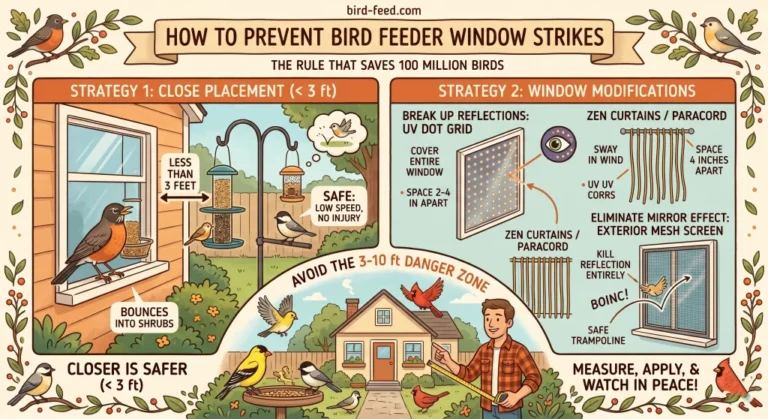
Height does not prevent window strikes. Distance from the glass is what matters. Feeders should be placed either closer than three feet to the glass or farther than thirty feet away to keep birds safe.
🦅 Will a higher feeder protect birds from hawks?
Raising a feeder higher actually leaves birds more exposed to avian predators like hawks. To protect small birds from hawks, ensure the feeder is located within ten feet of dense natural cover like a brush pile or thick evergreen shrub.