The Reality of Hawks at Bird Feeders
Watching a hawk take a bird near a feeder is difficult, especially when the whole reason you put food out was to help and enjoy backyard birds. The important thing to remember is that the feeder did not create predation. It concentrated birds in one place, which can make a natural hunting event much easier for you to witness.
Hawks that hunt feeder birds are not doing anything abnormal. Cooper’s Hawks and Sharp-shinned Hawks are specialized bird predators, and both occur in suburban and backyard settings where small birds gather. Project FeederWatch research has also found that feeder environments do not appear to expose birds to a greater overall predation risk than birds encounter away from feeders.
What you can control is whether your feeding station keeps concentrating prey after one hawk starts returning regularly. You can add escape cover, reduce exposed ground feeding, or pause feeding long enough for the flock to disperse. What you should not do is attempt to trap, capture, injure, poison, shoot, or personally relocate the hawk.
Warning: Native hawks such as Cooper’s Hawks and Sharp-shinned Hawks are protected under the Migratory Bird Treaty Act. Federal law generally prohibits taking, capturing, or killing protected migratory birds without authorization, and state wildlife laws may add further restrictions. If a raptor creates an unusual human-safety or wildlife-conflict issue, contact the appropriate wildlife agency rather than trying to handle it yourself.
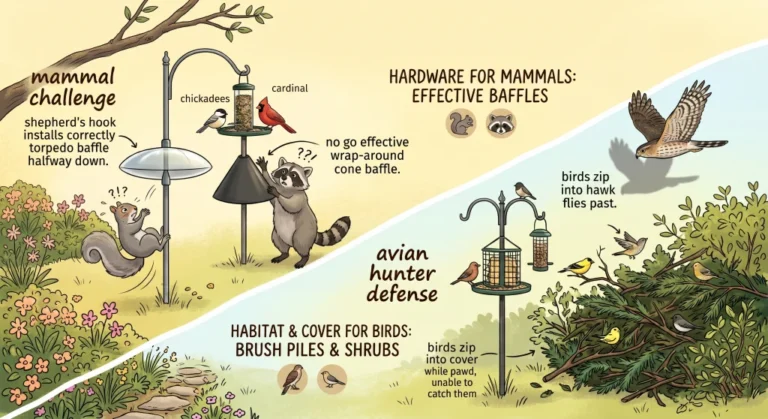
The same principle applies when you work through broader bird feeder tips. Squirrels can be excluded with hardware. A hawk cannot be treated like a climbing pest. The useful tools here are habitat, feeder management, and time.
The Hawks Most Often Seen Hunting Feeder Birds
Not every hawk you see over the neighborhood is focused on your feeder. Red-tailed Hawks, for example, eat many mammals and other prey, although they can take birds. Around feeding stations, Cooper’s Hawks and Sharp-shinned Hawks are especially well known for pursuing birds.
Both are fast, long-tailed woodland hawks adapted to maneuvering around trees and other obstacles. They can be difficult to tell apart because size overlaps between a male Cooper’s Hawk and a female Sharp-shinned Hawk, so do not build your response around a rushed identification from one glimpse.
| Hawk Species | Physical Characteristics | Hunting Behavior |
|---|---|---|
| Cooper’s Hawk | Usually the larger of the two. Adults have a long tail that often looks rounded at the tip, a relatively large head, and reddish barring below. | Frequently hunts medium-sized birds and may rush through vegetation or across a yard in pursuit of doves, starlings, jays, and other birds. |
| Sharp-shinned Hawk | Generally smaller, with a small-looking head and a long tail that often appears more squared at the tip. Females can overlap male Cooper’s Hawks in size. | Specializes heavily on small birds and may appear suddenly around feeders where finches, sparrows, chickadees, and similar prey are concentrated. |
A feeder visit can happen during migration, winter, or other seasons depending on where you live. Cornell notes that some hawks only pass through briefly, while others may return to a productive feeding area repeatedly. That is why one flyby does not require the same response as a hawk making regular hunting attempts.
Use a Brush Pile as Escape Cover
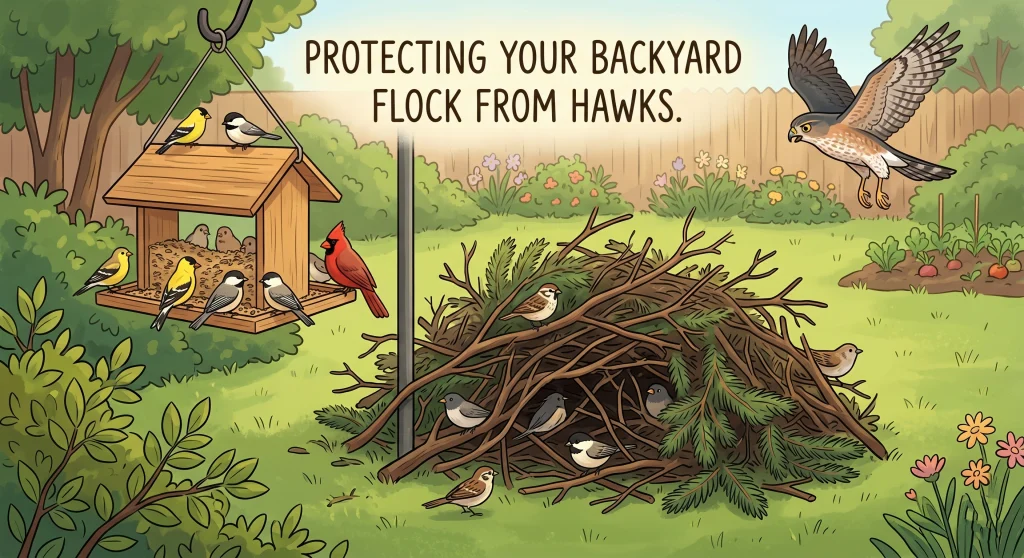
If your feeder sits in a broad open lawn, look at the distance a small bird has to cross before it can reach dense cover. Shrubs, evergreens, tangled vegetation, and loosely stacked brush can give feeder birds a place to dive when a predator appears.
Cornell and Project FeederWatch specifically recommend natural cover near feeding stations and mention brush piles as resting and escape cover for ground-oriented birds. Around ten feet from a feeder is often suggested as a practical starting point because it keeps cover useful without putting strong branches or cat hiding places directly against the feeding station. Treat that distance as a yard-specific compromise, not a biological rule.
Field Note: When I looked at feeder-placement problems in the store, an exposed station with no nearby refuge was one of the easiest things to spot on a customer’s yard description. My practical fix was to look for existing shrubs or evergreen cover first. A brush pile was the low-cost option when the yard had nothing useful nearby.
If you need to create temporary cover, keep the job simple:
- Use clean fallen branches, twigs, and evergreen boughs from material that is safe to keep on the property.
- Stack the material loosely so small birds have gaps and interior spaces rather than one tightly packed mound.
- Place the pile near enough to be useful as refuge while still leaving enough separation that cats cannot sit concealed directly beside the feeder.
- Check the pile as it settles and remove anything sharp, unstable, diseased, or otherwise unsuitable for the yard.
A brush pile does not make birds hawk-proof, and a Cooper’s Hawk can maneuver through surprisingly dense vegetation. The value is simpler: it gives small birds more options than an uninterrupted flight across open grass. Permanent native shrubs and evergreens can provide the same function with additional food and shelter benefits.
Temporary Takedown: From a Few Days to a Week or Two
If a hawk begins hunting your feeding station repeatedly, the most directly supported way to reduce the attraction is to stop concentrating prey there for a while. Cornell recommends taking feeders down for a few days and, in some situations, waiting a week or two before putting them back.
You do not need to make the yard biologically barren. Take down the feeders that are concentrating birds, clean up obvious piles of spilled seed, and let the usual feeder flock spread out to other food sources. Wild birds routinely use multiple feeding locations, so a temporary pause does not mean your cardinals or chickadees suddenly have nowhere else to eat.
There is no guaranteed countdown. A Cooper’s Hawk may move on after a few days, a Sharp-shinned Hawk may continue using the neighborhood, or the same hawk may notice the feeder again when birds return. Cornell explicitly notes that reopening a station can sometimes bring the hawk back because raptors search a fairly large area for hunting opportunities.
That is why I would not describe a two-week takedown as a way to “break” a hawk’s habit or force it to establish a new territory. It is a practical reset. If regular attacks resume immediately after the feeders return, you can pause again, improve cover, reduce crowding, or decide that the feeding station should stay closed longer.

The Audubon Squirrel Proof Caged Tube Feeder surrounds a central seed tube with a sturdy metal cage that limits access by squirrels and larger birds. Four feeding ports allow finches, chickadees, nuthatches, and other small songbirds to reach the seed while remaining protected inside the cage. The feeder holds about 1.25 pounds of mixed seed and can be hung from a hook, branch, or feeder pole for regular backyard feeding.
Check on AmazonIf you click this link and buy, we earn a commission at no additional cost to you.
Adjust the Feeding Setup Without Pretending It Is Hawk-Proof
If you reopen the station, focus on reducing unnecessary exposure rather than trying to engineer a feeder a hawk cannot defeat. Birds can be caught while approaching a feeder, leaving it, sitting in a nearby tree, or feeding on the ground, so no cage or hanging height creates a protected bubble.
Scattering large amounts of seed across an open lawn while a hawk is making repeated hunting passes, then assuming an elevated feeder nearby makes the ground-feeding birds safe.
Reduce unnecessary ground scatter, keep useful escape cover nearby, and pause the feeding station if a hawk continues making regular attacks despite those changes.
Hulled sunflower can reduce the volume of discarded shells under some feeders, which may make cleanup easier. It does not create zero debris, and it will not stop doves, sparrows, or other birds from using the ground if edible pieces still fall. Keep the area beneath the station clean and avoid putting extra seed on exposed grass during a period of repeated hawk activity.
Cage-style feeders are useful for excluding some larger feeder visitors and squirrels, depending on the cage spacing. I would not call the cage a structural defense against a hawk. A small bird can still be vulnerable immediately outside the cage, and a pursuing hawk is not required to strike through the feeder to catch prey.
I would also skip flash tape, plastic owls, bells, and similar scare devices as the core solution. Visual and noise deterrents can produce inconsistent, temporary responses, and wildlife often habituates to objects that never become a real threat. Cover and a temporary feeder pause have much clearer support for this specific problem.

100% dehulled, shell-free sunflower seeds with zero waste and zero mess. Attracts finches, chickadees, sparrows, grosbeaks, titmice, nuthatches, and more. Works in hopper, tube, or platform feeders. Family owned, American made.
Check on AmazonIf you click this link and buy, we earn a commission at no additional cost to you.
Final Thoughts: Manage the Feeding Station, Not the Hawk
A hawk taking a feeder bird is a natural predation event happening in a place where you can see it clearly. That does not mean you have to keep concentrating birds in the same spot while a raptor hunts there repeatedly.
Start with nearby escape cover. If attacks become regular, take the feeders down for a few days and give the birds time to disperse. Put the station back up when you are ready, then watch what actually happens rather than assuming the hawk has permanently left.
Most importantly, keep the response legal and proportionate. Do not trap, injure, poison, capture, or relocate a protected raptor yourself. If the problem shifts from normal hunting behavior to an unusual safety or wildlife-management issue, contact the appropriate wildlife authority.
If the animals causing trouble are mammals rather than raptors, the solution changes completely. The page on bird feeder predators separates hawk management from the hardware used for squirrels and raccoons.

Kaytee Sunflower Hearts & Chips attract more birds than any other seed. This highly nutritious food is made with 100% edible sunflower hearts, and the hulls have been removed to make it easier for birds to eat. This means less mess for you and more energy for your feathered friends.
Check on AmazonIf you click this link and buy, we earn a commission at no additional cost to you.
FAQs
🦉 Will a plastic decoy owl scare away a hawk?
It might change a hawk’s behavior briefly, but I would not rely on a stationary plastic owl as a lasting solution. Raptors can habituate to a harmless object, and there is much better support for providing escape cover or temporarily removing feeders when a hawk is hunting the station regularly.
🦅 Are hawks bad for the local bird population?
Hawks are native predators and a normal part of bird communities. Project FeederWatch research found that feeder environments did not appear to expose birds to a higher overall predation risk than birds face without feeders, and Penn State notes that feeder-hunting hawks have little if any negative effect at the population level.
🐦 Do crows help keep hawks away?
Crows sometimes mob hawks and other raptors, but their presence is not a dependable hawk-control system for a feeder. Let natural interactions happen, but do not try to attract or manipulate crows as a substitute for cover or a temporary feeder takedown.
🕰️ How long will a hawk stay in my yard?
There is no fixed timetable. Some hawks pass through once, while others return repeatedly when a feeding station offers regular hunting opportunities. Taking feeders down for a few days and, if needed, waiting a week or two before reopening can encourage the hawk to hunt elsewhere, but it may return later.
🔔 Can I put bells on my feeder to scare them?
I would not count on bells or wind chimes to deter a hunting hawk. They also add another disturbance around the feeder without changing the basic reason the hawk is there: concentrated prey. Escape cover and temporarily dispersing feeder birds are more direct responses.
🌳 Does the height of the feeder matter to a hawk?
Height alone is not a reliable defense. Cooper’s Hawks and Sharp-shinned Hawks are agile bird predators that can pursue prey through yards and vegetation at different heights. Nearby safe cover, limited ground concentration, and pausing the feeder during repeated attacks matter more than choosing one supposedly hawk-proof hanging height.