The Difference Between Seed Raiders and Bird Predators
When dealing with bird feeder predators, start by identifying what is actually happening at the station. A squirrel stealing sunflower seed is a different problem from a Cooper’s Hawk hunting the birds gathered around that seed. A raccoon may raid the feeder for food and damage the hardware, while an outdoor cat is a direct predation risk to birds on or below the feeder. Treating all of those visitors as the same kind of nuisance leads to bad advice.
For squirrels, chipmunks, and many nighttime mammals, the practical problem is usually access to seed. Placement, baffles, weight-sensitive feeders, secure storage, and cleaning spilled seed can reduce that access. I would not say these mammals have “zero interest” in birds, because raccoons and squirrels are opportunistic and can take eggs, nestlings, or other animal food. At a typical seed feeder, though, the immediate conflict is usually the food and the hardware.
Hawks and cats require a different response because the birds themselves are the target. U.S. Fish and Wildlife Service specifically lists predation as one of the major risks associated with concentrating birds at feeders. A baffle that stops a squirrel from climbing a pole does nothing to stop a Cooper’s Hawk from hunting a flock or a cat from waiting beneath low cover.
The useful split is therefore simple: block access when an animal is raiding seed, and reduce predation risk when an animal is hunting birds. That keeps the solution matched to the actual problem instead of turning the yard into a collection of random deterrents.
Field Note: One of the more useful troubleshooting questions at the store was, “What is the animal getting from the setup?” A bent pole, emptied hopper, feathers under a shrub, and a hawk perched nearby point to very different causes. Once the visitor and the reward were clear, the solution usually became much simpler.
The Limits of Placement Against Agile Mammals
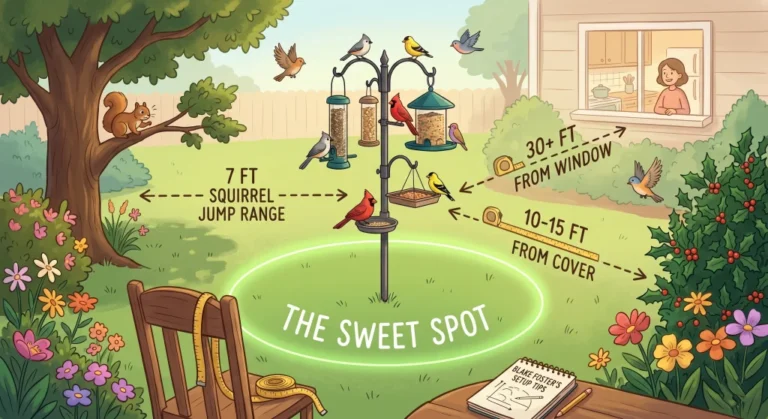
Placement is one of the cheapest tools you have, but there is no universal 5-7-9 formula that defeats every squirrel. Cornell and University of New Hampshire Extension both recommend keeping feeders about ten feet from obvious jumping-off points such as trees, fences, roofs, or buildings when squirrels are a problem. That is a useful starting point, not a guarantee.
The complication is that feeder placement has to solve more than squirrel access. Cornell also recommends nearby natural shelter for birds and describes about ten feet from cover as a reasonable compromise between giving birds an escape route and keeping the feeder away from branches that help squirrels or hiding places that help cats. Window safety matters too, so do not move a feeder farther from one hazard only to place it in a dangerous collision zone.
Most real yards have overlapping launch points: a fence on one side, shrubs on another, and a deck railing nearby. Squirrels can jump several feet, climb rough surfaces, and test the same route repeatedly. Raccoons are strong climbers as well. If the feeder can be reached from above, from the side, or by climbing the support, placement alone may never be enough.
That is when physical exclusion becomes useful. The goal is not to find a mythical unreachable point in the yard. It is to remove the easy launch routes you can control, then make the remaining route up the pole or down the hanger difficult enough that the animal stops getting rewarded.
Baffles: One of the Strongest Structural Defenses
A properly matched baffle is one of the most useful structural tools for squirrels and climbing mammals, but I would not call it the only solution that works. Squirrel-resistant feeders, placement away from launch points, clean ground under the station, and secure seed storage can all reduce the reward. A baffle is valuable because it attacks the route to the feeder rather than trying to scare an animal after it has already reached the food.
The style has to match the route:
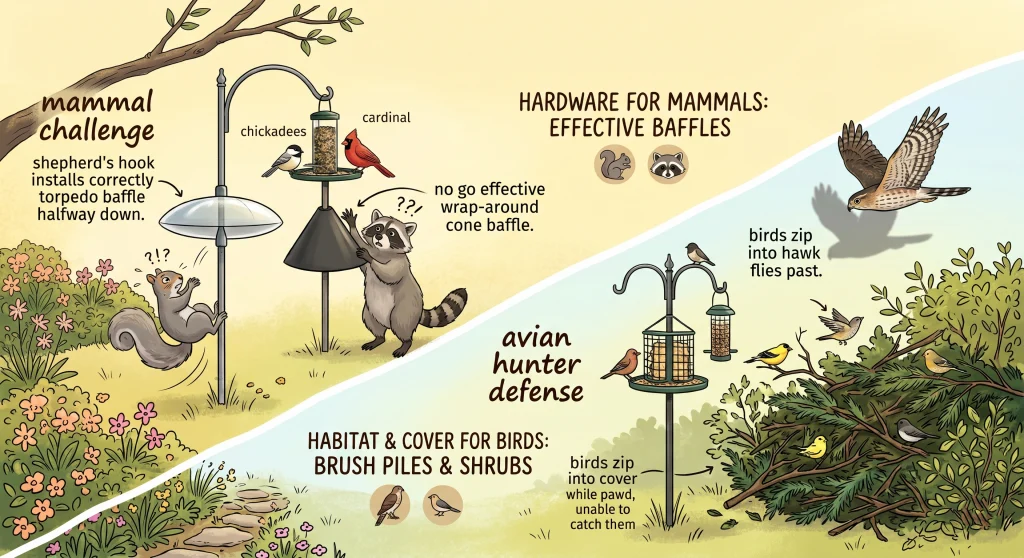
- Pole baffles: These mount below a feeder on a freestanding pole and block the climb. Cylindrical and cone-shaped designs both work by forcing the animal around a surface it cannot easily grip or bypass.
- Wrap-around cone baffles: These can be useful on existing poles when the feeder cannot easily be removed for installation. The important part is enough width and correct mounting height for the target animal.
- Hanging dome baffles: These sit above a hanging feeder and are meant to block squirrels approaching from a branch, wire, or chain. They work only if there is no alternate side jump onto the feeder.
I would avoid generic claims that every “standard” squirrel baffle is 15 or 16 inches or that every raccoon requires exactly 24 inches. Extension recommendations for predator guards vary with the application, and a baffle that works on a nest-box pole is not automatically the correct size for a feeder station. Raccoons are larger and have a longer reach than squirrels, so they often require a substantially larger guard, more mounting height, and a sturdy pole.
The better buying rule is to check the manufacturer’s dimensions, the pole diameter it fits, how high it must be mounted, and which animal it is intended to exclude. Then look at the finished geometry in your own yard. A large baffle does very little if a raccoon can simply reach the feeder from the ground or a squirrel can jump to it from a fence.
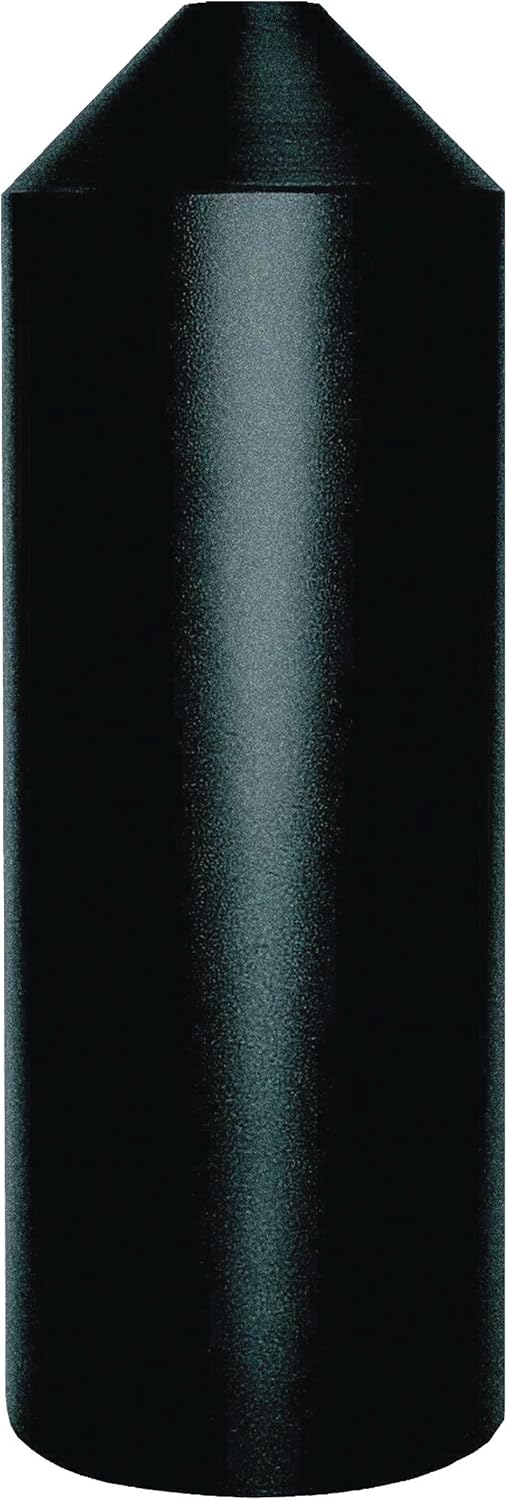
A torpedo-shaped steel squirrel baffle with a textured powder-coated finish. Measures 6.125 inches in diameter and slides onto any pole ranging from 1/2 to 1-3/8 inches in diameter via an included coupler. Easy to install - simply remove the zip tie and secure the coupler around the pole. Pole not included.
Check on AmazonIf you click this link and buy, we earn a commission at no additional cost to you.
The Danger of DIY Chemical and Grease Deterrents
Greasing a feeder pole is a bad shortcut. Cornell and University of New Hampshire Extension both warn against using grease, oil, petroleum jelly, or similar substances to stop squirrels because they can mat fur and feathers and reduce their insulating function. A physical baffle does the same job without coating wildlife in something difficult to remove.
Warning: Do not coat poles, hangers, or feeder surfaces with petroleum jelly, cooking oil, axle grease, or other sticky products. Birds can brush against those surfaces, and mammals can carry the material away on their fur. Use a purpose-built barrier instead.
Hot-pepper seed is a different category. Birds do not respond to capsaicin the way mammals do, which is why commercially prepared hot-pepper bird foods are sold as squirrel deterrents. Cornell notes that results are mixed, so I would treat capsaicin as an optional deterrent rather than a guaranteed fix. A determined squirrel with few alternative foods may behave differently from one yard to another.
If you use a commercial hot-pepper seed or suet product, follow the product directions and handle it carefully. Capsaicin can irritate human eyes, skin, and airways. I would not improvise by dumping concentrated pepper powder or homemade sprays onto feeder surfaces. Keep the deterrent in the food product where it is intended to be used, then wash your hands after handling it.

A no-melt suet dough made with beef suet and roasted peanut pieces, staying solid up to 100F for year-round use in any climate. Fully consumable with no shells or waste, keeping feeders clean. Rich in healthy fats and protein to support daily activity, nesting, and migration. Attracts woodpeckers, nuthatches, chickadees, wrens, and other songbirds. Made in the USA.
Check on AmazonIf you click this link and buy, we earn a commission at no additional cost to you.
Habitat Adjustments for Avian Hunters
A Cooper’s Hawk or Sharp-shinned Hawk visiting a feeder can be unsettling because the feeder has concentrated exactly the kind of prey these raptors hunt. Cornell notes that feeder birds can attract hawks, and U.S. Fish and Wildlife Service identifies predation as one of the risks that comes with predictable feeder concentrations.
Hawks covered by the Migratory Bird Treaty Act cannot be killed, captured, or otherwise taken without authorization. The practical backyard response is therefore to change the feeding situation, not to attack or trap the hawk. Native raptors are part of the same wildlife community as the songbirds at the feeder.
Nearby escape cover can help small birds respond when a predator passes through. Cornell recommends feeders near natural shelter and describes roughly ten feet as a useful compromise: close enough for birds to reach cover, but not so close that branches become easy squirrel launch points or dense low vegetation becomes a cat ambush site. If you do not have established shrubs, a loose brush pile can provide temporary cover for some ground-feeding and small birds.
I would not promise that a brush pile makes a feeder “hawk-proof.” Cooper’s Hawks are agile woodland hunters and can pursue birds through vegetation. Cover gives prey more options, not immunity.
If a hawk begins hunting the feeder repeatedly, temporary feeder removal is the strongest evidence-backed response. Cornell recommends taking feeders down for a few days and, if necessary, leaving them down for a week or two so the small birds disperse and the hawk has less reason to keep checking the same spot. Put the feeders back once the pattern has broken and reassess if the hawk immediately resumes regular attacks.
Neighborhood Cats: The Ground-Level Hunters
Outdoor cats are different from squirrels because they are a direct predation risk. U.S. Fish and Wildlife Service goes so far as to say that if cats regularly visit your yard, you should reconsider whether a feeder is appropriate in that location. For owned cats, the best solution is keeping them indoors, on a leash, or in a secure catio rather than trying to make wild birds better at escaping them.
Seed choice is not a reliable cat-control strategy. Millet does not “force” birds onto the lawn, and switching to hulled seed does not make ground-feeding behavior disappear. Sparrows, juncos, doves, and other species naturally forage on the ground, and spilled seed can draw birds below almost any feeder. Reducing spill and cleaning the ground helps, but it does not remove the predator.
Placement needs a balance. Birds benefit from nearby escape cover, while cats benefit from dense hiding cover immediately beside the feeding spot. Cornell suggests about ten feet between a feeder and shrubs or trees as a practical compromise. Keep the area directly beneath and around the feeder visible enough that a stalking cat cannot sit hidden a few feet from feeding birds.
A motion-activated sprinkler may discourage an individual cat from repeatedly entering one part of a yard, and it does so without trapping or poisoning the animal. I would treat it as a supplemental boundary tool, not proof that the feeder is safe. If a cat continues to hunt at the station, moving or temporarily removing the feeder is more responsible than accepting repeated attacks.

This weatherproof animal deterrent uses infrared motion detection to trigger precise bursts of water from multiple angles, humanely keeping deer, squirrels, cats, and other unwanted visitors out of gardens and lawns. Adjustable spray duration and a built-in timed watering mode let it double as a regular sprinkler. The tripod height is fully adjustable for flexible placement, and a 2-year limited warranty backs every purchase.
Check on AmazonIf you click this link and buy, we earn a commission at no additional cost to you.
Dealing With Heavyweight Disruptors
Some feeder visitors are large enough that ordinary squirrel hardware stops being the main issue. Deer may reach hanging food from the ground, raccoons and opossums can climb, and bears can turn bird seed into a serious human-wildlife conflict. The larger the animal, the less useful it becomes to think only in terms of making the feeder “tougher.”
With deer, height and physical access matter, but there is no universal seven- or eight-foot number that makes every setup deer-proof. Look at what the animal can reach from the ground and whether spilled seed is attracting it below the feeder. A stable pole and a feeder positioned beyond normal reach can help, but local deer pressure and feeder design vary.
Opossums and raccoons are both capable climbers. A large, correctly mounted pole guard can reduce access, but I would not claim that the same 24-inch baffle automatically stops both species in every installation. If a nighttime animal keeps winning, reduce spilled food, inspect the approach route, and consider bringing the feeder in after daylight feeding ends.
Bears are the exception where I would stop trying to out-engineer the animal. National Park Service guidance treats bird seed as a bear attractant and recommends removing feeders if bears have been seen in the area. Some regions recommend seasonal feeder removal while bears are active, and local wildlife rules can be stricter. A heavy steel pole or locking feeder does not solve the larger problem of rewarding a bear for approaching homes.
If you live in bear country, check current advice from your state wildlife agency or local authority. At the first sign that a bear is using the feeding station, remove the food source and clean up spilled seed rather than testing how strong the hardware is.
When to Bring the Setup Inside
Bringing feeders in at night can be a practical response to raccoons, opossums, mice, and other nocturnal visitors when daytime bird use is the reason the food is outside. It removes the reward during the hours when many of those mammals are active and can save a lightweight feeder from being pulled apart overnight.
I would not turn that into the absolute claim that birds never feed at night or that an empty feeder in the morning identifies one specific mammal. Most familiar backyard seed-feeding songbirds are active during daylight, but bird behavior varies, and nighttime damage alone does not tell you whether the visitor was a raccoon, flying squirrel, mouse, rat, opossum, or something else. A small trail camera is much better evidence if you need to identify the culprit.
Nighttime removal also is not enough for an active bear problem. Bears can visit during daylight as well, and wildlife agencies often recommend removing bird feeders entirely when bears are active nearby. In that situation, secure the seed indoors and switch to native plants or other natural food sources until feeding is appropriate again.
For ordinary raccoon or opossum trouble, take the feeder in before dark, clean up spilled seed, and put it back out in the morning. If the raids stop, you have removed the reward without changing the whole yard. If the animal is still causing damage, identify the route and address the access point rather than escalating to poisons or sticky deterrents.

The most popular large-capacity squirrel-proof feeder around. When a squirrel climbs on, its own weight automatically closes the feeding ports, keeping seed safe without harming the animal. Patented weight-adjustable spring lets you control which birds can feed. Built with UV-stabilized, chew-proof materials for long-lasting outdoor use. Backed by lifetime support with real humans on the phone.
Check on AmazonIf you click this link and buy, we earn a commission at no additional cost to you.
Final Thoughts on Managing the Yard
A feeding station changes how wildlife uses a small part of your yard, so the occasional squirrel, hawk, raccoon, or cat should not be surprising. The useful question is whether the visitor is merely sharing the space or creating a repeated risk to birds, equipment, or people.
For squirrels and climbing mammals, start with placement and physical barriers. For hawks, give birds reasonable escape cover and remove feeders temporarily if hunting becomes routine. For cats, prioritize keeping owned cats contained and do not maintain a feeder where a roaming cat repeatedly ambushes birds. For bears, remove the attractant rather than trying to build stronger hardware around it.
The broad maintenance and placement principles in these bird feeder tips still apply, but predator problems reward specificity. Identify the animal, identify what it is getting from the setup, and remove that reward with the least harmful method that actually fits the species.
Specific Predator Solutions
Squirrels, raccoons, and hawks create different problems, so the next step should match the animal you are actually seeing rather than adding more generic deterrents.
| Predator Problem | What It Covers |
|---|---|
| How to Keep Squirrels Off a Bird Feeder | Placement, climbing barriers, feeder design, and practical ways to reduce access to seed. |
| Raccoons at Bird Feeders | Nighttime raids, stronger climbing barriers, spill control, and when removing the feeder is simpler than defending it. |
| Hawks Hunting at Bird Feeders | Why raptors visit feeding stations, legal protection, escape cover, and when temporary feeder removal is appropriate. |
FAQs
🦅 Is it illegal to kill a hawk at a bird feeder?
Hawks such as Cooper’s Hawks and Sharp-shinned Hawks are protected migratory birds in the United States. The Migratory Bird Treaty Act prohibits killing, capturing, or otherwise taking protected migratory birds without authorization. If a hawk is hunting at your feeder, use nonlethal steps such as temporary feeder removal rather than trying to trap or harm it.
🌶️ Does hot pepper seed hurt the birds?
Birds do not experience capsaicin heat the way mammals do, which is why commercial hot-pepper bird foods can be used as squirrel deterrents. That does not mean every product is guaranteed to stop squirrels. Use a product intended for bird feeding, follow its directions, and handle it carefully because capsaicin can irritate your own skin and eyes.
🦝 Will a squirrel baffle stop a raccoon?
Sometimes, but do not assume a baffle designed for squirrels is large enough for raccoons. Raccoons are bigger, have a longer reach, and can defeat a setup if the guard is too small or mounted too low. Choose a guard intended for larger climbing mammals and check the finished reach distance in your own installation.
🌳 Can squirrels jump from trees to the feeder?
Yes. Squirrels can jump several feet from branches, fences, roofs, and other launch points. Cornell and University of New Hampshire Extension recommend placing problem feeders about ten feet from obvious jumping-off points when the yard allows it. Treat that distance as a practical starting point rather than a guaranteed squirrel-proof boundary.
🐈 How do I keep neighborhood cats away from my feeder?
Keep owned cats indoors, leashed, or in a secure catio whenever possible. At the feeder, reduce spilled seed, avoid giving a cat dense hiding cover immediately beside feeding birds, and consider moving or removing the feeder if a roaming cat repeatedly hunts there. A motion-activated sprinkler may discourage some individual cats, but it should not be the only protection.
🌙 Do birds eat at night?
Most familiar backyard seed-feeding songbirds use feeders during daylight, but “birds never eat at night” is too absolute. If food disappears or equipment is damaged overnight, a nocturnal mammal is a reasonable suspect, but the pattern alone cannot identify the species. A trail camera or tracks around the station will tell you much more.