Raccoon Damage Is a Different Problem From Squirrel Theft
A squirrel problem often shows up as missing seed or repeated attempts to reach a feeder. Raccoon damage can look very different. Raccoons are capable climbers, have long mobile digits, and can manipulate latches and containers. Washington Department of Fish and Wildlife specifically warns that their dexterous paws allow them to open various fasteners.
That is why I do not diagnose overnight feeder damage from the broken feeder alone. Muddy tracks, a tipped pole, damaged trash nearby, or a trail-camera image can tell you more than the damage pattern by itself. If something is repeatedly dismantling or dragging feeder parts at night, a raccoon is one reasonable suspect, but bears, opossums, and other wildlife can create different problems depending on where you live.
Field Note: When someone came into the store with a feeder that had been knocked apart overnight, I found it more useful to ask how the feeder was mounted and what evidence was left around the station than to guess the animal immediately. Once the access route was clear, the fix usually became much more obvious.
General bird feeder tips about seed, cleaning, and daytime squirrel control still matter, but raccoon management starts with access and attractants. If the animal can climb the support or reach the feeder from another structure, a stronger lid alone is unlikely to solve the problem.
Why a Squirrel Baffle May Not Be Enough
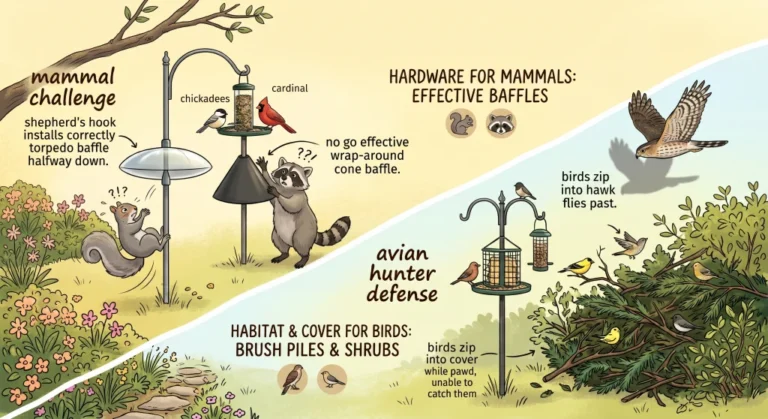
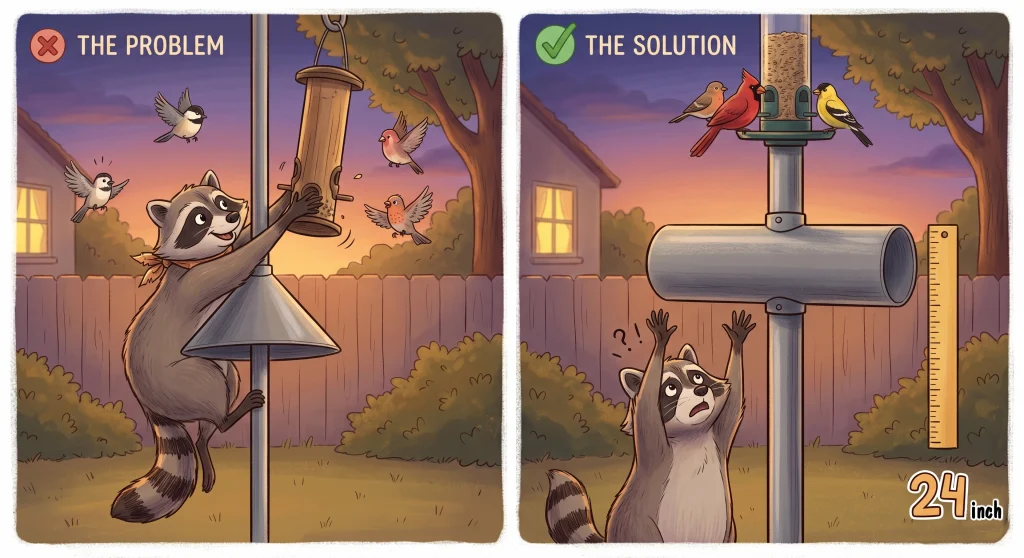
A baffle that works against squirrels is not automatically sized or positioned for a raccoon. Raccoons are larger, can wrap around narrow supports, and can use nearby structures as alternate routes. The question is not whether the product says “squirrel proof.” The question is whether it creates a smooth section the raccoon cannot get around before reaching the feeder.
Washington Department of Fish and Wildlife recommends a 24-inch-long aluminum, galvanized metal, or heavy-plastic barrier around a narrow support to prevent raccoons from climbing. It also warns that raccoons will use surrounding trees and structures to reach the area above the barrier. That second point is just as important as the length.
I would not describe a typical 16-inch squirrel baffle as guaranteed to fail, because designs vary. A wide cone, cylinder, pole diameter, mounting height, and surrounding layout all change the result. But if raccoons are already bypassing a short baffle, moving to a longer smooth barrier designed with raccoon access in mind is a more defensible upgrade than simply buying another squirrel product.
Replacing one short squirrel baffle with another while leaving a fence, tree limb, railing, or other route that reaches above it.
Using a long smooth barrier on an isolated support and checking the entire approach path for ways a raccoon can bypass the pole.
A baffle works only as part of the mounting system. If the feeder hangs from a tree that a raccoon can climb, the pole barrier is irrelevant.
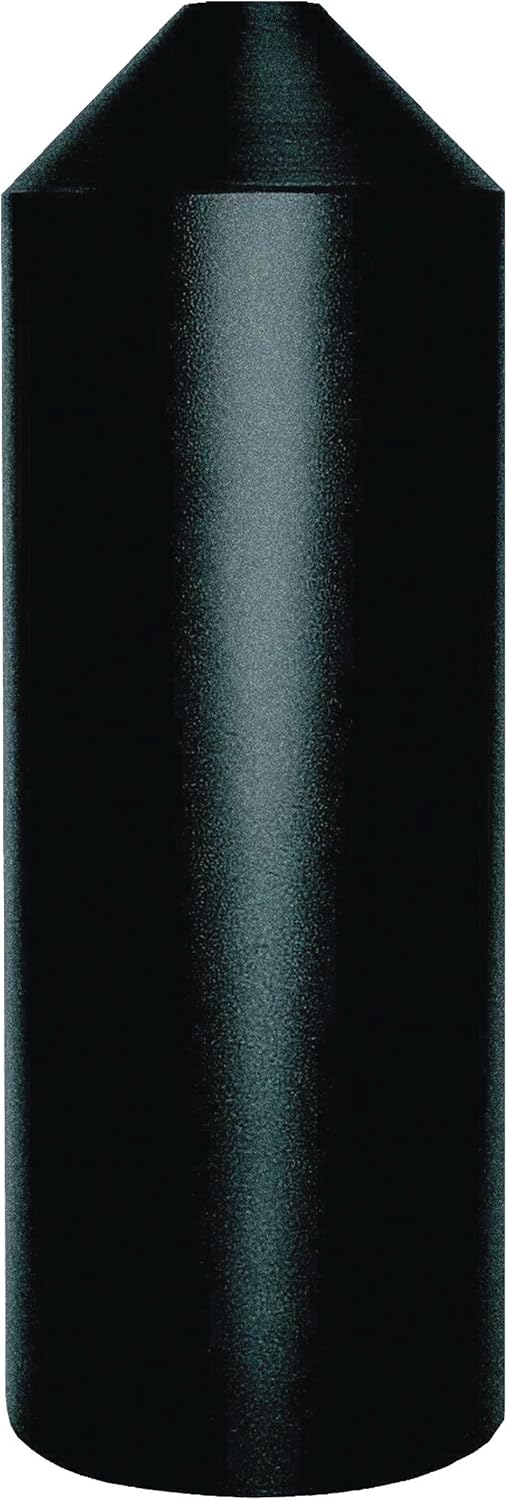
A torpedo-shaped steel squirrel baffle with a textured powder-coated finish. Measures 6.125 inches in diameter and slides onto any pole ranging from 1/2 to 1-3/8 inches in diameter via an included coupler. Easy to install - simply remove the zip tie and secure the coupler around the pole. Pole not included.
Check on AmazonIf you click this link and buy, we earn a commission at no additional cost to you.
Build the Defense Around the Access Route
I think about raccoon control in layers, but the layers are not all feeder gadgets. The most important layer is denying access to the food. The second is reducing the amount of spilled seed and other food odor around the station. Feeder design comes after those two.
| Problem | What to Address First | Useful Tool |
|---|---|---|
| Raccoon climbing a narrow feeder pole | Create a long smooth section it cannot easily climb around | About 24 inches of metal or heavy-plastic barrier as recommended by WDFW |
| Raccoon reaching from a tree, fence, or deck | Move the station or remove the alternate route | More open clearance around the feeder |
| Raccoon returning for spilled seed at night | Remove the food reward | Ground cleanup and nighttime feeder removal |
A weight-sensitive feeder may reduce seed access if a raccoon reaches the feeder, but I treat that as backup rather than primary protection. These feeders are designed mainly around squirrel-size pressure on perches or shrouds. A raccoon can pull on the body, hanger, lid, or pole instead of politely landing on the intended perch.
The stronger setup is the one that keeps the raccoon from touching the feeder in the first place. If the animal never gets above the barrier and there is no alternate path, feeder locks and spring mechanisms have much less work to do.

Weight-activated Seed Shield automatically closes feeding ports when squirrels climb on, while the Sure-Lock cap keeps the lid secure. Holds up to 4 lbs of seed with patented Flexports that are 4x more shake-resistant to reduce waste. Ladder-style perch pads welcome both small and large birds like cardinals and blue jays.
Check on AmazonIf you click this link and buy, we earn a commission at no additional cost to you.
Using a 24-Inch Pole Barrier Correctly
The strongest dimension I found for raccoon pole protection comes from Washington Department of Fish and Wildlife: a 24-inch-long section of aluminum or galvanized vent pipe can serve as a barrier around a narrow support. A smooth heavy-plastic barrier can serve the same basic purpose.
I would not call 24 inches a magic reach limit. Raccoons vary in size, the feeder pole varies in diameter, and mounting geometry matters. Think of the 24-inch figure as a field-tested barrier length from a wildlife agency, not proof that every raccoon has the same maximum reach.
Installation should follow the hardware manufacturer’s instructions and the actual layout of the yard. The barrier needs to cover the section a raccoon would otherwise climb, remain stable on the pole, and leave no rough hardware, nearby branch, fence, or railing that allows the animal to get above it.
- Use a pole and ground mount sturdy enough for the feeder load and for wildlife pushing against the system.
- Use a smooth barrier roughly 24 inches long when raccoons are the target, rather than assuming a small squirrel baffle is equivalent.
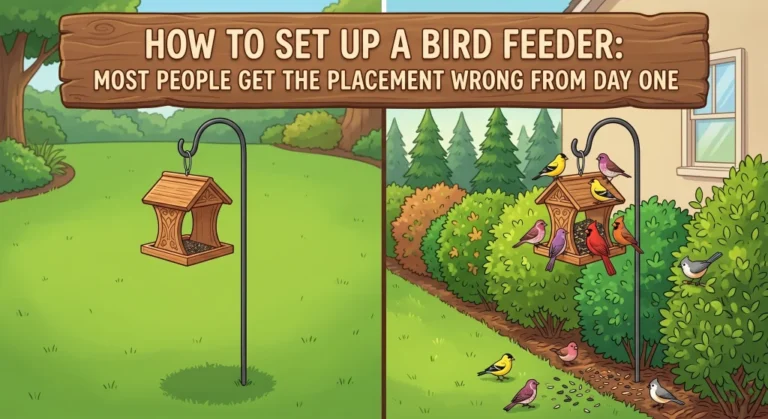
- Position the barrier high enough that the raccoon cannot simply reach above it from the ground or another foothold. Follow the baffle manufacturer’s mounting guidance rather than relying on one universal height.
- Keep the feeder away from trees, fences, roofs, railings, and other structures that let a raccoon bypass the protected section.
If the required isolation is impossible in your yard, that is useful information. It means the better solution may be changing your daily feeding routine instead of adding more hardware.

Standing 80 inches tall at 1 inch in diameter, this pole features a twist-in ground socket for secure anchoring in any soil type. A 3.75 by 5.625 inch mounting flange at the top supports large, heavy birdhouses and feeders with added stability. The ground socket inner diameter of 1 and 1/32 inches fits the pole precisely for a snug, wobble-free fit.
Check on AmazonIf you click this link and buy, we earn a commission at no additional cost to you.
Why Securing the Lid Is Only Secondary Protection
A tight lid is worth having because it reduces easy access to seed. It just does not solve the access problem by itself. Raccoons can manipulate fasteners, and Washington wildlife guidance specifically notes their ability to open different latches and containers.
Even when a lid stays closed, an animal that can physically reach the feeder can pull on the hanger, tip a tray, shake loose seed, or damage the body. I would rather spend effort preventing contact with the feeder than trying to invent an increasingly complicated lid puzzle.
Use the feeder’s intended latch or a secure manufacturer-compatible closure. Avoid loose wires, exposed sharp hardware, or improvised traps that could injure birds or mammals. If raccoons are getting to the feeder despite the lid, fix the pole, the alternate access route, or the availability of the feeder after dark.
When Hardware Is Not Practical: Remove the Food Reward
If your feeder hangs from a climbable tree or the yard is too tight to isolate a pole, removing access to the food is often simpler than trying to defeat the animal mechanically. Wisconsin DNR’s nuisance-raccoon guidance emphasizes removing food sources and placing bird feeders where raccoons cannot access them.
Pro Tip: If the damage happens at night, bring the feeder into a secure building or wildlife-resistant storage area before dark, clean up spilled seed underneath, and put the feeder back out early enough for daytime birds.
Raccoons are primarily nocturnal, so nighttime removal directly targets the period when many feeder raids occur. But I would not call this an absolute guarantee. Wisconsin DNR notes that raccoons may also forage during the day, and seeing one in daylight does not automatically mean it is sick.
Removing spilled seed matters as much as removing the hanging feeder. If the ground remains covered with sunflower kernels, suet crumbs, or other food, the yard can still reward a raccoon even when the feeder is indoors. Clean the station regularly and secure nearby pet food, garbage, or other attractants too.
This same attractant-removal principle is useful when dealing with other bird feeder predators. If a wild mammal is repeatedly rewarded with food, making the reward unavailable is usually more dependable than trying to scare it away.
If a raccoon is unusually bold, appears injured, is staggering, is behaving aggressively, or creates a safety concern around people or pets, contact your local wildlife agency or animal-control authority rather than approaching it.
Final Thoughts: Stop Access Before Reinforcing the Feeder
For raccoons, I would start lower down the system. A 24-inch smooth pole barrier has direct support from Washington Department of Fish and Wildlife, but it only helps when the raccoon has to climb that protected support. Nearby trees, fences, decks, and other structures can defeat the entire idea.
When you cannot create that setup, remove the feeder during the period when raids are occurring and clean up the seed underneath. A stronger lid or weight-sensitive feeder can add resistance, but neither is a substitute for denying access to the food.
The useful question is not, “What feeder can a raccoon never break?” It is, “How is the raccoon reaching the reward?” Fix that route first.

Wagner's Four Season Sunflower Seed is 100% black oil sunflower seed. Sunflower seed is the favorite seed of most wild birds. It is high in energy and has a thin shell making it easy for all birds to consume. Use tray feeders or hopper feeders to attract sunflower loving songbirds. Cardinals, Chickadees, Finches, Nuthatches, Woodpeckers and much more. Trust your backyard birds to the experts at Wagner’s.
Check on AmazonIf you click this link and buy, we earn a commission at no additional cost to you.
FAQs
🦝 Will hot pepper bird seed stop raccoons?
I would not rely on hot-pepper seed as a raccoon-control method. Capsaicin-treated birdseed is mainly marketed around squirrel deterrence, while raccoon tolerance, hunger, and access can vary. If raccoons are damaging equipment, a physical barrier or removing the food reward is a more predictable solution.
🌙 Do raccoons visit bird feeders during the day?
Yes, they can. Raccoons are generally more active at night, but Wisconsin DNR specifically notes that it is not uncommon to see them searching for food during the day. Daytime activity by itself is not proof of rabies or another illness.
🌳 Can I hang my feeder from a tree to keep it safe?
A tree usually makes raccoon exclusion harder because raccoons are strong climbers. Washington Department of Fish and Wildlife notes that they can use surrounding trees and structures to reach above a pole barrier. An isolated pole is much easier to protect than a feeder hanging from a climbable branch.
🧴 Should I grease my bird feeder pole?
No. Grease and petroleum jelly can transfer to birds that touch the pole or nearby hardware and can mat or contaminate feathers. Use a smooth physical barrier instead of coating surfaces birds may contact.
📏 How high off the ground should my baffle be?
There is no single height that works for every raccoon baffle and pole. The protected section needs to start high enough that the animal cannot simply reach above it from the ground or another foothold, and nearby structures must not bypass it. Use the manufacturer’s mounting instructions together with the 24-inch barrier length recommended by Washington Department of Fish and Wildlife.