Why Feeder Windows Need Special Attention
If you are wondering how to prevent bird feeder window strikes, you are dealing with one of the biggest human-caused hazards birds face around homes. Current U.S. Fish and Wildlife Service guidance puts the national toll from glass collisions at more than one billion birds each year, with homes and other low-rise buildings responsible for a large share of the problem. A feeder does not cause glass to become dangerous, but it brings more birds into the flight paths around nearby windows.
At the store, people sometimes came in after hearing that unmistakable thud against a sliding door or picture window. The instinct was often to blame the feeder and take it down. I would rather start by looking at the window itself, the feeder distance, and what the glass reflects. In many yards, feeding can continue once the collision hazard is addressed properly.
Birds can collide with glass because they see reflected trees, sky, or vegetation as real habitat, or because they see a clear route through transparent glass. A startled bird leaving a feeder may make that mistake at speed. Reflections are a major issue, but they are not the only mechanism, which is why the strongest fixes make the entire glass surface visibly solid to a bird rather than trying to scare it with one object.
Warning: A bird that flies away after a window strike can still have serious internal injuries. Current collision guidance recommends treating a stunned window-strike bird as injured: contain it safely if you can, keep it dark and quiet, do not give food or water, and contact a permitted wildlife rehabilitator for instructions.
Why Closer Can Actually Be Safer
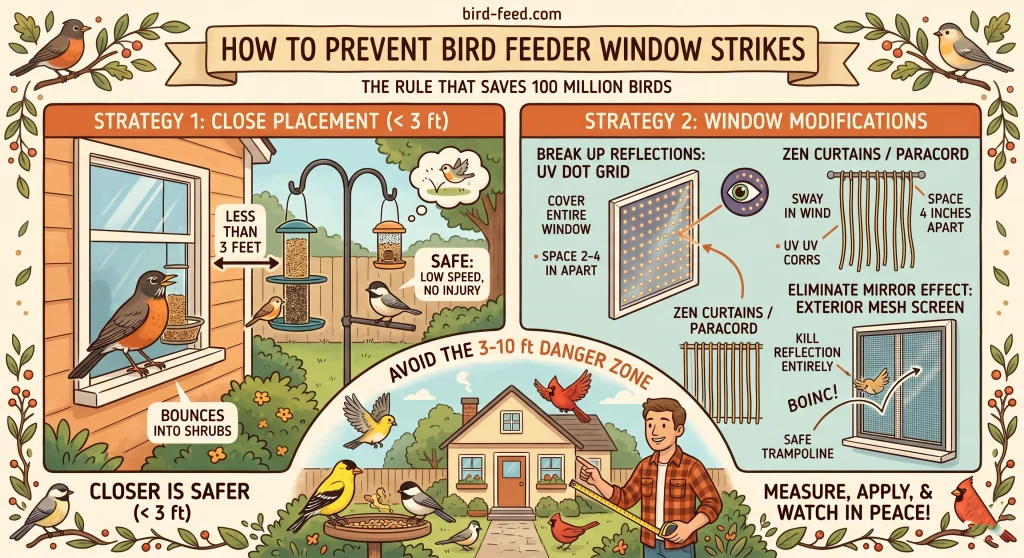
Most people assume that moving a feeder a few extra feet away from the house must reduce collision risk. That sounds reasonable, but feeder placement research and current Cornell, Audubon, and U.S. Fish and Wildlife guidance support a counterintuitive rule of thumb: feeders are safer when they are very close to a window, generally within about three feet, or much farther away, around thirty feet or more.
When you are figuring out how to set up a bird feeder, the close option can be especially practical. A bird leaving a feeder only a foot or two from the glass has less distance to accelerate before a collision. That does not make an untreated window harmless, and it does not guarantee that every impact will be minor, so I would still treat a window that has a history of strikes.
This is one of those recommendations that sounds wrong until you understand what it is trying to control. The close placement reduces the speed a bird can build after leaving the feeder. The far placement increases separation between the feeder activity and the glass. Neither distance replaces a visible exterior treatment on a known problem window.
Moving a feeder a few feet away from the glass and assuming that any extra distance automatically makes the window safer.
Use the three-or-thirty rule as a starting point, then treat any window that has produced collisions with a dense exterior pattern, screen, or other proven solution.
The 3-to-30-Foot Middle Zone
The placement range I would be most cautious about is the broad middle between a close feeder and a genuinely distant one. A feeder five, ten, or twenty feet from reflective glass can give a startled bird substantial room to accelerate while still keeping the window directly in the feeder’s immediate flight environment.
That does not mean every feeder between three and thirty feet will cause a collision, or that a feeder at thirty-one feet is magically safe. Window size, reflections, nearby vegetation, weather, lighting, and the directions birds use when leaving the feeder all matter. The distance rule is a practical risk-reduction tool, not a hard biological boundary.
If your feeder is currently several feet from a sliding door or large reflective window and you have already had strikes, I would not simply move it from six feet to twelve feet and call the problem fixed. Either bring it into the close zone, move it substantially farther away if the yard allows, or leave the feeder where it works and make the glass bird-visible. Good bird feeder tips should reduce the hazard you can actually observe, not just satisfy a measurement.
Field Note: When someone described repeat strikes near a feeder, I found it more useful to ask which exact pane was being hit and how far the feeder sat from it than to assume the entire feeding station had to move. Treating the problem pane and adjusting that one flight path is often more practical than rebuilding the whole yard.

A clear perforated vinyl bird collision tape that is 85% effective at preventing bird-window strikes. Reduces outdoor reflections to make glass visible to birds while remaining subtle enough to preserve your view and curb appeal. One 40-foot roll covers 2 to 3 windows. Apply to exterior glass surfaces - no tools needed, one-time installation that lasts for years.
Check on AmazonIf you click this link and buy, we earn a commission at no additional cost to you.
Window Decals: Patterns That Actually Work
Sometimes moving the feeder is impractical, and on a window that has already caused collisions I prefer not to rely on distance alone anyway. The goal of a window treatment is to make the glass read as a barrier across the whole dangerous surface.
A single hawk silhouette in the middle of a large window is not enough. Birds can simply steer around one isolated shape and fly toward the untreated reflection beside it. The effectiveness comes from the pattern, visibility, spacing, and placement on the exterior surface.
- Put the treatment on the outside: Exterior markings interrupt the reflection where the bird sees it. Interior treatments can be hidden by strong exterior reflections, although closing blinds or curtains at night still helps reduce light escaping during migration.
- Use tight spacing: A two-inch by two-inch grid is the safest general rule for small birds. Cornell and U.S. Fish and Wildlife guidance recommend markings about two inches apart across the entire glass surface. One or two decals, or large untreated gaps, are not enough.
- Choose visibility over novelty: Dots, tape, paint, decals, or other visible exterior markers can work when the spacing is correct. UV products can work for some songbirds, but their visibility changes with UV light levels and not all birds see ultraviolet well. A visible, high-contrast pattern is easier to evaluate under changing light.

A pack of 30 semi-transparent dot-pattern static-cling decals, each approximately 1.25 inches across, that prevent birds from flying into windows and sliding doors. UV-reflective material appears as a glowing warning to birds while looking like frosted glass to humans. Apply to clean exterior glass surfaces. Made in the USA.
Check on AmazonIf you click this link and buy, we earn a commission at no additional cost to you.
Exterior Screens and Films
If you do not want a dot or tape pattern on the glass, exterior screens are one of the strongest home options. American Bird Conservancy notes that external insect screens can virtually eliminate reflections, and Cornell also lists exterior screens as highly effective when they cover the full problem surface.
A normal exterior insect screen can make the glass much easier for birds to perceive. If you are installing netting specifically as a collision barrier rather than using a fitted window screen, Cornell recommends keeping it taut and separated from the glass by a few inches so a bird can hit the flexible barrier instead of the hard pane and so loose material does not create an entanglement hazard.
Another proven option is an Acopian-style cord curtain, often called a Zen curtain or BirdSavers. The vertical cords hang outside the window and create a visual barrier. These cords can be spaced farther apart than small dots because the vertical lines are much more conspicuous; current U.S. Fish and Wildlife guidance uses spacing under four inches for paracord curtains.
| Barrier Type | How It Works | Approximate Cost |
|---|---|---|
| Exterior Dot or Tape Pattern | Makes the full glass surface visible when markers follow tight spacing | Varies by window size and product |
| Exterior Bug Screen | Reduces reflection and creates a softer barrier in front of the glass | Varies by window and whether the screen is custom |
| Zen Curtains / Paracord | Creates closely spaced vertical lines that birds perceive as a barrier | Low-cost DIY or higher for pre-made systems |

A military-grade Type IV nylon paracord with 550 lbs of certified strength. Built for survival kits, camping, tactical gear, and DIY projects including bracelets, lanyards, and gear ties. Engineered to withstand extreme conditions. Made in the USA.
Check on AmazonIf you click this link and buy, we earn a commission at no additional cost to you.
Final Thoughts: Fix the Glass, Not Just the Feeder
You do not have to choose between feeding backyard birds and reducing window strikes. Start with feeder distance: very close to the window, generally within about three feet, or substantially farther away, around thirty feet or more. If one pane has already caused a collision, treat that glass rather than trusting distance alone.
For the glass itself, the most dependable home fixes are visible exterior treatments with tight spacing, full exterior screens, or properly spaced cord systems. The key is covering the whole hazardous surface so a bird does not see an apparent opening between a few scattered stickers.
Night lighting is a related but different part of the collision problem. Many birds migrate at night, and artificial light can draw or disorient them around buildings during spring and fall migration. Turn off unnecessary indoor and outdoor lights, use shielded exterior lighting, and close curtains or blinds at night to reduce light spill. You do not need an arbitrary 11 PM cutoff; reducing unnecessary light through the night is the more useful habit.
If you hear another collision after making a change, do not assume the treatment has failed or that the bird was simply careless. Recheck the exact impact area, reflections at that time of day, and any untreated gaps. Window safety is one of the rare backyard bird problems where a visible change to the environment can directly reduce a preventable hazard.

A UV-reflective liquid that prevents birds from flying into windows and sliding doors. Applied as dots on exterior glass using a bingo marker, the liquid dries virtually clear and is easy to remove. Designed to fill gaps between window decals for complete coverage. Each 1-oz bottle lasts three months. Made in the USA.
Check on AmazonIf you click this link and buy, we earn a commission at no additional cost to you.
FAQs
🦉 Will a plastic owl stop birds from hitting the window?
Do not rely on a plastic owl or a single predator silhouette for window-strike prevention. The proven approach is to make the glass itself visible with a properly spaced exterior pattern, screen, cord system, or another tested treatment.
🪟 Does closing the blinds inside the house help?
Interior blinds can reduce some visual cues and are useful for reducing light spill at night, but they may not overcome strong daytime reflections on the outside of the glass. For a daytime collision window, an exterior treatment is the more reliable fix.
📏 Does the height of the feeder matter for window strikes?
Distance from hazardous glass and whether that glass is visibly treated are more useful factors than a simple feeder-height rule. A feeder at any height can be associated with strikes if birds leaving it fly toward untreated reflective or transparent glass.
🩹 What should I do if a bird hits the glass and is stunned?
Treat a stunned window-strike bird as potentially injured. If you can safely capture it, place it gently in a small ventilated box or paper bag in a dark, quiet place, keep pets and people away, and do not give it food or water. Contact a permitted wildlife rehabilitator for instructions, even if the bird later appears alert enough to fly.