Safflower vs. Sunflower: The Cardinal’s Perspective
If your goal is simply to attract Northern Cardinals, black oil sunflower is hard to beat. Cornell lists it among the seeds Cardinals commonly eat, and Audubon reports that black oil sunflower ranks ahead of safflower in Cardinal feeder preference. Its relatively thin shell also makes the kernel easy for many feeder birds to access.
Safflower works differently. Cornell describes it as a thick-shelled seed that is a favorite among Cardinals, while also noting that some House Sparrows, European Starlings, and squirrels tend not to like it as much. The important word is some. Cornell also notes that squirrels in certain areas appear to develop a taste for safflower, so I would never sell it as squirrel-proof seed.
That gives the two foods different jobs. Sunflower is the stronger general attraction. Safflower can be useful when you want to keep feeding Cardinals while making the feeder less rewarding to some of the animals that dominate sunflower. If your sunflower feeder is already calm and Cardinals are getting plenty of access, there may be no reason to switch at all.
The Second-Choice Reality (And How to Handle It)
Safflower can sit untouched when a yard has been offering a food the birds prefer more strongly. Audubon’s current Cardinal feeding information supports that general pattern: black oil sunflower ranks ahead of safflower as a feeder food for Northern Cardinals. That does not mean every individual Cardinal will make the same choice every time, but it explains why an immediate switch can reduce traffic.
I do not use a fixed two-week or three-week acceptance rule because I have never seen good evidence for one. Feeder use changes with the birds already present, natural food availability, season, feeder placement, and what other foods remain available nearby. A quiet safflower feeder after three days tells you very little by itself.
Field Note: When someone told me safflower “didn’t work,” I would first ask what else was still available in the yard. If a nearby feeder was full of sunflower, the comparison was not really safflower versus nothing. It was safflower versus a food the same Cardinals may prefer. That is a much tougher test for the new seed.
If you want to transition rather than switch abruptly, mix in a modest amount of safflower and watch actual use. Increase it only if Cardinals are taking it and the feeder traffic still looks healthy. There is no need to force a 25/75 formula or follow a rigid month-long schedule. The useful signal is whether the target birds are eating the safflower while the unwanted traffic becomes easier to manage.

A premium safflower seed that attracts cardinals, chickadees, titmice, and grosbeaks while naturally deterring squirrels, grackles, and starlings. Its bitter taste keeps unwanted visitors away without any extra effort. Can be used alone or gradually mixed with other seed blends to transition your feeder to a more desirable bird-friendly environment.
Check on AmazonIf you click this link and buy, we earn a commission at no additional cost to you.
When Serving Safflower Alone Makes Sense
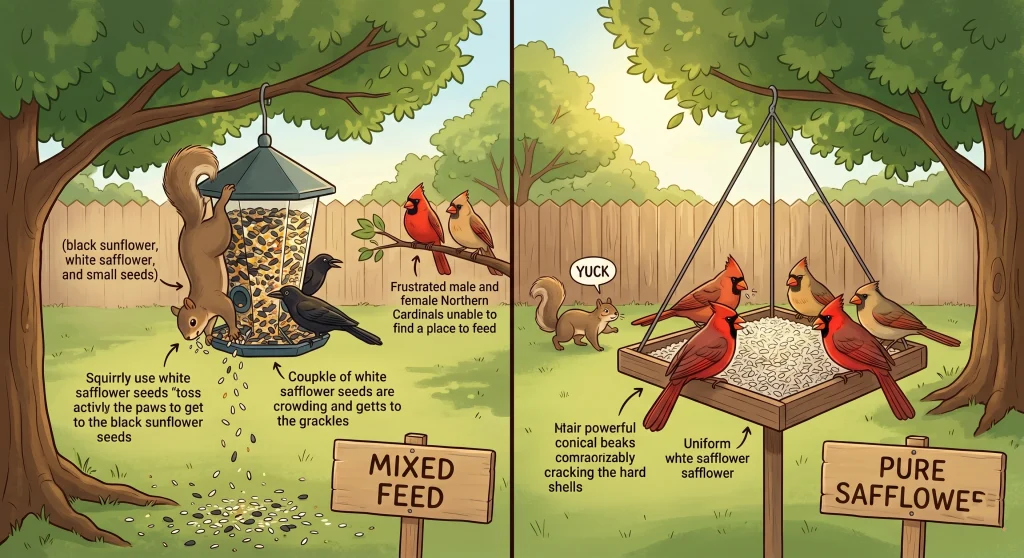
When people ask how to evaluate the best bird seed for a specific yard problem, I separate attraction from deterrence. A mixed feeder containing sunflower, peanuts, and safflower can still attract squirrels and larger flocking birds because the foods they want are still present.
That is the strongest reason to test safflower by itself. If your goal is to learn whether safflower reduces competition, a dedicated feeder gives you a clean test. You can see which birds actually use safflower instead of watching squirrels sort through a mix for sunflower and peanuts.
Expecting safflower to deter squirrels or blackbirds while the same feeder is still offering sunflower, peanuts, or other foods they readily eat.
Testing plain safflower in one suitable feeder and comparing the visitors, seed turnover, and Cardinal use with your previous setup.
I would not turn that into an absolute rule that safflower must always be served alone. Cornell and university-extension feeding information include safflower in mixed feeding recommendations, and Cardinals can use those mixes perfectly well. Serving it alone is most useful when deterrence is the reason you bought safflower in the first place.
If you still want to offer sunflower for chickadees, finches, or other birds, a separate feeder can make the experiment easier to read. Just remember that squirrels and flocking birds may still visit the yard for that other feeder, so separation does not create a pest-free zone.

A large hopper bird feeder made from 100% recycled materials with a weather-resistant finish. Holds up to 6 lbs of seed and 2 suet cakes, with a large perching area for multiple birds. Features a roof to keep seed dry, drainage holes, and a seed diverter to prevent moisture buildup. Includes a built-in socket for pole mounting.
Check on AmazonIf you click this link and buy, we earn a commission at no additional cost to you.
Understanding the Squirrel Deterrence Bonus
Safflower has a real reputation for reducing squirrel pressure, but I would describe the effect as preference rather than repulsion. Cornell says that according to some sources squirrels do not like safflower, while also noting that squirrels in some places seem to have developed a taste for it.
The same caution applies to blackbirds. Cornell suggests that safflower and striped sunflower, both with relatively hard shells, can make feeding more difficult for grackles and other blackbirds. That can reduce how quickly they dominate a feeder, but it does not mean every grackle or starling will refuse safflower.
This is why I like safflower as one layer of a setup rather than the entire defense. If it reduces traffic from the animals causing the problem, great. If a persistent squirrel keeps eating it, the seed has reached the limit of what preference can accomplish.
For a deeper look at that tradeoff, safflower bird seed covers which visitors tend to use it and where the deterrent effect becomes unreliable. If squirrels are still taking over the feeder, a baffle or genuinely squirrel-resistant feeder is more predictable than changing food repeatedly.

A large all-metal mesh bird feeder with a circular seed tray that accommodates up to 15 birds at once. The mesh surface is ideal for clinging birds while the tray suits perching birds, attracting cardinals, grosbeaks, finches, chickadees, and more. Holds up to 2.5 lbs of black oil sunflower seed. Zinc-plated finish resists rust and squirrel damage. Features a large overhang for shelter and a built-in hanging hook. Collapses flat for compact storage.
Check on AmazonIf you click this link and buy, we earn a commission at no additional cost to you.
The Cost Trade-Off: Is Safflower Worth the Higher Price?
Safflower often costs more than black oil sunflower, but price per pound does not tell you whether it is the better buy for your yard. What matters is how much of the seed goes to the birds you intended to feed, how much gets scattered or stolen, and whether the change actually solves a problem.
If squirrels were emptying a sunflower feeder every day and they largely ignore your safflower, the more expensive bag may last longer. In that specific yard, the effective cost can improve. If the squirrels eat safflower too, or if the Cardinals barely use it, the higher price buys you very little.
I would test a smaller bag before committing to bulk safflower. Track how quickly the feeder empties and who is eating from it for several refill cycles. That tells you far more than a blanket claim that safflower always saves money in the long run.
Choosing the Right Feeder for Safflower
Cardinals have large, strong bills that handle hard seeds well, and Cornell specifically recommends tray and hopper feeders for offering safflower to Cardinals and grosbeaks. Those feeder styles also give a Cardinal a broad, stable place to land and feed.
That does not mean Cardinals are physically incapable of using tube feeders. They can use many feeder designs when the perch, tray, or port arrangement gives them enough room. The practical issue is comfort and access, not an anatomical inability to twist their bodies.
Understanding that preference helps when learning how to attract Cardinals consistently. If a tube feeder has tiny perches and narrow ports, it may be a poor choice for both the bird and a relatively large seed. A hopper, platform, or tube feeder with a generous tray may work much better.
| Feeder Type | Safflower Compatibility | Cardinal Use |
|---|---|---|
| Broad Hopper Feeder | Excellent for whole safflower | Strong choice because Cardinals commonly use hopper feeders |
| Platform / Tray Feeder | Excellent, with good drainage and small fresh fills | Strong choice because it provides a broad landing area |
| Standard Tube Feeder | Depends on port size and seed flow | Can work if the perch or tray gives Cardinals enough room |
| Window Feeder | Usually workable in a tray-style design | Depends on tray size, placement, and whether Cardinals use that location |
Start with the feeder Cardinals are already comfortable using if you have one. Changing both the seed and the feeder at the same time makes it harder to tell which change caused a drop in visits.
Final Thoughts: Use Safflower for the Problem It Actually Solves
If your only goal is maximum Cardinal attraction, I would start with black oil sunflower. If your Cardinals are being crowded out by squirrels or certain flocking birds, safflower becomes more interesting because it may keep the Cardinals feeding while reducing some of that competition.
Test it instead of treating the marketing claim as a guarantee. Use a feeder Cardinals can access comfortably, offer a small fresh amount, and watch which animals actually eat it. If the unwanted visitors lose interest and Cardinals keep feeding, safflower is doing useful work in your yard.
If nothing improves, move on without forcing the strategy. Safflower is a food preference tool, not a chemical repellent and not a substitute for physical squirrel control when a determined squirrel decides to eat it.

A premium quality safflower seed that attracts cardinals, rose-breasted grosbeaks, and other wild birds while naturally deterring squirrels. Always fresh and clean. Made in the USA.
Check on AmazonIf you click this link and buy, we earn a commission at no additional cost to you.
FAQs
🐦 Do Cardinals actually eat safflower seed?
Yes. Cornell describes safflower as a favorite among Cardinals, and Audubon includes it among the foods Northern Cardinals will eat at feeders. Black oil sunflower generally has the stronger preference signal, so safflower is especially useful when reducing competition matters as much as attracting Cardinals.
🚫 Should I mix safflower with sunflower seeds?
You can, but mixing the two weakens the usefulness of safflower as a deterrence test because squirrels and other birds can still target the sunflower. If your main reason for buying safflower is to reduce unwanted feeder traffic, try it alone in one feeder and compare the result.
⏳ How long does it take for birds to get used to it?
There is no reliable universal number of days or weeks. Some Cardinals may use safflower quickly, while feeder traffic in another yard may stay low because sunflower or natural foods are more attractive. Introduce a small amount and judge the change over several refill cycles rather than waiting for a fixed deadline.
🐿️ Are squirrels guaranteed to stay away?
No. Cornell notes that squirrels often dislike safflower, but squirrels in some areas appear to have developed a taste for it. Treat safflower as a possible reduction in squirrel pressure, not as a squirrel-proof food.
🏠 Can I put it in a standard tube feeder?
Yes, if the ports handle the seed and the feeder provides enough room for Cardinals to perch comfortably. Cornell particularly recommends tray and hopper feeders for Cardinals eating safflower, but a suitable tube feeder can still work.