The One Buying Mistake That Keeps Feeders Empty
If you are standing in the store trying to find the best suet for birds, the wall of labels can make the choice look more complicated than it is. Peanut, berry, insect, plain, and no-melt cakes are often presented as if each one has a precise target bird. In practice, the first question I would ask is simpler: will this cake stay fresh and firm in the weather where you plan to hang it?
That matters because suet is a fat-based food. Traditional rendered suet is especially useful in cool weather, but it can soften as temperatures rise. Cornell Lab guidance notes that suet is particularly attractive to woodpeckers, nuthatches, chickadees, jays, and starlings, with several other species visiting occasionally. The ingredient list may influence what shows up, but no flavor guarantees a particular bird.
At the store, the useful conversation was rarely “Which flavor is best?” It was more often “What birds are already in your yard, how warm is it outside, and did the last cake stay firm?” That same approach works when choosing the best bird seed for a feeder: start with the feeding conditions, then watch what your local birds actually accept.
The Five Main Flavor Profiles
Commercial suet labels are not standardized biological categories, but most cakes fall into a few familiar groups. Thinking of them as recipe styles rather than species-specific formulas makes shopping much easier.
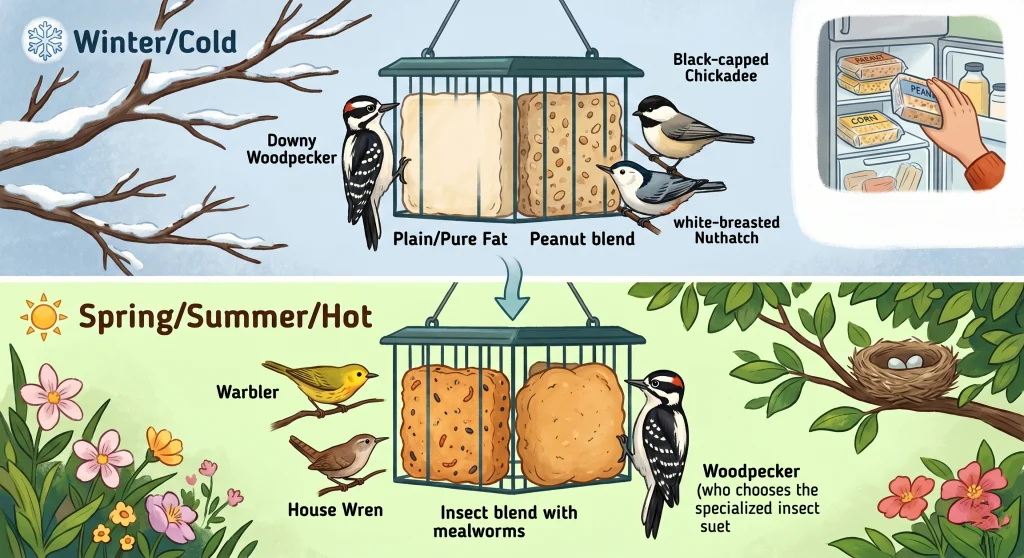
Plain or traditional suet is the simplest version. It is based mainly on rendered animal fat, sometimes with dry ingredients added for structure. It is a strong cool-weather starting point because fat is energy-dense and the lower temperature helps the cake stay firm.
Peanut or nut blends add chopped nuts, peanut meal, peanut butter, or similar ingredients. These are commonly used by woodpeckers, chickadees, nuthatches, and other birds that already visit suet feeders. I would choose a peanut blend because the birds in my yard use it, not because the word “peanut” guarantees a wider species list.
Insect blends usually contain dried mealworms, crickets, or insect meal along with the fat and dry ingredients. They can be worth trying if your local birds already take suet, but dried insects do not automatically turn a cake into a spring or summer necessity. In warm weather, the more important question is whether the entire cake remains firm and fresh.
Fruit or berry blends add dried fruit, fruit pieces, or flavoring. Some individual birds may prefer them, but I would not buy one expecting robins or mockingbirds to suddenly become regular suet visitors. Cornell lists some species, including cardinals and warblers, as occasional suet users, which is a good reminder that feeder behavior varies.
No-melt or hot-weather dough is the fifth common category. This label describes physical performance more than flavor. These cakes are formulated to stay firmer at higher temperatures than ordinary suet, although “no-melt” does not mean “cannot soften or spoil.”
A practical buying rule is:
- Choose traditional or nut-based suet when temperatures are cool and you want a simple starting point.
- Try insect or fruit blends as preference tests, not as guaranteed species attractants.
- Choose a heat-stable formula only when the package is intended for the temperatures you expect.
- Remove any cake that becomes soft, greasy, rancid-smelling, moldy, or otherwise spoiled.
The label gets you into the right part of the shelf. The birds and the weather tell you whether you bought the right cake.

A no-melt suet dough made with beef suet and roasted peanut pieces, staying solid up to 100F for year-round use in any climate. Fully consumable with no shells or waste, keeping feeders clean. Rich in healthy fats and protein to support daily activity, nesting, and migration. Attracts woodpeckers, nuthatches, chickadees, wrens, and other songbirds. Made in the USA.
Check on AmazonIf you click this link and buy, we earn a commission at no additional cost to you.
The Seasonal Transition Strategy
Cold weather is where traditional suet is easiest to manage. Rendered fat stays firm, and its high energy density makes it an especially useful supplemental food during winter. Woodpeckers, nuthatches, chickadees, and other regular suet visitors can use it without the soft, oily mess that becomes a concern in heat.
Spring and summer require more judgment. Cornell warns that softened suet can coat belly feathers, and that grease transferred from an incubating bird’s plumage may clog tiny pores in eggs and interfere with gas exchange. The lesson is not that every cake must disappear on the first warm day. It is that any suet that is becoming soft or oily is no longer a good choice.
That also means insect flavor is not a safety solution by itself. A cake containing mealworms can soften just like another cake if the fat base cannot handle the temperature. A no-melt formulation may extend the useful season, but Cornell also cautions that even heat-stable commercial cakes can soften or become rancid during prolonged high heat.
| Suet Type | Best Use | What to Watch |
|---|---|---|
| Plain / Traditional Rendered Suet | Cool weather | Excellent simple option when it stays firm; remove if it softens or smells rancid. |
| Peanut / Nut Blend | Cool weather or mild conditions | Popular with many regular suet visitors; follow package storage instructions and keep it fresh. |
| Insect Blend | Preference test for suet-eating birds | The insect label does not make the cake heat-safe; judge the complete formula. |
| Fruit / Berry Blend | Preference test | Bird response varies; do not expect a reliable fruit-eating species match. |
| No-Melt / Hot-Weather Dough | Warmer conditions within product limits | Still monitor for softness, oiliness, rancid odor, mold, and prolonged extreme heat. |
This is a more useful seasonal system than rotating flavors by the calendar. Temperature determines whether the fat is physically safe to offer; local bird preference determines whether the recipe is worth buying again.
Protein-packed blend of dried mealworms, crickets, ground peanuts, and corn to attract a wide variety of songbirds and wild birds. High energy formula perfect for year-round feeding.
Check on AmazonIf you click this link and buy, we earn a commission at no additional cost to you.
Understanding the No-Melt Category
If you live where ordinary cakes soften quickly, no-melt suet for birds can be useful. Just read the claim as “more heat-stable than ordinary suet,” not as a promise that the cake can sit indefinitely in any summer condition.
Formulas vary by manufacturer. Cornell notes that some prepackaged no-melt cakes are rendered multiple times so they remain solid at higher temperatures. Other commercial recipes also use dry ingredients that change the texture and firmness. That is why two products carrying the same no-melt label can feel very different in the hand and perform differently in direct sun.
The practical test is straightforward. Keep the feeder in shade when possible, check the cake during hot spells, and remove it if the surface becomes greasy or the food develops an off odor or visible spoilage. A product that stays physically solid can still age, become rancid, or grow mold.
Some birds may also take time to accept a denser or drier dough after being accustomed to a softer cake. That is a preference issue, not proof that the formula is nutritionally wrong. If you want the broader context for when fat-based foods make sense, the section on suet for birds covers the basic role of suet at a feeding station.
The Storage Rule for Suet Food Safety
Buying several cakes at once can be convenient, but storage advice should match the product instead of following one blanket refrigerator rule. Unopened commercial cakes may have specific shelf-stable storage instructions, while homemade mixtures and opened products need more cautious handling.
Cornell specifically notes that corn, cornmeal, and peanuts can provide a growth medium for harmful bacteria and says it may be prudent to keep suet cakes containing those ingredients refrigerated until use. That is a good conservative habit when the package does not tell you otherwise, especially if your alternative is a hot, humid garage.
Field Note: When customers asked whether a bulk case could sit in a hot shed all summer, I never treated the plastic wrapper as a magic shield. I would check the storage directions first and choose the coolest, driest practical location. If a cake smelled off, showed mold, or had leaked oil through the package, it was not worth putting in front of birds.
The same rule applies after a cake goes outside. Heat, moisture, and time matter more than whether the package originally looked shelf-stable. Keep only as much food out as birds are using at a reasonable pace, and discard spoiled material rather than trying to rescue it.
Wrong approach:
Assuming every wrapped suet cake can sit for months in a hot garage because it was sold at room temperature.
Right approach:
Following the manufacturer’s storage directions, keeping corn- or peanut-heavy cakes cool when practical, and refrigerating or freezing extra cakes when the product instructions allow it.
Storage is not complicated, but it is worth taking seriously. Fresh food and a clean feeder do more for birds than a clever flavor name on an old cake.

Metal cage with 1.5 inch openings lets woodpeckers and small birds feed safely while blocking squirrels. Anti-rust powder coat finish holds up to rain, snow, and chewing year-round. Holds 2 suet cakes, removable roof for easy refilling, and a 9.8 inch top baffle plus bottom baffle to keep things clean and dry. A great gift for any bird lover!
Check on AmazonIf you click this link and buy, we earn a commission at no additional cost to you.
Final Thoughts on Choosing Suet
Choosing suet gets easier once you stop treating flavor names as precise bird-targeting tools. In cool weather, a fresh traditional or peanut-based cake is a sensible first buy for the species that commonly use suet. If you want to test fruit or insect ingredients, do it because your local birds respond to them, not because the label guarantees a robin, warbler, or bluebird.
When temperatures rise, let the condition of the cake make the decision. A heat-stable formula can be useful, but no cake belongs outside once it is soft, oily, rancid, moldy, or otherwise spoiled. Shade and smaller amounts can help, but during genuinely hot weather taking suet down is a perfectly reasonable choice.
Northern Cardinals are a good example of why expectations matter. They can visit suet, but Cornell describes cardinals as occasional suet users, so I would not buy a suet setup specifically to attract them. If woodpeckers, nuthatches, or chickadees are the goal, your odds are much better.
Start with one fresh cake rather than a bulk case, watch who uses it, and learn how quickly it changes in your weather. That simple test tells you more than the flavor artwork on the wrapper, and it prevents you from stocking a freezer with twelve cakes your local birds have no interest in eating.

Real mealworms and roasted peanuts packed into a no-melt formula that stays solid up to 100F, perfect for warm weather feeding. Attracts bluebirds, sparrows, cardinals, and other insect-loving birds. More economical than traditional seeds and easy to use with any wire feeder. Made in the USA since 1986.
Check on AmazonIf you click this link and buy, we earn a commission at no additional cost to you.
FAQs
❓ Which suet attracts woodpeckers the fastest?
There is no single flavor that is guaranteed to work fastest. Woodpeckers commonly use suet, and a fresh traditional or peanut-based cake is a practical place to start in cool weather. Feeder placement, local species, and whether the birds have discovered the station can matter as much as the recipe.
🥶 Does suet go bad if it freezes in the winter?
Cold weather is generally favorable for keeping suet firm, and rendered suet is especially useful in winter. Freezing does not make an otherwise fresh cake unsafe, but it also does not make a product last forever. Follow the package storage guidance and discard any cake that shows spoilage.
🐿️ Will peanut suet attract squirrels to my feeder?
It can. Squirrels readily eat peanuts and high-fat foods, so a peanut suet cake may be attractive to them when they can reach it. If squirrels are consuming the cake, physical exclusion is more reliable than changing to another peanut-based recipe.
🔥 What happens if I leave plain suet out in the summer?
Traditional suet can soften or become rancid in hot weather. Soft fat may foul a bird’s feathers, and Cornell warns that grease on an incubating bird can be transferred to eggs and interfere with their pores. If a cake is soft, oily, or spoiled, remove it rather than leaving it out because birds are still visiting.