Does Safflower Seed Actually Deter Squirrels?
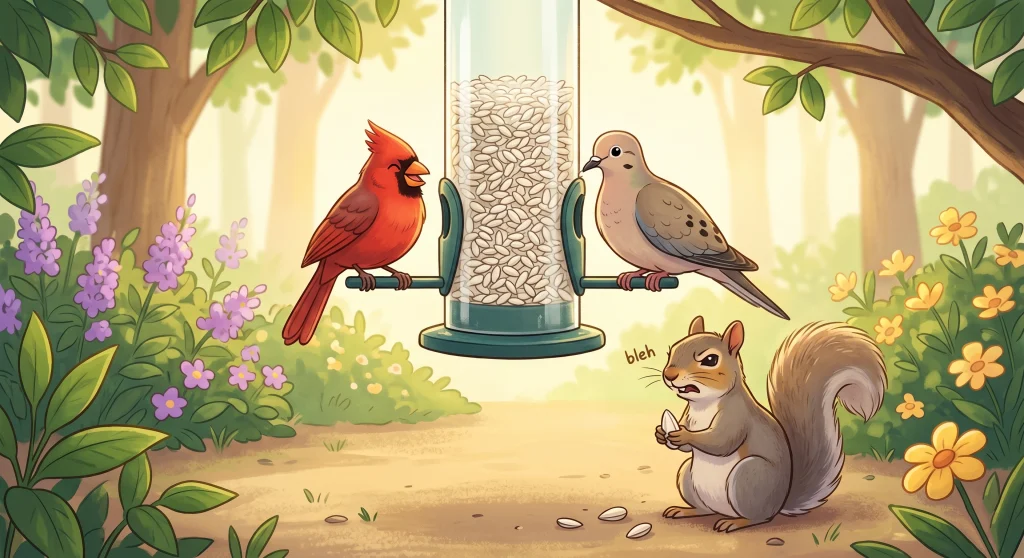
If you are asking does safflower deter squirrels, the most accurate answer is that it often discourages them, but not consistently enough to call it squirrel-proof. Audubon describes safflower as a useful option because many birds eat it while squirrels generally dislike it. Cornell Lab guidance adds the important caveat that squirrels in some areas do eat safflower, so local results can differ.
That distinction matters because a deterrent does not have to work on every animal to be useful. If switching from sunflower or peanuts to safflower cuts down the number of squirrel visits, reduces how long they stay, or makes your feeder less rewarding to them, you may save a noticeable amount of seed without changing the rest of your setup.
When I discussed safflower with customers at the store, I found it more helpful to frame it as an experiment than a promise. Put it out, watch who actually eats it in your yard, and judge the result by what happens at your feeder rather than by what the bag claims. Wildlife preferences are variable, and one persistent squirrel can make a broad rule look completely wrong.
Why Safflower Can Reduce Squirrel Interest
Safflower is a pale, thick-shelled oilseed that many familiar feeder birds can eat. Northern Cardinals are especially well known for taking it, and Cornell also lists grosbeaks, chickadees, doves, and native sparrows among the birds that may use safflower. That makes it useful when you want to change the food without abandoning seed-eating birds altogether.
The common explanation is that squirrels dislike the taste. Audubon uses that preference as the practical reason safflower can discourage squirrels, but I would not take the biology further than the evidence supports. There is no need to claim that safflower overwhelms a squirrel’s taste receptors or that birds are unable to notice the same flavor. What matters in a backyard is the simpler observation that safflower is often less attractive to squirrels than foods such as sunflower seed or peanuts.
Field Note: When someone asked me whether safflower was guaranteed to stop squirrels, I treated the first bag as a trial. If the target birds kept eating and the squirrels lost interest, it was a cheap win. If one squirrel sat down and ate it anyway, I would stop trying to explain that animal out of existence and move on to a physical barrier.
This is also why I would look at the broader best bird seed options before buying new hardware. Seed choice can change which animals find a feeder rewarding, even though it cannot physically prevent an animal from reaching the food.

A premium safflower seed that attracts cardinals, chickadees, titmice, and grosbeaks while naturally deterring squirrels, grackles, and starlings. Its bitter taste keeps unwanted visitors away without any extra effort. Can be used alone or gradually mixed with other seed blends to transition your feeder to a more desirable bird-friendly environment.
Check on AmazonIf you click this link and buy, we earn a commission at no additional cost to you.
What Safflower May Discourage, and What It Won’t
Squirrels are the main reason people try safflower, and they are the one group for which the practical deterrence claim has reasonable support. Even then, the wording matters: many squirrels may prefer other foods, but safflower does not create a barrier and does not guarantee that a hungry or experienced individual will leave.
The claims get much shakier when safflower is marketed as a universal pest-bird solution. Cornell notes that House Sparrows and European Starlings may avoid safflower in some places but may eat it in others. Audubon goes further on starlings, warning that they will eat safflower, which is why feeder design is more dependable when the goal is to exclude them.
Here is the expectation I would use:
- Squirrels: Worth testing. Many will show less interest in safflower than in sunflower seed or peanuts, but some will still eat it.
- European Starlings: Do not count on safflower alone. They can and do eat it.
- Common Grackles: Do not assume the thick shell will exclude them. Grackles are among the larger birds that can use hopper feeders stocked with safflower.
- House Sparrows: Results vary. Some populations may show less interest, while others readily learn to use the food available.
Key point: Safflower is best used to change feeding preference, not to create a species-proof boundary. If an unwanted animal or bird is already eating it comfortably, adding more safflower will not make the feeder physically inaccessible.
That may sound less dramatic than the marketing on a seed bag, but it is more useful. A deterrent that reduces pressure is still valuable as long as you know when to stop asking it to do a job that requires hardware.
Where Safflower Is an Unreliable Deterrent
The easiest mistake is turning a general preference into a rigid species rule. Mourning Doves, for example, are specifically listed by Cornell among the birds that eat safflower, so safflower is not a sensible way to exclude them. The same caution applies to other seed-eating visitors: if they can access the feeder and accept the food, the seed itself is not a barrier.
Chipmunks are another case where I would avoid promising too much. They eat grains, nuts, and seeds and are common visitors around spilled bird food. I have not found strong evidence that safflower reliably deters them, so if chipmunks are the actual problem, I would treat safflower as an uncertain experiment rather than a solution.
| Species or Group | How Reliable Is Safflower? | What to Expect |
|---|---|---|
| Gray / Fox Squirrels | Sometimes useful | Many squirrels show less interest, but some individuals still eat safflower. |
| European Starlings | Low reliability | Starlings can eat safflower, so feeder exclusion is more dependable. |
| Common Grackles | Low reliability | Do not assume safflower will prevent large blackbirds from feeding. |
| House Sparrows | Variable | Some may avoid it, while local populations can develop a taste for it. |
| Chipmunks | Uncertain | They readily eat seeds in general, and safflower should not be treated as a proven chipmunk deterrent. |
| Mourning Doves | Not a deterrent | Doves are among the birds known to eat safflower. |
The table is a starting point, not a substitute for watching your own feeder. Local food availability, the other foods you offer, feeder design, and individual behavior can all change what turns up for dinner.
Why Safflower Can Stop Working
The original temptation is to explain every failure as a “winter hunger override,” but that is too neat. Cornell’s more useful observation is simply that squirrels in some areas seem to develop a taste for safflower. Audubon also describes squirrels as persistent and adaptable animals that are good at exploiting available food.
That means a feeder can work differently over time without there being a fixed one-to-three-week adaptation period. One squirrel may ignore safflower from the start, another may sample it occasionally, and another may decide it is worth eating. Seasonal changes in natural food can also change how rewarding your feeder looks, but I would not promise a particular month or temperature when safflower will suddenly fail.
If squirrels begin eating the safflower regularly, take the result at face value. The seed has stopped functioning as a deterrent for those animals. At that point, changing the physical access to the feeder is more reliable than waiting for the squirrels to dislike the food again.

A large-capacity, squirrel-proof bird feeder that pays for itself in saved seed. When a squirrel climbs on, its weight automatically closes the feeding ports — keeping squirrels out without harming them. A patented weight-adjustable spring lets you control which animals can access the food. Built with UV-stabilized, chew-proof materials for long-lasting outdoor use.
Check on AmazonIf you click this link and buy, we earn a commission at no additional cost to you.
The Honest Solution: Use Preference Until You Need Exclusion
Safflower makes the most sense as the first, simple test when you still want seed-eating birds but would like to make the feeder less attractive to squirrels. It is inexpensive compared with replacing an entire feeding station, and you can tell quickly whether the animals in your yard consider it worth eating.
What safflower cannot do is stop an animal that has already decided it likes the food. That is the point where a physical squirrel-resistant setup becomes the more dependable tool. I would keep this decision simple rather than stacking several unproven tricks around the feeder.
Calling safflower “squirrel-proof,” leaving the feeder fully accessible, and assuming any squirrel that keeps eating must eventually give up.
Testing pure safflower first, watching the actual response, and switching to physical exclusion if squirrels continue feeding regularly.
Pure safflower bird seed also gives you a cleaner test than a blend that still contains sunflower, peanuts, or other squirrel favorites. If the seed experiment fails, the next step is not a stronger flavor claim. The broader approach in how to attract birds but not squirrels covers the physical side without pretending that one seed can control every visitor.
Final Thoughts: Set the Right Expectation
Safflower is useful because it can change the economics of a feeder without changing the whole station. Many target birds will eat it, while many squirrels would rather have something else. That makes it a legitimate deterrence option, just not a guarantee.
I would judge success by a practical question: are the birds you want still feeding while squirrel pressure drops? If yes, keep using it. If the squirrels are sitting at the feeder and eating safflower comfortably, believe what you are seeing and move to an access-control solution instead of searching for a biological rule that says they should not be there.

A textured powder-coated steel squirrel baffle that mounts on any 1/2 to 1-3/8-inch pole or shepherd hook via an included black coupler. No need to remove the bird feeder during installation. Snaps apart easily for quick setup. Defeats squirrels every time.
Check on AmazonIf you click this link and buy, we earn a commission at no additional cost to you.
FAQs
🐿️ Do squirrels eventually get used to safflower seed?
Some do. Cornell notes that squirrels in some areas appear to have developed a taste for safflower, so there is no universal adaptation timeline. If squirrels in your yard are eating it regularly, treat safflower as ineffective for those individuals and use another control method.
🐦 Will safflower keep grackles away completely?
No. Safflower should not be treated as a reliable grackle-exclusion seed. Large blackbirds can use feeders that offer safflower, so feeder design is a better tool when excluding them is the main goal.
❄️ Why are squirrels eating my safflower in the winter?
Individual squirrels do not all share the same food preferences, and available natural food changes through the year. Winter may make a feeder more valuable, but there is no fixed “hunger override” rule. If the squirrels are eating safflower, respond to the behavior you can see rather than assuming they will stop.
🦝 Does safflower deter raccoons?
Do not rely on safflower to control raccoons. The useful evidence for safflower deterrence is mainly about squirrels, and raccoons are broad, opportunistic feeders. A physical exclusion strategy is the safer expectation if raccoons can reach the feeder.
🕊️ Will safflower stop doves from emptying my feeder?
No. Mourning Doves are among the birds known to eat safflower. If too many doves are dominating a feeder, changing feeder access or presentation is more reliable than switching to safflower for deterrence.