The Brand Name Doesn’t Guarantee Fresh Nyjer
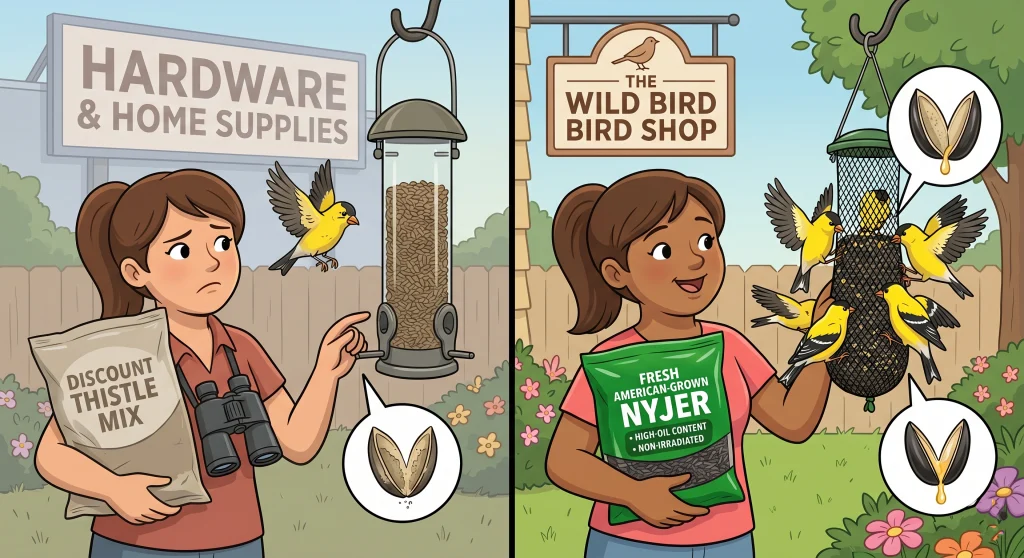
If you want to know what the best nyjer seed for goldfinches is, start with the condition of the seed rather than assuming one logo guarantees better food. A well-known brand can still sit too long after purchase or spend weeks in a feeder getting damp, while a less familiar bag with fast turnover can perform perfectly well.
American Goldfinches and Pine Siskins readily use nyjer, and Cornell lists it among the foods that commonly bring these small finches to feeders. The frustrating part is that a feeder can stay full even when the food itself was once appropriate. Nyjer has a thin shell and a high oil content, and Wild Birds Unlimited notes that finches may turn away once it dries out or becomes stale.
That makes freshness one of the first things I check when somebody says, “The feeder is full, but the finches disappeared.” It is not the only possible cause. Bird movement, natural food, feeder cleanliness, weather, disease concerns, and placement can all change activity. But replacing questionable nyjer is a cheap test before you start moving hardware around the yard.
Why Freshness Matters So Much
Nyjer is the small seed of Guizotia abyssinica, an oilseed plant native to Africa. Project FeederWatch describes it as especially useful for American Goldfinches, Pine Siskins, and redpolls, and its tiny size is one reason it works best in feeders with very small ports.
The seed does not become nutritionally empty the moment it loses its shine. That is too simple. What does happen is that storage conditions and time can reduce quality, while moisture can promote clumping, mold, and spoilage. WBU specifically warns that nyjer can dry out and become stale in the feeder and recommends replacing uneaten seed after roughly three to four weeks.
Field Note: When someone brought in a finch feeder that had been sitting full for weeks, I learned not to start with the feeder brand. I checked whether the seed looked clean and dry, whether it smelled normal, and how long it had been sitting there. Replacing old nyjer with a small fresh batch was often the simplest troubleshooting step.
A dull or dusty appearance can be a warning sign, but color by itself is not a laboratory freshness test. Different lots can vary. Damp clumps, musty or sour odor, visible mold, insect activity, or seed that has sat uneaten for weeks are stronger reasons to discard it.
The practical lesson is simple: buy manageable quantities, keep the reserve seed sealed in a cool, dry place, and do not keep topping fresh seed onto an old layer that the birds have already stopped eating.
Inventory Turnover Matters More Than Store Category
It is easy to blame big-box retailers when finches ignore a bag of nyjer, but I would not claim that large chains routinely buy stale seed at a discount or that their warehouses automatically ruin it. That is not something you can verify from the bag in your hand.
What you can evaluate is turnover and storage. A bird store that sells a lot of nyjer may move through inventory quickly. A busy online seller can do the same. A hardware store in an area with heavy bird-feeding demand may also have fresh stock. Conversely, a specialty shop can still have a slow-moving bag on the shelf.
Buying the largest bag solely because the price per pound is lower, even though your feeder uses only a small amount each week.
Buying an amount your birds are likely to finish within a few weeks, from a seller that stores seed dry and appears to move inventory regularly.
When possible, check the package for a lot code, packed-on date, best-by date, intact seal, or other traceability information. None of those guarantees that finches will appear, but they give you more useful information than store type alone.
This is also where smaller bags can be worth the higher unit price. Nyjer that gets eaten costs less in practice than a bargain bag that spends months in a warm garage and then another month untouched in a feeder.

A 100% genuine nyjer seed, high in oil and fat content to attract goldfinches, house finches, purple finches, chickadees, juncos, redpolls, and mourning doves. Naturally unappealing to squirrels, chipmunks, and nuisance birds. Best used in nyjer-specific feeders to minimize spillage. Sealed in an airtight, CO2-flushed barrier bag for maximum freshness. Available in an 8-pound bag.
Check on AmazonIf you click this link and buy, we earn a commission at no additional cost to you.
American-Grown Nyjer Is a Real Option, Not an Automatic Upgrade
Most nyjer sold for wild birds in North America has historically been imported. USDA APHIS currently requires imported Guizotia abyssinica seed to meet phytosanitary treatment requirements because imported seed can carry unwanted weed seeds and other agricultural risks.
One detail worth correcting is the common description that all imported nyjer is “irradiated.” APHIS recognizes different phytosanitary treatment methods, and current APHIS guidance says niger seed may be treated at an approved facility in the exporting country or after arrival at the first U.S. port. Cornell and Project FeederWatch describe the commercial bird seed as heat-treated to prevent sprouting.
American-grown nyjer also exists. Because domestically grown seed is not an imported commodity, it does not go through the same import-treatment pathway. Some sellers market this as “live” or non-heat-treated seed.
What I would not promise is that domestic origin automatically means longer shelf life, more oil, or stronger Goldfinch preference. Those are product-quality claims that need evidence for the specific seed being sold. Imported nyjer that is fresh and stored well remains a standard, widely used finch food, and Cornell notes that import heat treatment is intended to reduce plant-risk while retaining food value.
Field Note: If a customer asked me to choose between two bags, I would put freshness, storage condition, and realistic bag size ahead of a domestic-versus-imported label. Origin is useful information, but it does not rescue seed that has been stored badly.
If you find American-grown nyjer and want to try it, treat it as a comparison rather than an automatic premium tier. Offer a small fresh batch, watch actual use, and compare waste and feeder activity with what you were feeding before.

Wagner's Nyjer Seed is a 5-pound wild bird food formulated to attract finches including American Goldfinches, House Finches, Purple Finches, and Pine Siskins. The small Nyjer seeds are well suited to finch feeders with narrow feeding ports and provide a high-energy food source for small songbirds. The resealable bag helps keep the seed contained between feeder refills.
Check on AmazonIf you click this link and buy, we earn a commission at no additional cost to you.
Where to Buy Nyjer Without Guessing
Freshness and storage matter more than a blanket rule about where you shop. The most useful question is whether the seller moves enough nyjer to keep stock reasonably fresh and protects it from moisture and prolonged heat.
| Retailer Type | Inventory Turnover | Reliability for Finches |
|---|---|---|
| Wild Bird Specialty Stores | Often good where there is strong local finch-feeding demand, but turnover still varies by store. | A strong option when staff can tell you when stock arrived and how the seed is stored. |
| Direct Online Retailers | Can be fast or slow depending on the seller and product volume. | Look for intact packaging, clear product information, and quantities you can use promptly. |
| Big-Box Hardware Stores | Variable. Some locations move bird seed quickly while others may not. | Judge the individual bag, storage conditions, package dating, and local turnover rather than rejecting the store automatically. |
A dedicated bird store can be useful because staff are more likely to understand nyjer turnover and feeder problems, but there is no reason to make one franchise or retailer type the only acceptable source. Buy where you can get clean, dry seed in a quantity that matches your actual use.
To understand why this seed behaves differently from sunflower and why feeder port size matters, see the page on nyjer bird seed. If your current bag seems questionable, replace only a small amount first. That lets you test freshness without buying another oversized supply.

A metal thistle tube feeder with 8 perches and a yellow antique finish, built for year-round use. V-shaped spacers and 4 drainage holes keep seed fresh and dry. Transparent tube for easy seed monitoring, flip-top lid for easy refilling, and a reinforced metal hook that stays stable in strong winds. Attracts goldfinches, finches, chickadees, redpolls, and siskins.
Check on AmazonIf you click this link and buy, we earn a commission at no additional cost to you.
How to Check Nyjer When You Bring It Home
There is no simple home test that can certify the age or oil percentage of a bag of nyjer. You can, however, catch obvious quality problems before filling an entire feeder.
- Appearance and feel: The seed should look clean and dry rather than dusty, damp, or heavily clumped. A slight oily feel can be normal. Dull color alone is a clue to investigate, not proof that the seed is stale.
- Smell and moisture: Reject seed with a musty, sour, rancid, or otherwise abnormal odor. Hard damp clumps, visible mold, or condensation inside the package are stronger warning signs than color.
- Feeder history: If a clean feeder that previously had regular finch use sits untouched and the nyjer has already been exposed for several weeks, replace it with a small fresh batch before assuming the feeder location is wrong.
I would not use a paper-towel oil spot as a pass-or-fail test. Pressing seeds may tell you that some oil is present, but it does not establish a reliable freshness threshold for backyard feeding.
If a bag is clearly damp, moldy, infested, or rancid, return or discard it rather than trying to make birds use it. Nyjer is only one option in a broader best bird seed setup, so there is no benefit in keeping questionable food outside just because it was expensive.
Final Thoughts: Buy an Amount Your Finches Can Finish
The most useful buying habit with nyjer is not chasing a supposedly perfect brand. It is keeping the seed fresh from purchase to feeder. Buy smaller amounts until you know how quickly your local finches use them, keep the reserve sealed in a cool, dry place, and avoid leaving the same uneaten seed exposed for weeks.
WBU recommends replacing nyjer that has been sitting uneaten in the feeder for about three to four weeks and buying quantities that will be used within a few weeks. Treat that as a practical freshness routine rather than an expiration date. Hot storage, rain, humidity, and a poorly protected feeder can shorten the useful period, while dry sealed storage helps preserve quality.
If fresh nyjer in a clean feeder still gets no attention, move beyond the bag. Goldfinches shift with season, natural seed crops, and local movement, and the feeder itself still has to be discoverable and appropriate for tiny seed. For the habitat and placement side of the problem, see how to attract Goldfinches.

A premium nyjer (thistle) seed specially loved by finches, including the desirable Goldfinch. With around 150,000 seeds per pound, it delivers exceptional value and countless feeder visits. High in energy and extra clean, it's ideal for use in finch feeders with small holes and tiny perches. Available in a 10-pound bag with a convenient velcro press-lok closure.
Check on AmazonIf you click this link and buy, we earn a commission at no additional cost to you.
FAQs
🟡 How long does nyjer seed last before it goes bad?
There is no universal four- or six-week expiration date for a sealed bag. WBU recommends buying amounts you can use within a few weeks and replacing nyjer that has sat uneaten in a feeder for about three to four weeks. Moisture, heat, storage, and feeder exposure can shorten that window, so condition matters more than the calendar alone.
🧊 Can you freeze nyjer seed to keep it fresh longer?
Freezing dry seed in a tightly sealed container is possible, but it is not required for normal nyjer storage. A cool, dry, airtight location is the standard recommendation. If you freeze a bag, keep it sealed while it returns to room temperature so condensation does not add moisture to the seed.
🐦 Can I put nyjer seed in a standard bird feeder?
Nyjer is so small that ordinary seed ports can waste it. Project FeederWatch recommends feeders with very small nyjer ports, and mesh finch feeders are another common option. A different feeder may physically hold the seed, but a nyjer-specific design controls spillage much better.
🐿️ Will squirrels eat my nyjer seed?
Nyjer is usually less attractive to squirrels than sunflower or peanuts, which is one reason finch feeders often get less squirrel pressure. Do not treat that as a guarantee. If a squirrel learns to raid the feeder, use placement or a physical baffle rather than assuming seed size will stop it.
🌿 Is thistle seed the same thing as the prickly thistle weed?
No. Commercial nyjer is the seed of Guizotia abyssinica, an African oilseed plant unrelated to the thistles people usually picture in North American fields. Imported nyjer is treated under USDA requirements to reduce the risk of unwanted plant material establishing from bird-seed shipments.