Why Finches Ignore Your Nyjer Bird Seed (And How to Fix It)
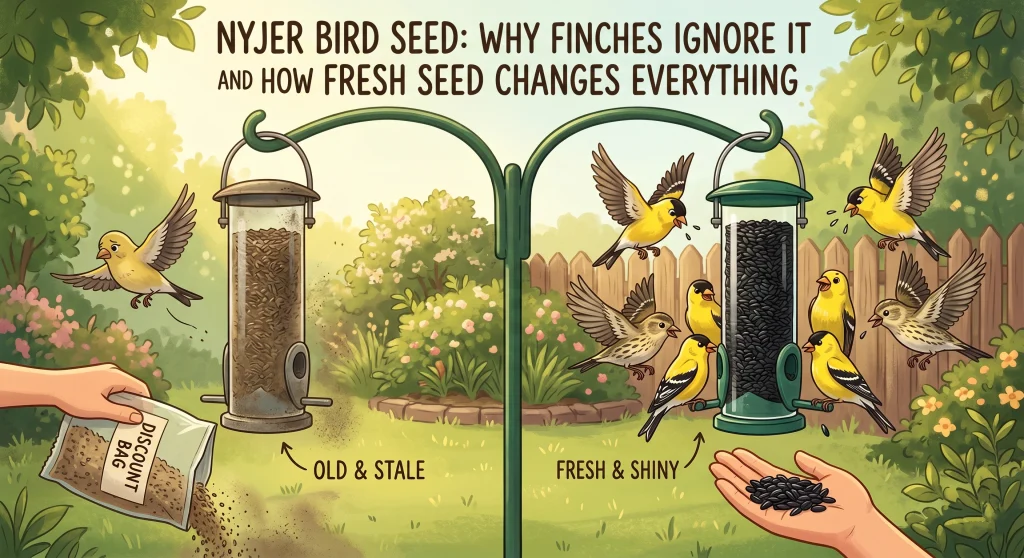
Nyjer bird seed is one of the standard foods used for American Goldfinches, Pine Siskins, Redpolls, and other small finches. It is an oil-rich seed, and its tiny size works well in feeders designed specifically for finches. Freshness matters, but I would not assume stale nyjer is the exact reason a quiet feeder is being ignored. Before changing the whole setup, I check the seed, the feeder ports, recent weather, and whether the birds are actually present in the area.
Nyjer can become stale or rancid, and its thin shell also makes it vulnerable to spoilage when moisture gets into the feeder. Wild Birds Unlimited specifically recommends keeping nyjer fresh, storing it airtight, and buying quantities that will be used within a relatively short period. Finches may reduce their use of stale seed, but there is no need to invent a one-bite rejection behavior or claim that every old seed has lost all nutritional value.
At the store, stale seed was one of the first things I checked when someone said a finch feeder had gone quiet. Sometimes that was the problem, and sometimes the birds had shifted to natural food or another feeder. Among the types of bird seed, nyjer is more specialized than sunflower because the seed is tiny and the feeder needs openings that retain it without spilling.
What Nyjer Actually Is (And Why It Is Not Thistle)
There is a lot of naming confusion in the bird-feeding aisle. Nyjer has long been sold under the informal name “thistle seed,” even though it does not come from the thistles that grow in North American fields. That old label can make beginners worry that spilled feeder seed will create a patch of prickly weeds.
Nyjer is the seed of Guizotia abyssinica, a plant in the sunflower family that is native to Africa and widely associated with production in Ethiopia and India. It is not a thistle. The bird-feeding industry used the thistle name because the tiny seed is offered to many of the same small finches people see feeding on thistle and other composite seeds in the wild.
This distinction matters because spilled nyjer is not going to turn into Canada thistle or another prickly thistle species. Imported nyjer sold for bird feeding is treated to reduce the risk of unwanted germination and weed introduction. Domestic seed may be handled differently, so I would not promise that every nyjer seed sold everywhere is incapable of sprouting.
Imported Nyjer Is Treated Before U.S. Entry
Imported Guizotia abyssinica seed is subject to U.S. plant-health requirements. USDA APHIS currently states that niger seed can be treated at an approved facility in the exporting country or at the first U.S. port of entry. Cornell describes bird-feeding nyjer as heat-treated during importation to limit unwanted sprouting. The treatment is about plant and weed risk, not because nyjer itself is a North American thistle weed.
Do not confuse treatment with irradiation. Heat treatment is commonly used for imported bird-feeding nyjer, but I could not find an authoritative source showing that the required treatment itself is what makes retail nyjer go stale quickly. Cornell specifically says the treatment limits spreading while retaining food value. The better-supported freshness concerns are storage time, heat, air, and moisture after processing.
Nyjer is an oil-rich seed, which is one reason it is useful to active finches. Oils can oxidize during storage, especially with prolonged heat and air exposure. That makes turnover important, but I would not invent a shipping timeline or call an older bag “dead.” What matters to you is whether the seed you buy is dry, clean, free of off odors and mold, and being eaten normally after you put it out.
How to Test Your Seed for Freshness
A printed best-by date can be useful context, but it does not tell you how the bag was stored or whether moisture entered after opening. I use several practical checks together rather than relying on one visual trick as a definitive freshness test.
Color by itself is not a reliable freshness test. The Wild Bird Feeding Institute notes that Nyjer from India is generally black while seed from Ethiopia is generally brown, so brown seed is not automatically old or stale. Instead, look for moisture, clumping, visible mold, insects, excessive dust, or an off or rancid odor, and compare feeder use after replacing questionable seed with a fresh small batch.
A crush-on-paper test can show that some oil is still present, so I treat it as a rough field check rather than a scientific pass-or-fail test. A visible oil mark does not prove the seed is fresh and safe, and a faint mark does not mean the seed has zero nutritional value. Smell, moisture, mold, storage history, and whether birds resume feeding after a fresh refill are more useful when you combine them.
Field Note: When someone brought in a finch feeder that had gone quiet, I would ask how long the same seed had been sitting in it and whether it had been through rain or summer heat. Old, dusty seed was sometimes part of the problem, but I would not use brown color alone to condemn it. I would clean the feeder and test a small fresh batch before telling someone to replace hardware.
Leaving the same slow-moving seed in a damp or exposed feeder for weeks without checking its condition.
Inspecting the feeder when activity drops, discarding wet or questionable seed, cleaning and drying the feeder, then trying a small fresh batch before changing the entire setup.

A no-grow nyjer thistle seed rich in protein and healthy fats, attracting finches, goldfinches, and other wild birds year-round. Won't sprout, keeping outdoor spaces clean. Ideal for tube feeders with minimal waste. Comes in a resealable 5 lb bag to keep seed fresh.
Check on AmazonIf you click this link and buy, we earn a commission at no additional cost to you.
Fresh Inventory Matters More Than a Famous Brand
When people try to solve a quiet nyjer feeder, they often start shopping for a more expensive brand. I care more about freshness, storage, and inventory turnover than the logo on the bag. That does not mean the store is always the single most important factor, because packaging, transport, home storage, and feeder exposure all affect the seed too.
Bird-feeding forums include reports of people having better luck after switching away from old big-box nyjer, but that is customer experience, not proof that large retailers universally buy stale seed or store it badly. I would not assume a bag is old because of the store name. Check package condition, stock turnover, and how much dust or damage you can see, and buy a size you can use reasonably quickly.
A busy wild-bird specialty store can be a good place to buy nyjer because staff may know how quickly the product moves and how it has been stored. A high-turnover online or general retailer can also sell perfectly fresh seed. I would ask about turnover rather than assume every specialty shop receives fresh stock weekly.
If you are choosing between bags, remember that nyjer and so-called thistle seed are usually the same Guizotia abyssinica product under different naming. Choose a clean, well-sealed bag from a seller with good turnover, and start with a smaller quantity until you know how quickly your birds use it.
American-Grown Niger Exists, but Do Not Assume It Is Automatically Better
American-grown Guizotia abyssinica is available from specialty producers, so imported seed is not the only option on the market. Domestic seed does not go through the import treatment required for foreign niger entering the United States. Availability is still niche and varies by region and seller.
I would not describe this simply as “non-irradiated,” because irradiation is not the standard term Cornell or USDA uses for imported feeder nyjer. More importantly, I could not find independent evidence showing that domestic untreated seed always has significantly longer shelf life because imported heat treatment destroys its oils. Treat longer-life claims from domestic suppliers as product claims unless the seller provides data.
Some birders report strong acceptance of domestic niger, but I would not promise that birds notice it immediately, that the hull is easier to crack, or that Pine Siskins universally choose it over sunflower. Cornell’s feeder observations show that finch preferences can vary, and even American Goldfinches may favor sunflower in some yards. If domestic seed is available to you, test it as another fresh option rather than as a guaranteed upgrade.
Domestic specialty seed may cost more or be harder to find, but price and availability change. I would compare it on freshness, cleanliness, how quickly your birds use it, and how much you actually discard. Without controlled shelf-life data, I would not promise a lower true cost.
Store Nyjer Cool, Dry, Airtight, and in Small Enough Quantities
Even a fresh bag can deteriorate if it sits in heat or moisture. A hot garage, damp shed, or container that allows humid air and pests inside is a poor storage setup for any oily bird seed.
I do not make freezer storage the default recommendation for nyjer. Wild Birds Unlimited recommends an airtight container and buying quantities that will be used within a few weeks. That approach is simpler and avoids the condensation problem that can happen when very cold seed is moved into warm humid air.
Here is a practical storage routine:
- Learn how much nyjer your birds actually use before buying a large bag.
- Keep the seed in a clean, airtight, pest-resistant container in a cool, dry location.
- Buy smaller quantities when feeder traffic is light so the same bag is not sitting open for months.
- Before refilling, check stored seed for moisture, clumping, mold, insects, or an off odor.
Pro Tips: Moisture is the enemy. Whatever storage method you use, do not put damp or condensation-covered seed into a finch feeder. If the seed gets wet, replace it rather than waiting for mold to become obvious.

An airtight bird seed storage container made from food-grade, BPA-free HDPE plastic. Features Gamma Seal technology with a threaded locking lid and double gaskets to lock in freshness and keep out pests, ants, and moisture. Shatter-resistant and suitable for indoor, garage, or outdoor use. Also works for dog, cat, and other dry pet food. Made in the USA.
Check on AmazonIf you click this link and buy, we earn a commission at no additional cost to you.
Feeder Setup, Placement, and Cleaning
Nyjer is tiny, so feeder opening size matters. A standard tube with sunflower-sized ports may spill it badly. A solid tray can technically hold nyjer, but it exposes more seed and does not provide the selective, low-waste setup that finch feeders are designed for.
The standard choices are a tube feeder with very small nyjer ports or a fine-mesh finch feeder or sock. Project FeederWatch specifically recommends small openings to prevent spillage. A well-designed tube bird feeder also keeps seed drier than an exposed tray and is usually easier to monitor than a large open platform.
Placement still matters, but I do not assume woodpecker or squirrel activity automatically scares finches away. A dedicated nyjer feeder can give small finches their own feeding access away from larger birds that dominate a general seed station. Keep the feeder in a location you can monitor and clean, with sensible nearby cover and without creating an easy ambush point for cats.
Prioritize weather protection and drainage because wet nyjer can clump and block tiny ports. I would not promise a universal forty-eight-hour mold deadline. If the seed becomes soaked, moldy, sour-smelling, or badly clumped, discard it. Clean the feeder regularly and whenever wet residue accumulates; Cornell recommends routine cleaning of tube feeders because many birds repeatedly use the same ports. Let every part dry completely before adding fresh seed.

A squirrel-proof nyjer/thistle tube feeder with 8 feeding ports and 4 perches for both clinging and perching finches. Features a patented ventilation system to keep nyjer seed fresh longer. UV-resistant components, easy to fill and clean. Backed by a lifetime warranty.
Check on AmazonIf you click this link and buy, we earn a commission at no additional cost to you.
Final Thoughts: Controlling the Variables
Feeding finches successfully is mostly about controlling the variables you can actually observe. Use clean seed from a seller with reasonable turnover, keep it dry, put only manageable amounts in the feeder, and watch whether local finches are using it. Do not reject brown nyjer on color alone because origin can affect seed color.
If a nyjer feeder has gone unused for weeks, inspect the seed and feeder instead of waiting indefinitely. Replace stale, wet, or questionable food, clean and dry the tube, then try a small fresh batch. If activity still stays low, consider season, local finch presence, natural food, and the rest of your setup. If you are specifically trying to attract those bright yellow visitors, my page on how to attract goldfinches covers the larger picture.
More Guides to Get the Most Out of Your Seed
If you are ready to refine your setup or troubleshoot a specific issue with your finches, these guides cover the exact steps you need to take next.
| Article | What You Will Learn |
|---|---|
| How to Tell If Nyjer Seed Is Fresh | Practical checks for stale or spoiled nyjer, including why color and oil marks should not be treated as perfect pass-or-fail tests. |
| Nyjer vs Thistle Seed: They’re Not the Same | Clarifying the naming confusion, import treatment, and what American-grown niger does and does not prove about freshness. |
| Best Nyjer Seed for Goldfinches | How to choose a manageable, clean bag from a seller with good turnover without assuming one store type always has fresher seed. |

A premium nyjer (thistle) seed specially loved by finches, including the desirable Goldfinch. With around 150,000 seeds per pound, it delivers exceptional value and countless feeder visits. High in energy and extra clean, it's ideal for use in finch feeders with small holes and tiny perches. Available in a 10-pound bag with a convenient velcro press-lok closure.
Check on AmazonIf you click this link and buy, we earn a commission at no additional cost to you.
FAQs
🐦 Why are birds suddenly ignoring my nyjer seed?
Stale or wet seed is one common reason, especially when a feeder used to be busy and then goes quiet. But finch numbers, season, natural foods, weather, clogged ports, and placement can also change feeder use. Replace questionable seed with a small fresh batch before blaming the feeder.
🌻 Is nyjer the same as thistle?
No. Nyjer comes from Guizotia abyssinica, a plant in the sunflower family, and it is not a thistle. “Thistle seed” is an old bird-feeding name that can be misleading because the product is unrelated to North American thistle weeds.
⏳ How long does nyjer seed last in a feeder?
There is no single shelf-life number that fits every feeder and climate. Wild Birds Unlimited suggests replacing nyjer after about three to four weeks if it is not being actively eaten, and using it sooner in warm or wet conditions. If it gets soaked, moldy, sour-smelling, or badly clumped, replace it immediately.
🧊 Can I freeze nyjer seed?
You can find birders who freeze oily seed, but I do not call freezing the best or necessary method for nyjer. A simpler supported approach is to buy smaller quantities and store them airtight in a cool, dry location. If you do freeze seed, prevent condensation before it goes into the feeder.
🌧️ What happens if nyjer gets wet?
Wet nyjer can clump around the tiny feeder ports and is much more vulnerable to mold and spoilage. If the seed is soaked, moldy, sour-smelling, or remains damp, discard it and dry the feeder before refilling.
🐿️ Do squirrels eat nyjer seed?
Squirrels often show less interest in tiny nyjer than in sunflower or peanuts, and Cornell lists that as one advantage of nyjer feeders. “Often” is the useful word here. A hungry or persistent squirrel can still investigate the feeder, so nyjer is not a squirrel-proofing method.
💸 Why is nyjer seed so expensive?
Most nyjer sold in North America has traditionally been imported, and imported Guizotia abyssinica is subject to USDA treatment requirements. Those logistics can contribute to cost, but retail price also depends on crop supply, packaging, transport, seller margins, and bag size. I would not assign the price to one treatment step alone.