The Wind-Sail Effect of Hanging Large Hoppers
A large hopper feeder fully loaded holds over 10 pounds of seed. Hanging that from a wire guarantees it will act like a sail in the wind. Most people buy these massive feeders because they want to refill them less often, which makes logical sense. They fill the hopper to the brim, hang it from a shepherd’s hook or a tree branch, and assume the weight will keep it stable. It doesn’t work that way. The sheer surface area of the roof and side panels catches every gust of wind, turning the entire unit into a heavy, swinging pendulum.
When a feeder swings violently, the seed inside shifts, pushing against the feeding ports and spilling out onto the ground. This not only wastes expensive seed but also creates a massive mess that attracts rodents and damages your lawn. I have watched this pattern repeat more times than I can count with frustrated backyard birders who thought the birds were simply messy eaters. The reality was that their mounting method was entirely wrong for the physical dimensions of the feeder.
Field Note: One of the most common things I heard at the store was customers complaining that their new, high-capacity hopper was emptying in two days. They assumed they had a massive flock of birds. When I asked how it was mounted, nine times out of ten, it was hanging from a long cable in an open yard. The wind was rocking the feeder and throwing the seed right onto the grass.
The solution is not to buy a different feeder, but to change the installation entirely. If you want to use a large wooden or recycled plastic hopper, you have to treat it like a permanent structure rather than a hanging ornament. This means transitioning away from hooks and wires and moving toward a rigid, ground-based support system.
Why a 4×4 Wooden Post Is the Best Solution
When dealing with heavy bird feeder mounting, standard metal poles eventually fail. A basic shepherd’s hook will bend under the sheer vertical weight of a loaded hopper, and the torque from wind will eventually loosen the base prongs in the soil. To completely eliminate movement, you need to mount the feeder directly on top of a standard 4×4 wooden post. A pressure-treated 4×4 post driven deep into the ground provides an incredibly stable foundation that simply ignores the wind.
This setup also gives you a lot more control over placement. Instead of relying on a sturdy tree branch that might be too close to a fence or a window, you can sink a post exactly where you want it. This is crucial for overall yard planning and ensuring the feeder is visible but safe. If you are comparing bird feeder types, it helps to understand that hoppers are unique in their architectural demands; they function much better as fixed platforms than as hanging accessories.
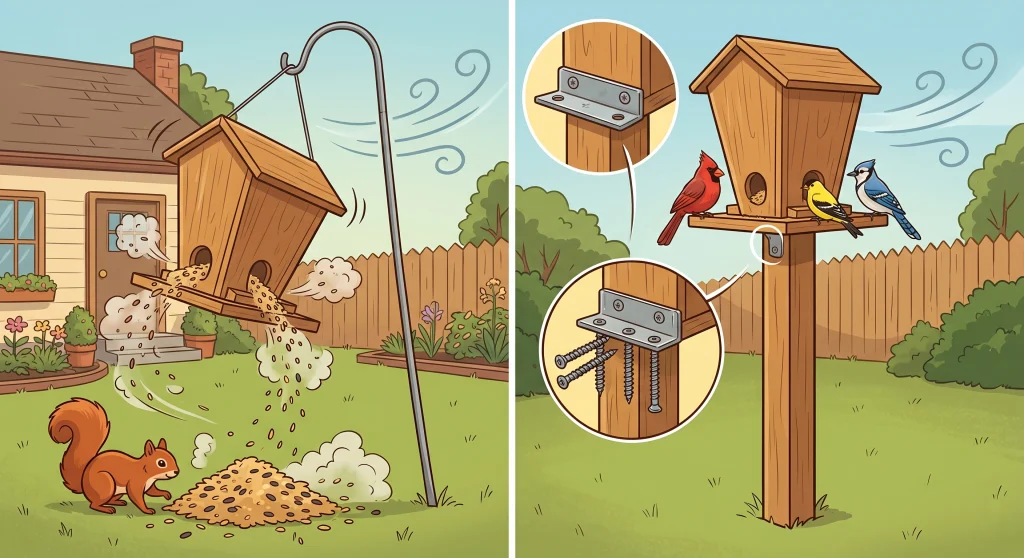
Hanging a 12-pound hopper from a thin shepherd’s hook in an open, windy area. The pole will lean over time, and the seed will scatter daily.
Sinking a 4×4 wooden post two feet into the ground and mounting the hopper securely on the flat top, eliminating all swinging motion.
Some people try to compromise by using thick metal industrial poles, but wood offers a distinct advantage for this specific feeder design. Wooden posts are inexpensive, easy to find at any hardware store, and incredibly easy to drill into for mounting hardware or attaching baffles. If you live in a colder climate with freeze-thaw cycles, remember to sink the post below your local frost line so the winter heave does not push your feeding station out of plumb. Once the post is set correctly, it becomes a permanent feeding station that can support the widest variety of birds, which is precisely why the hopper bird feeder is so highly regarded for backyard birding.
Hardware Checklist: Flanges and Screws
The hardware connecting the wooden post to your feeder needs to be strong enough to handle both the weight and the weather. You cannot just balance the feeder on the wood and drive a few long screws through the bottom board. To do this correctly, you must use a dedicated bird feeder post mount flange. This is a metal bracket that screws into the top of the 4×4 post and provides a secure, flat mounting plate that connects to the underside of the hopper.
When shopping for a flange, expect to spend around $15 to $30. Look specifically for powder-coated steel rated for outdoor use, and avoid cheap zinc-plated hardware, as it corrodes quickly in wet conditions. You also have to verify the dimensions of your specific feeder’s base. Some hoppers come pre-drilled for specific flange patterns, while others require you to measure and center the bracket yourself. Most flanges designed for 4×4 posts will either slip directly over the top of the wood or sit flush against it. Do not rely on the cheap, short screws that usually come in the plastic hardware bag with the flange.
Here is the exact hardware you need for a permanent, weather-resistant setup:
- A steel or powder-coated mounting flange that matches your feeder’s base dimensions.
- Exterior-grade deck screws (at least 1.5 inches long) for attaching the flange to the feeder.
- Heavy-duty exterior wood screws (at least 2 inches long) for securing the flange to the 4×4 post.
- A small bubble level to ensure the post is perfectly straight before securing the feeder.
| Mounting Method | Stability in High Wind | Seed Waste Level | Hardware Required |
|---|---|---|---|
| Hanging Wire | Very Poor (swings violently) | High | Wire cable, S-hooks |
| Shepherd’s Hook | Poor (pole bends over time) | Moderate | Thick metal pole |
| 4×4 Wooden Post | Excellent (zero movement) | Very Low | Post, metal flange, screws |
Using the correct hardware prevents the feeder from tearing loose during a severe storm. I have seen feeders ripped off their posts because the owner used indoor drywall screws that rusted out after one wet winter. Exterior deck screws cost a few dollars more but are absolutely necessary for any outdoor wooden installation.

Sturdy steel mounting bracket designed to secure a bird feeder or birdhouse to a standard 4x4 wooden post. Its 7 x 5 inch flat mounting surface supports a wide range of flat-base birding accessories. Four mounting points provide a simple and stable outdoor installation.
Check on AmazonIf you click this link and buy, we earn a commission at no additional cost to you.
Action Log: Mounting the Hopper
Mounting hopper bird feeder on 4×4 post hardware is a straightforward process, but the order of operations matters. The most common mistake I see is people attaching the flange to the post first, and then struggling to attach the heavy feeder to the flange while standing on a ladder. The physics of holding a heavy, awkward box while driving screws upward is a recipe for stripped screws and an uneven feeder.
The correct method is to attach the hardware to the feeder on the ground. First, flip your empty hopper upside down on a workbench or flat table. Center the mounting flange exactly in the middle of the feeder’s base. If it is off-center, the feeder will look tilted and seed will pool on one side. Mark your drill holes, pre-drill slightly to prevent the wood or recycled plastic from splitting, and drive your screws in securely.
Then, once the flange is firmly attached to the feeder base, bring the entire unit out to your prepared 4×4 post. Lift the feeder, align the flange over the top of the post, and use your bubble level to verify the alignment. This is the moment to adjust for any minor tilts before you lock it down permanently.
Finally, drive your heavy-duty exterior wood screws through the side of the flange and directly into the 4×4 post. This sequence ensures the feeder stays level and the weight is properly balanced over the center of the post, creating a straight and stable installation every single time.
Pro Tips: Before setting your final post height, calculate where the roof of the feeder will end up. If the bottom of the feeder sits at five feet to deter squirrels, the hinged roof where you pour the seed might be over seven feet high. If that is too tall for you to comfortably reach, you will want to invest in a dedicated outdoor step stool or a large seed scoop with an extended funnel.
Integrating a Post-Baffle for Squirrel Proofing
A wooden post provides incredible stability, but it also creates a perfect, high-traction highway for squirrels. Squirrels can climb a 4×4 post as easily as they climb a mature oak tree. If you mount a large hopper full of sunflower seeds on a bare wooden post, you are simply building a highly stable dining room table for local rodents.
Key point: To make this setup work, you must integrate a wrap-around squirrel baffle specifically designed for 4×4 posts. Standard pole baffles are designed for thin metal pipes and will not fit around a wooden post.
A 4×4 post baffle is usually a large, cylindrical piece of metal, often called a torpedo baffle, that wraps completely around the wood and secures with a specialized bracket. It needs to be mounted so the top of the baffle is at least four and a half to five feet off the ground. When a squirrel climbs the wood, they hit the inside of the metal cylinder and cannot climb over it. If you need help figuring out the exact distances and clearances required for your yard, our bird feeder pole guide covers the spatial rules in detail to keep squirrels from jumping horizontally onto your setup.
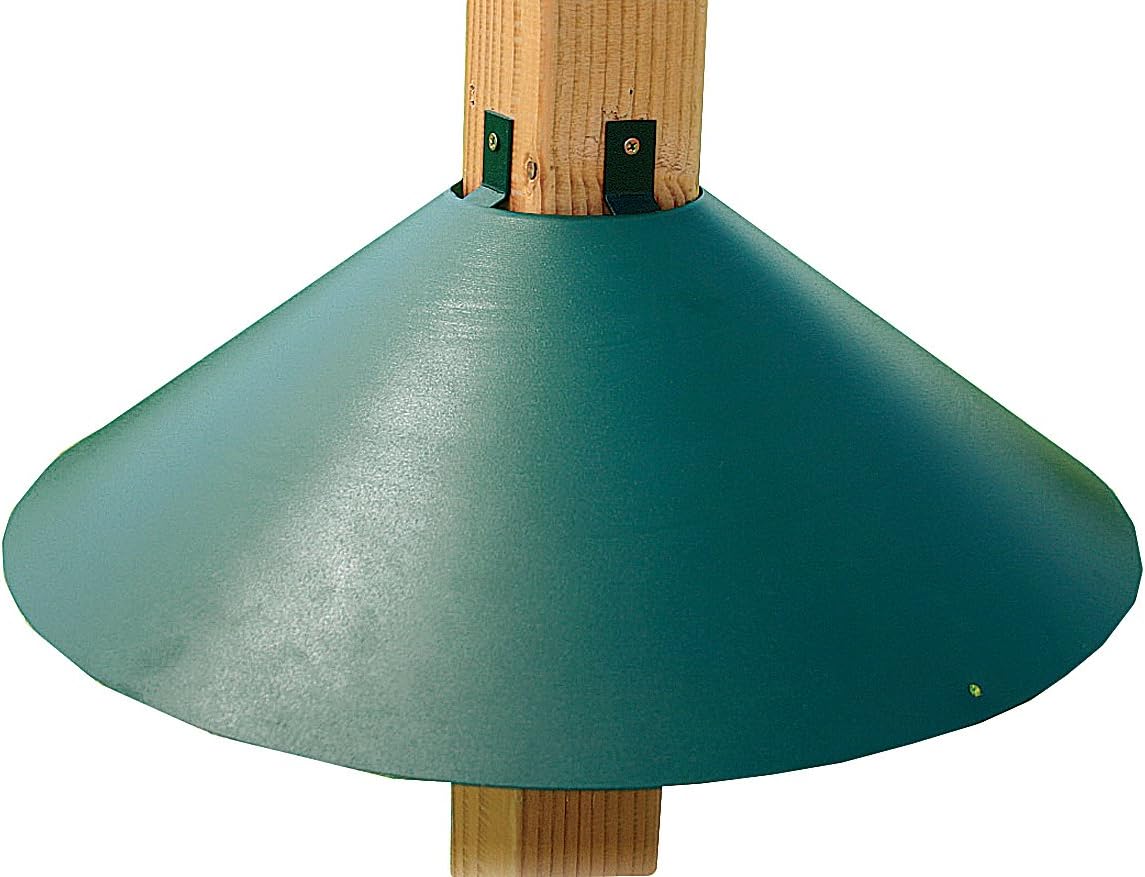
An inverted cone-shaped steel squirrel baffle that wraps around a standard 4x4-inch post, blocking squirrels, raccoons, and other predators from climbing up to feeders or birdhouses. Secured with included zinc-plated screws. Weather-resistant dark green finish for long-lasting outdoor use.
Check on AmazonIf you click this link and buy, we earn a commission at no additional cost to you.
Final Thoughts: Doing It Right the First Time
Setting up a heavy hopper feeder requires a bit more effort upfront than hanging a simple plastic tube, but it is the only way to stop wind from draining your seed budget. Before you head online or to the hardware store to buy mounting hardware, go outside and flip your current hopper upside down to inspect the base.
Check the underside for pre-threaded central holes or pre-drilled screw points. Knowing whether your feeder needs a slip-over flange or a flat-mount bracket will save you a trip back to the store. Measure the width of that base today so you can order the right flange for your base type, and finally get that swinging feeder permanently locked down.

A premium year-round seed blend featuring black oil sunflower seeds, peanuts, sunflower chips, raisins, nuts, and striped sunflower seeds. Attracts nuthatches, cardinals, juncos, titmice, finches, and more. Compatible with tube, hopper, and platform feeders.
Check on AmazonIf you click this link and buy, we earn a commission at no additional cost to you.
FAQs
🪵 Can I use a round wooden post instead of a square 4×4?
You can, but it is much harder to mount standard hardware to a round surface. Most commercial mounting flanges and post baffles are specifically engineered to fit perfectly over a standard square 4×4 post.
🔩 Do all hopper feeders come with a mounting flange included?
No, most do not. Manufacturers usually sell the mounting flange as a separate accessory because many people still try to hang them. Always check the box contents before you start your installation project.
💨 Will a post-mounted feeder completely stop seed from falling to the ground?
It eliminates seed spillage caused by wind swinging the feeder. However, birds will still naturally scatter some seed as they pick through the tray looking for their favorite pieces. It drastically reduces the mess, but does not completely eliminate natural bird behavior.
🐿️ How high off the ground should the bottom of the feeder be?
For comfortable viewing and practical squirrel-proofing, the bottom of the feeder should sit roughly five to six feet off the ground. This gives you enough vertical room on the post to mount a squirrel baffle at the required height.
🌧️ Do I need to treat the wooden post to prevent rot?
Yes, it is highly recommended to use pressure-treated lumber for any post that comes into contact with the ground. If you use untreated wood, the moisture from the soil will cause it to rot and snap within a few years.