The Feeder Most People Should Buy First
I have spent years talking to people who were incredibly frustrated with their backyard birding experience. A customer would walk into the store, explain that they bought a premium bag of seed and a brand new feeder, but the only birds visiting were tiny finches. The cardinals, jays, and grosbeaks were completely ignoring the setup. In almost every single case, the problem was not the seed or the location. The problem was that they bought the wrong style of feeder for the birds they actually wanted to see.
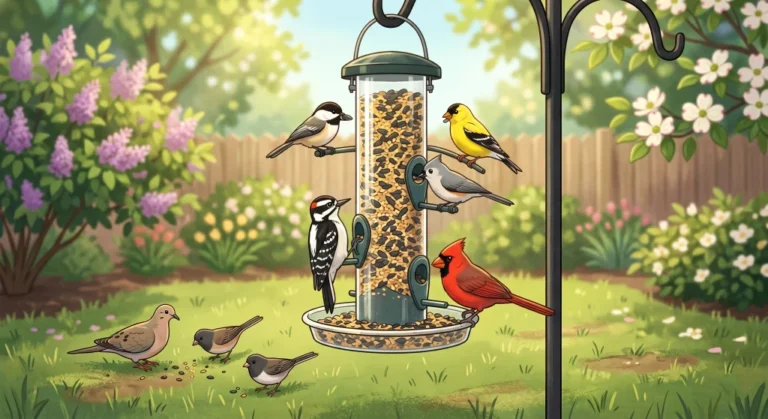
To understand why this happens, you have to look at how different feeders operate. If you read my broad overview on different bird feeder types, you will know that the physical design of the hardware dictates who can eat from it. A hopper style bird feeder, often called a house bird feeder because of its pitched roof, uses a gravity-fed central bin that spills seed out onto a flat bottom tray. This combination of a large seed reservoir and a flat, spacious feeding area makes it the undisputed workhorse of the backyard.
Field Note: A customer once came in complaining that her beautiful new tube feeder was completely ignored by the cardinals in her yard. I convinced her to take home a basic cedar hopper feeder. She called the store three days later to tell me she had five cardinals feeding at the exact same time. The birds were there all along; they just needed the right furniture.
How a Hopper Feeder Actually Works
Before looking at which birds these feeders attract, it helps to understand the basic mechanics of how they operate. A hopper feeder is essentially a bulk storage bin attached to a feeding tray. The central chamber holds the seed, and gravity forces the food out through small gaps at the bottom as the birds eat what is on the ledge.
This gravity-fed design is brilliant because it protects the bulk of your seed supply inside the enclosed chamber, only exposing a small amount to the outside air and humidity. As birds clear the tray, fresh seed automatically spills out to replace it. However, because the seed rests on a flat bottom tray, that tray must have built-in drainage. If water pools on the feeding surface, the seed will wick that moisture right back up into the main hopper, ruining the entire batch.
When you look at different models, always check the bottom corners of the tray. Quality hoppers use a perforated metal screen or have strategically drilled holes to let rainwater pass straight through.
Why Cardinals and Jays Prefer This Design
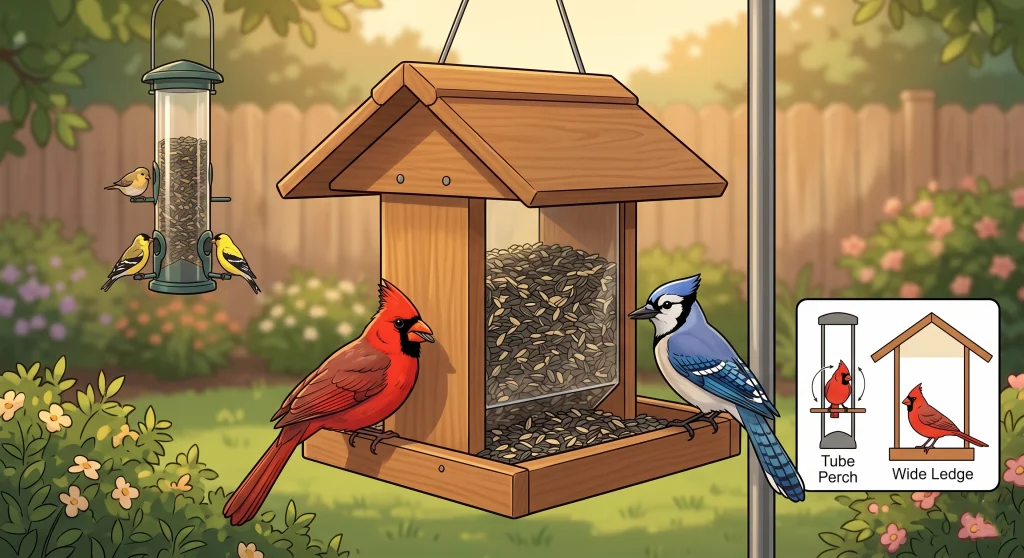
If you want to see a Northern Cardinal, you have to accommodate their specific physical limitations. Cardinals are heavy birds with relatively stiff necks. When a cardinal lands on a tiny peg perch attached to a tube feeder, it has to turn its head entirely sideways to extract a seed from the port. This is an uncomfortable and unnatural feeding posture for them. After a few frustrating attempts, they will simply fly to the ground to forage for dropped seeds instead.
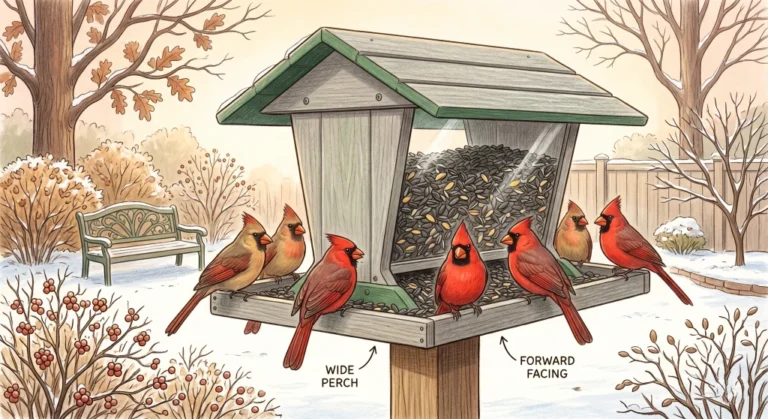
A hopper feeder solves this anatomical problem entirely. The wide bottom tray provides a stable platform where large birds can land, balance easily, and face completely forward while they eat. They do not have to twist their necks or hang at odd angles. This forward-facing feeding position is the primary reason why hopper feeders are so successful at attracting large, desirable species like Blue Jays, Rose-breasted Grosbeaks, and Cardinals.
When you are shopping for the best hopper feeder, the single most important measurement to check is the width of that bottom ledge. You want to look for a feeder that offers at least a two-inch landing space extending outward from the seed trough. Anything narrower than that will force larger birds to balance awkwardly, defeating the main purpose of the hopper design.

A ranch-style bird feeder made from up to 90% recycled plastic, built to resist chipping, fading, and rust. The two-sided seed tray accommodates multiple birds at once and holds up to 5.5 lbs of mixed seed. Features a removable perforated metal screen bottom for drainage and a hinged roof for easy filling and cleaning. Overhanging roof keeps seed dry. Hangs via included heavy cable. Made in the USA.
Check on AmazonIf you click this link and buy, we earn a commission at no additional cost to you.
The Material Trap: Wood vs Recycled Plastic vs Metal
Because hopper feeders are meant to stay outside year-round, holding pounds of seed through rain and snow, the material you choose makes a massive difference in how long your investment lasts. Most beginners default to purchasing a wooden hopper because it looks incredibly natural hanging in a garden. However, from what I have seen over time, wood comes with a severe maintenance cost.
Wood is highly porous. If you live in a wet climate like the Pacific Northwest or the humid Southeast, a standard pine or cedar feeder can begin to rot in just two seasons. I watched customers return wooden feeders repeatedly because the moisture caused the joints to split, which then allowed water to seep in and mold the seed. If you want the traditional look without the rot, recycled plastic lumber is a vastly superior choice. It looks nearly identical to wood from a distance, but it will never fade, crack, or harbor mold spores.
| Feeder Material | Typical Lifespan | Best Climate Application |
|---|---|---|
| Untreated Wood | 2 to 3 years | Dry, arid climates |
| Cedar or Redwood | 4 to 6 years | Moderate climates |
| Recycled Plastic | 10+ years | Wet, humid, or snowy regions |
| Powder-Coated Metal | 10+ years | Squirrel-heavy environments |
If squirrels are your primary concern, an all-metal hopper is your best defense. Rodents will quickly chew through wood and plastic to widen the seed ports, completely ruining the feeder. A heavy-duty steel or aluminum hopper prevents chewing entirely.
For most readers in humid or rainy climates, a recycled plastic hopper is the clear starting point for longevity. If squirrels are an immediate problem in your yard, skip the plastic and go straight to a heavy-duty metal model.
Weight-Sensitive Hoppers as Species Selectors
Many metal hopper feeders come equipped with a spring-loaded perch. The intended mechanism is simple: when a heavy squirrel lands on the perch, its weight pulls a metal gate down, instantly closing off access to the seed. Most people buy these exclusively for squirrel protection. But in practice, this mechanism is actually the most effective species selection tool available to backyard birders.
Bully birds like Common Grackles and European Starlings travel in large, aggressive flocks. They will descend on an open hopper feeder and empty a massive pile of seed in a few hours, chasing away smaller songbirds in the process. However, a Common Grackle weighs roughly four ounces. A Northern Cardinal weighs about 1.6 ounces. If you purchase an adjustable weight-sensitive hopper, you can tune the tension spring to somewhere around two ounces.
This fine-tuning ability allows you to selectively feed the birds you want while locking out the nuisance birds you do not. When buying a weight-sensitive model, always check the product specifications to confirm the tension is manually adjustable. Some cheaper models have fixed factory tensions that cannot be modified.
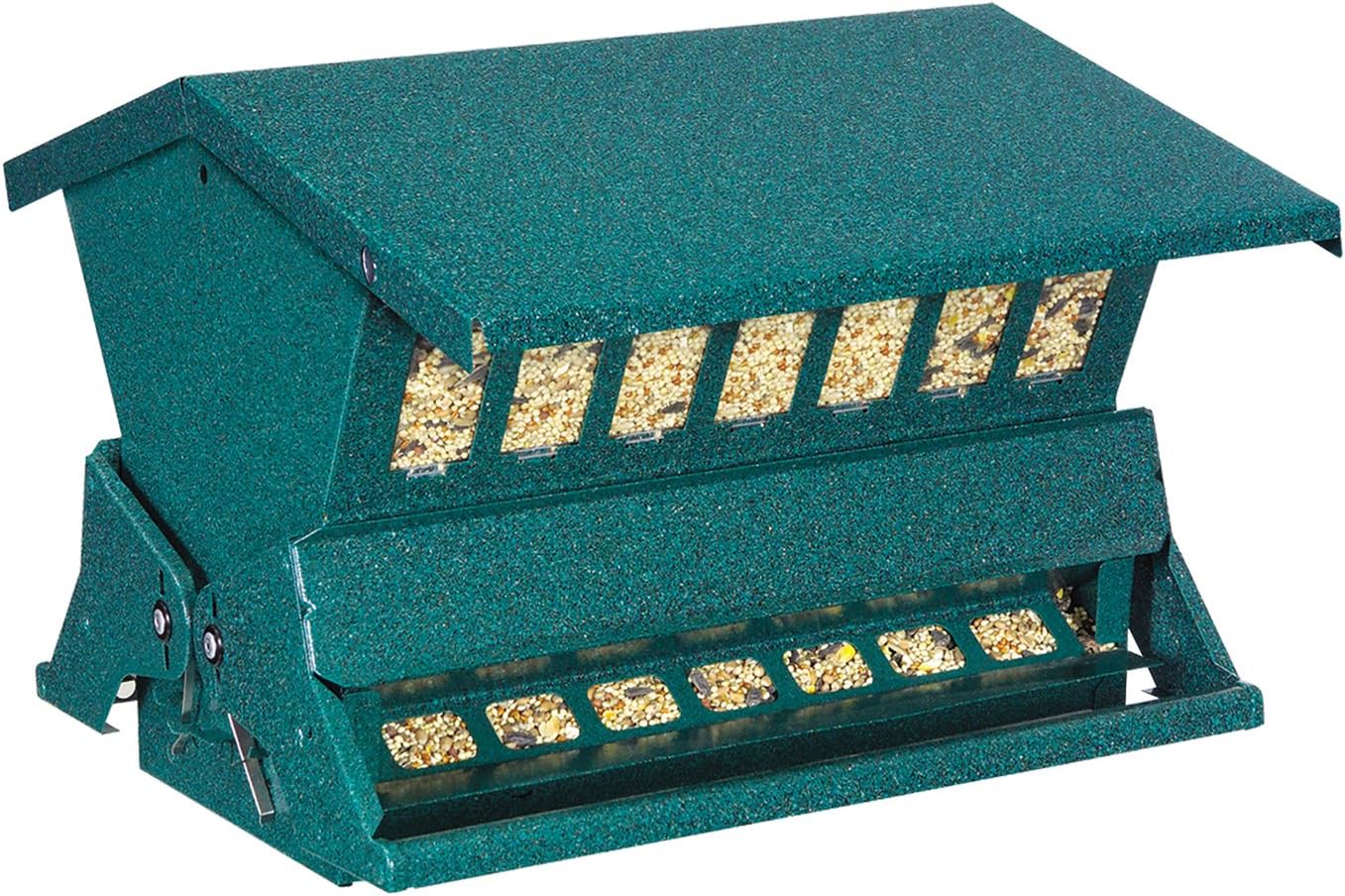
A large-capacity, all-metal squirrel-proof feeder holding up to 12 lbs of seed. Features spring-activated perches adjustable to three weight settings - when a squirrel or unwanted bird steps on, a metal shield instantly blocks seed access. A locking top prevents squirrels from entering from above. Built from chew-resistant powder-coated steel with a no-waste seed saver baffle and a seed level indicator window. The overhanging roof keeps seed dry in all weather. Can be hung or pole-mounted - all hardware included.
Check on AmazonIf you click this link and buy, we earn a commission at no additional cost to you.
Seed Capacity and Realistic Refill Expectations
One of the biggest selling points of a hopper feeder for birds is its massive seed capacity. While a standard tube feeder might hold one or two pounds of seed, a large hopper can easily hold six to ten pounds. Beginners often look at these numbers and assume that buying a larger feeder means they will only have to carry a heavy seed bag out to the yard once a month.
That is a massive underestimation of how much wild birds actually eat. In a moderately active yard, an eight-pound hopper filled with high-quality sunflower seeds will be completely empty in two to three days. Birds have incredibly high metabolisms, and a large tray area allows a dozen birds to feed simultaneously. When you buy a high-capacity model, you are not buying yourself weeks of free time. You are simply ensuring the feeder does not run dry while you are away at work during the day.
Warning: During periods of low activity, such as mid-summer, never fill a large hopper to the very top. Ten pounds of seed sitting in high humidity for two weeks will inevitably spoil. Only put out enough seed that the birds can consume within three days.
Weather Protection and Roof Design
The roof is the feature most buyers look at last, and the one that matters most when the forecast calls for rain. The hallmark feature of a hopper design is its pitched roof, which acts like an umbrella over the feeding tray. This roof is crucial for keeping snow and rain off the seed, but not all roofs are created equal.
When you are evaluating a hopper feeder cardinals will love, pay close attention to the roof overhang. A roof that ends exactly flush with the edge of the feeding tray is useless in a windy rainstorm. You want a roof that extends at least two to three inches past the feeding ledge. This deep overhang creates a dry pocket underneath, allowing birds to continue eating comfortably even during a heavy downpour.
Additionally, look closely at the hinge mechanism. You will be opening this roof hundreds of times a year to pour heavy scoops of seed inside. Flimsy wire hinges will bend or rust quickly. Opt for models with solid metal piano hinges, or roofs that slide straight up a thick steel hanging cable, ensuring the feeder remains structurally sound for years.
Final Thoughts: The Best Starting Point
If you only have the space or budget for a single feeder in your yard, a well-built hopper is the smartest investment you can make. It welcomes the widest variety of birds, protects the seed from the elements, and gives you the volume needed to sustain a busy flock. By choosing a durable material and an adjustable weight mechanism, you can create a backyard feeding station that works exactly the way you want it to. If you are ready to pick a specific model, start with the setup guides below to find the exact feeder that matches your yard.

Wagner's Four Season Sunflower Seed is 100% black oil sunflower seed. Sunflower seed is the favorite seed of most wild birds. It is high in energy and has a thin shell making it easy for all birds to consume. Use tray feeders or hopper feeders to attract sunflower loving songbirds. Cardinals, Chickadees, Finches, Nuthatches, Woodpeckers and much more. Trust your backyard birds to the experts at Wagner’s.
Check on AmazonIf you click this link and buy, we earn a commission at no additional cost to you.
Specific Hopper Setup Guides
Getting the basic hopper design is the first step. Depending on the specific birds you want to see and the climate you live in, adjusting your materials and mounting style will drastically improve your results. I have put together a few detailed guides on the specific choices you will need to make next.
| Topic | What You Will Learn |
|---|---|
| Hopper Feeders for Cardinals | The exact tray dimensions required to support winter flocking behavior. |
| Wood vs Metal Bird Feeders | An honest breakdown of which materials actually survive heavy rain and aggressive squirrels. |
| Post Mounting Hopper Feeders | Why hanging a heavy, ten-pound feeder is a mistake, and how to secure it to a post safely. |
FAQs
🐦 What kind of seed goes in a hopper feeder?
You can use almost any seed blend, but black oil sunflower seeds or safflower seeds work best. Avoid fine seeds like nyjer, as they will pour out of the wide bottom gap too quickly.
🐿️ Are hopper feeders squirrel-proof?
Standard wooden hoppers are not squirrel-proof and will be chewed apart. To stop rodents, you must buy a specific weight-sensitive metal hopper or place a standard hopper on a pole equipped with a torpedo baffle.
🌧️ How do I keep the seed dry in a hopper feeder?
Ensure you buy a model with a wide roof overhang and check that the bottom feeding tray has adequate drainage holes. If water pools on the tray, the seed will mold rapidly.
🕊️ Will doves use a hopper feeder?
Yes, Mourning Doves frequently use them if the landing tray is wide enough. Doves prefer flat, stable surfaces rather than small perches.
🧼 How hard is it to clean a large hopper?
It depends on the design. Look for hoppers with removable bottom screens or side panels that slide out. Feeders that cannot be disassembled require soaking in a large tub to clean thoroughly.