The Mechanics Behind the Workhorse
If you are setting up your very first yard station, a tube bird feeder is almost always the best place to start. It keeps seed relatively dry, holds a large capacity, and caters to the clinging birds that most people want to watch. The design is straightforward. You have a clear cylinder, a series of feeding ports, and small perches located below or beside those ports.
While the concept is simple, the execution is where most beginners run into trouble. People often buy a feeder, grab the first bag of mixed seed they see at the grocery store, and wonder why the birds pick through it and throw half of it on the ground. A tube feeder is a specialized tool. It is not designed to handle every single type of seed or every single type of bird. Before you dive into the broader world of bird feeder types, mastering the tube feeder will save you a massive amount of frustration and wasted money.
The secret to success with this feeder lies in the feeding ports. The ports dictate the seed, and the seed dictates the birds. Once you understand that chain of events, you stop guessing and start attracting exactly what you want.
Port Size Determines Your Success
The biggest mistake I see happens before the feeder even gets hung up. It happens in the seed aisle. Tube feeders come with different port sizes, and putting large seed into small ports creates an immediate blockage.
Field Note: One of the most common things I heard at the store was people complaining that their new tube feeder was defective because the birds stopped coming after day two. Nine times out of ten, they had filled a small-port feeder with a chunky safflower blend. Safflower has a larger diameter than black oil sunflower. The seeds had jammed tight against the inner plastic wall, completely blocking the ports. The birds did not leave because they hated the feeder. They left because the kitchen was closed.
When you shop for a feeder, you need to look at the shape and width of the openings. Standard ports are wide enough to easily pass black oil sunflower seeds and small striped sunflower seeds. Specialized micro-ports are tiny slits designed strictly for nyjer, which is incredibly fine. If you put standard mixed seed into a nyjer feeder, nothing comes out. If you put nyjer into a standard tube feeder, the seed pours right out onto your lawn in a matter of hours.
To keep the seed flowing smoothly, you have to match the hardware to the menu.
| Port Size | Compatible Seed | Common Result If Mismatched |
|---|---|---|
| Standard (Large) | Black oil sunflower, hulled sunflower, mixed blends | nyjer will spill out completely; small millet may flow too fast. |
| Finch / Micro-slit | nyjer, fine sunflower chips | Standard seeds will instantly jam and block the port. |
| Wire Mesh Tube | Peanuts, black oil sunflower (depending on mesh size) | Small seeds fall through; large nuts get stuck if mesh is too tight. |
If you want to feed safflower, you have to inspect the ports closely. Some standard tubes have internal baffles that catch on the rigid edges of safflower seeds. In my experience, a completely open port works best if safflower is your primary offering.
The Regulars: Which Birds Prefer This Setup
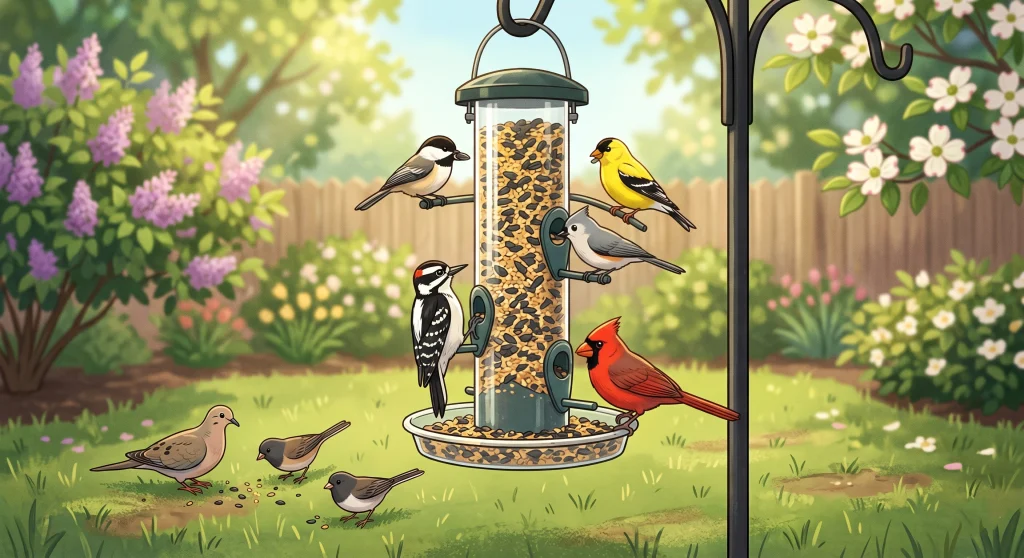
Tube feeders favor acrobats. Because the perches are short and the feeding position requires a bit of balance, these feeders naturally select for small, agile species. The classic tube feeder birds include chickadees, titmice, nuthatches, and finches.
A chickadee will rarely sit at the port and eat. Their natural behavior is to dart in, grab a single black oil sunflower seed, and fly to a nearby branch to crack it open. They will repeat this process dozens of times an hour. Nuthatches operate the same way, often approaching the feeder upside down. These birds thrive on the quick access a tube provides.
Finches behave differently. Goldfinches and house finches prefer to sit and eat right at the port, shelling the seed and dropping the hull. If you have a busy yard, you will often see every single port occupied by a finch, while chickadees wait their turn in the bushes. If your main goal is to attract large flocks of goldfinches, you will want to look into the best tube feeder for finches, which specifically focuses on small ports and nyjer seed.
The short perches naturally discourage heavy, clumsy birds. A mourning dove, for example, cannot land on a standard tube perch. They simply do not have the balance or the foot structure for it. They will wait on the ground below, cleaning up whatever the smaller birds drop.
Caged vs Uncaged: Managing the Bullies
A standard open tube is beautiful and offers unobstructed views. However, if your neighborhood is full of grackles, European starlings, or aggressive squirrels, an open tube can be emptied in a single afternoon. This is where upgrading to a tube bird feeder with cage becomes necessary.
A caged feeder is essentially a standard tube wrapped in a wider wire grid. The spaces in the grid are large enough for chickadees, finches, and titmice to slip through easily. The gaps are too small for large bully birds to pass. A grackle might land on the outside wire, stretch its neck, and quickly realize it cannot reach the seed ports inside. After a few frustrating attempts, they usually give up and look for an easier meal elsewhere.
What most people do not realize is that the cage does more than just exclude pests. It actively encourages a specific type of desirable bird. Downy woodpeckers are small enough to eat from tube feeders, but they are clinging birds, not perching birds. They feel vulnerable sitting awkwardly on a tiny metal peg.
Key point: The outer wire of a caged feeder acts like the bark of a tree. A downy woodpecker will land on the wire cage, feel completely secure in its natural clinging posture, and stretch inside to grab a seed. I have watched yards that never saw a woodpecker suddenly get daily visits just by swapping an open tube for a caged one.
Squirrels are another factor. A quality cage will stop an adult gray squirrel from chewing on the plastic tube and destroying the ports. Just be aware that in the spring, juvenile squirrels are remarkably small and flexible. They can occasionally squeeze through a standard cage gap. The cage slows them down immensely, but true squirrel deterrence always requires proper pole placement.

The Kingsyard Squirrel Proof Bird Feeder uses a weight-activated mechanism that closes access to the feeding ports when a heavier animal lands on the feeder. Its chew-resistant metal construction, four feeding ports, and 3-pound seed capacity make it suitable for regular backyard feeding. The removable base and drainage design also make cleaning easier while helping reduce moisture buildup around the seed.
Check on AmazonIf you click this link and buy, we earn a commission at no additional cost to you.
The Cardinal Limitation
If there is one complaint that comes up repeatedly with standard tube setups, it is the lack of Northern Cardinals. People fill the tube with high-quality sunflower seeds, see the cardinals in the trees, but never see them actually land and eat.
The problem is pure anatomy. Cardinals are heavy birds with relatively short, thick necks. To eat comfortably, they need a flat surface where they can face their food directly. The perches on a standard tube require the bird to land, turn its head sideways, and reach into the port. A lightweight chickadee does this effortlessly. A cardinal finds it physically awkward and uncomfortable.
Buying five different brands of expensive seed trying to lure cardinals to a feeder with tiny, straight pegs.
Recognizing that cardinals need forward-facing footing and altering the hardware to give them a place to stand.
You will occasionally see a desperate cardinal flapping wildly, trying to grab a seed from a small perch before falling off. But if they have any other options in the neighborhood, in most cases, they will choose a more comfortable option if available.
The Simple Hardware Fixes
If cardinals are your primary goal, switching to a hopper bird feeder may be the more practical long-term answer. However, you do not have to throw away your tube and buy a completely different system right now just to get cardinals. The most effective workaround is modifying what you already have. Many high-quality tubes come with a threaded hole in the bottom base, allowing you to screw on accessories.
Adding a tube bird feeder with tray changes the entire geometry of the setup. The tray acts as a wide landing pad beneath the bottom ports. Cardinals can land on the edge of the tray, face forward, and eat the seeds that spill out, or pull directly from the lowest ports comfortably. This simple plastic addition completely solves the anatomical problem.
However, adding a tray or modifying the flow introduces a second problem: the mess. Birds are messy eaters. Finches drop nyjer, chickadees drop sunflower shells, and whatever they reject ends up in your grass. Over time, a thick layer of decomposing seed hulls will choke out your lawn and attract rodents.
If you attach a tube bird feeder seed catcher, you solve the landscape damage before it starts. A catcher is typically wider than a standard feeding tray. It sits far enough below the ports to catch the scatter without acting as a feeding platform for large bully birds. Emptying the catcher once a week is far easier than raking a dead patch of grass every spring.

Suitable for suet nuggets, mealworms or sunflower seeds (not for thistle/nyjer, millet, milo or seed blend); Great for attracting Woodpecker, Cardinal, Chickadee, Nuthatch, Siskin, Sparrow and more.
Check on AmazonIf you click this link and buy, we earn a commission at no additional cost to you.
Keeping the Seed Dry and Flowing
While a catcher tray solves the problem of seed falling out, you also have to manage what stays inside. The biggest enemy of any bird feeder is not squirrels or raccoons. It is moisture. A clear plastic tube acts like a greenhouse when the sun hits it after a heavy rain. The trapped moisture condenses inside the plastic walls, soaking into the seed.
When seed gets wet in a confined space, it spoils quickly. The bottom two inches of a tube are notorious for turning into a solid, moldy brick of rotted seed. Birds have an excellent sense of smell when it comes to their food. If the seed at the bottom is spoiled, they will often refuse to eat out of the top ports as well.
Pro Tips: During periods of heavy rain or high humidity, only fill your feeder halfway. It is much better to refill it every two days with fresh, dry seed than to fill it to the top and throw away half a tube of moldy waste at the end of the week.
You must clean the interior regularly. Every time you refill, look closely at the bottom ports. If you see clumping, it is time for a wash. Buy a long, stiff bottle brush. Take the feeder apart, scrub the inside with a mild bleach solution (one part bleach to nine parts water), rinse it thoroughly, and let it dry completely before refilling. A clean tube is the foundation of a healthy backyard flock.

This 19-piece hummingbird feeder cleaning set includes three brush sizes for reaching reservoirs, feeding ports, bottle holders, and other narrow areas. The largest brush has a double-ended design for cleaning both nectar bottles and smaller feeder components, while the medium and small brushes handle tighter spaces. Nylon bristles combined with stainless steel and plastic handles provide a practical reusable set for routine bird feeder cleaning.
Check on AmazonIf you click this link and buy, we earn a commission at no additional cost to you.
Final Thoughts
A tube feeder will do exactly what it is designed to do, provided you set it up with the right expectations. Match your seed size to your port size, add a cage if the neighborhood bullies get out of hand, and attach a tray if you want to bring the cardinals to the party. Once you dial in the hardware, this feeder will run like clockwork, requiring nothing more from you than routine cleaning and a steady supply of fresh seed.
If you are looking to refine your setup or fix a specific problem, these dedicated guides cover the exact hardware solutions for tubes.
| Targeted Guide | What It Solves |
|---|---|
| Best Tube Feeder for Finches | Why standard ports waste nyjer and how micro-slits fix the problem. |
| Tube Feeder with Tray | The exact attachment you need to get cardinals to land and stay. |
| Tube Feeder Seed Catcher | How to stop dropped seed hulls from destroying your lawn and attracting rats. |

Wagner's Four Season Sunflower Seed is 100% black oil sunflower seed. Sunflower seed is the favorite seed of most wild birds. It is high in energy and has a thin shell making it easy for all birds to consume. Use tray feeders or hopper feeders to attract sunflower loving songbirds. Cardinals, Chickadees, Finches, Nuthatches, Woodpeckers and much more. Trust your backyard birds to the experts at Wagner’s.
Check on AmazonIf you click this link and buy, we earn a commission at no additional cost to you.
FAQs
🐦 Why won’t birds use my new tube feeder?
The most common reason is mismatched seed. If you put large seeds in small ports, the feeder clogs instantly. Alternatively, it can take birds up to two weeks to trust a new object in the yard.
🌧️ How do I keep seed from rotting at the bottom?
Moisture collects easily in the bottom two inches. During rainy weeks, only fill the feeder halfway so the birds consume it before it has a chance to mold.
🐿️ Will a standard tube stop squirrels?
No. A standard plastic tube offers no resistance to squirrels. They will hang from the top or chew straight through the plastic ports. You need a caged version or a dedicated pole baffle.
🔴 How do I get cardinals to use it?
Cardinals hate the short, straight perches on a standard tube. The best tube feeder fix for this is screwing a wide plastic tray into the bottom base so they can land and face forward.
🧼 How often should I clean the inside of the tube?
Clean it at least once a month, or immediately if you spot clumped, moldy seed at the bottom. Use a long bottle brush and a ten percent bleach solution, then let it dry completely.