Why Finches Suddenly Abandon Your Feeder
A full Nyjer feeder with no finches can make the seed look guilty immediately, and sometimes it is. Project FeederWatch notes that Nyjer can grow stale relatively quickly even when it is kept dry, so freshness deserves an early check when a previously busy feeder goes quiet. But I would not say stale seed explains almost every disappearance. Natural food crops, weather, predators, habitat changes, seasonal movement, and feeder condition can all change bird traffic too.
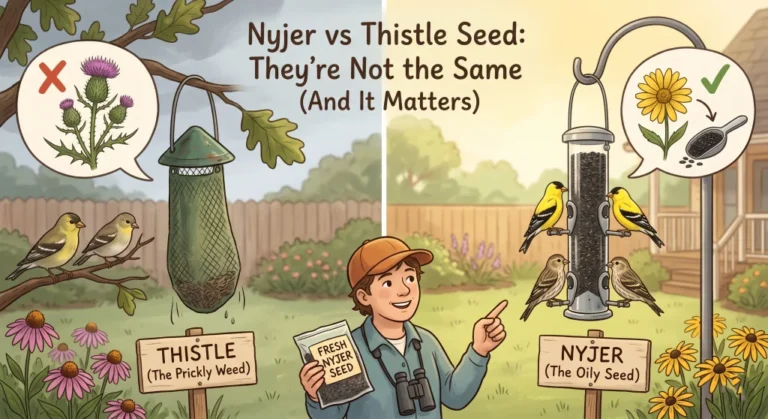
Nyjer comes from Guizotia abyssinica, an African plant unrelated to North American thistles. Imported Nyjer is treated to reduce the chance that viable seed or contaminants will germinate after entering the United States. Cornell describes the seed as heat-treated before importation, while current USDA APHIS rules require qualifying imported niger seed to receive an approved treatment. That is different from saying every bag is “irradiated,” and I would not blame the treatment alone for a fixed short shelf life.
Nyjer is a small, oil-rich seed, and Project FeederWatch specifically warns that it can become stale faster than many people expect. That is the useful takeaway. If finches stop visiting, check the food along with the feeder and the yard rather than assuming the birds have permanently left. For the broader background on this seed, see nyjer bird seed and how it differs from the other best bird seed options.

A premium nyjer (thistle) seed specially loved by finches, including the desirable Goldfinch. With around 150,000 seeds per pound, it delivers exceptional value and countless feeder visits. High in energy and extra clean, it's ideal for use in finch feeders with small holes and tiny perches. Available in a 10-pound bag with a convenient velcro press-lok closure.
Check on AmazonIf you click this link and buy, we earn a commission at no additional cost to you.
Test 1: The Visual Condition Check
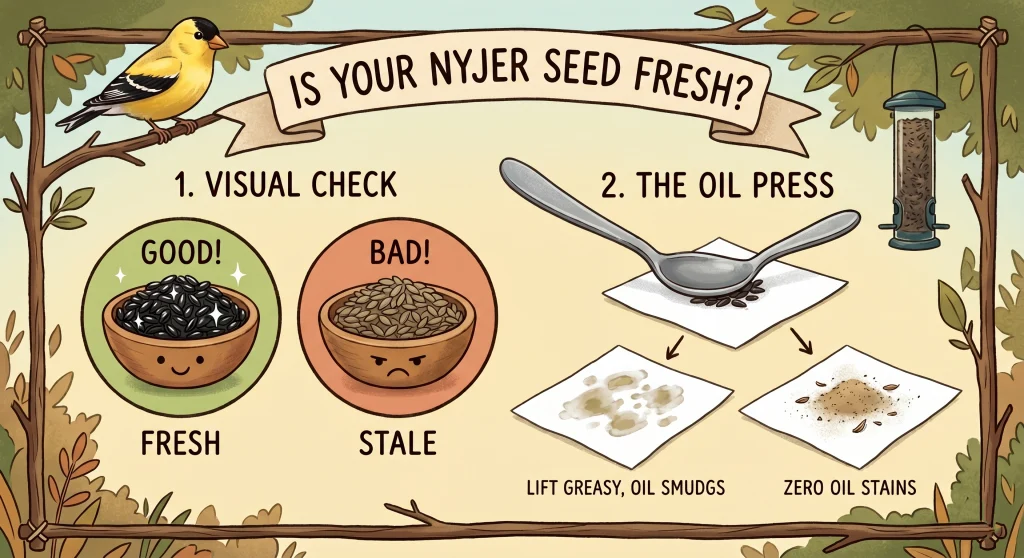
The first check is still visual, but I would not use the old rule that “glossy black means fresh and brown means stale.” Nyjer color varies naturally by source. The Wild Bird Feeding Institute notes that seed from India is generally black while Ethiopian Nyjer can be brown, and its consumption research has not supported a simple black-is-better assumption. A brown seed is therefore not automatically old.
What you can look for is deterioration within the batch. Seed should be dry and free-flowing rather than damp or stuck into clumps. Watch for visible mold, webbing or insects, an unusual amount of fine dusty residue, and any musty or rancid odor. If you regularly buy the same product, a sudden change from clean, intact seed to a dusty, weathered-looking batch is useful evidence that deserves a closer check.
A slight sheen can be a useful observation, especially when you compare seed from the same source, but it is only one clue. Lighting, seed origin, processing, and natural variation all change how the hull looks. I would never reject an unopened bag solely because the seed is brown.
Field Note: At the store, appearance was most useful when it was combined with history. If someone brought in seed that had been sitting for a long time, looked unusually dusty compared with the product they normally bought, and was being ignored at a previously active feeder, replacing a small amount with a fresh bag was a sensible test. The birds’ response then gave us more information than color alone ever could.
Test 2: The Paper Towel Oil Press
The paper-towel test is a useful backyard field check because Nyjer contains oil. Put a small pinch of seed on clean white paper, fold the paper over it, and crush the seeds firmly with the back of a spoon or another hard, flat object. Then open the paper and look for a translucent greasy mark around the crushed seed.
A noticeable oil stain suggests that the kernels still contain readily detectable oil. If repeated crushing produces only dry powder and no visible grease mark, I would be more suspicious of an old or dried-out batch. But this is not a calibrated freshness test, and it cannot tell you an exact age, oil percentage, or nutritional value. The result is most useful when combined with storage history, smell, moisture condition, and whether birds are still eating the seed.
| What You Check | More Reassuring | More Concerning | What It Means |
|---|---|---|---|
| Seed condition | Dry, loose, clean, no off odor | Damp clumps, mold, webbing, musty or rancid smell | Condition is more important than hull color alone |
| Hull appearance | Consistent with a fresh bag from the same source | Suddenly dusty or weathered compared with normal stock | Useful as a comparison, not a black-vs-brown rule |
| Paper towel crush | Visible translucent oil mark | Repeatedly crushes dry with little or no visible oil | A practical clue, not a laboratory measurement |
| Bird response | Finches continue feeding normally | Previously regular birds repeatedly stop using that batch | Supports the diagnosis only after other causes are considered |
I like this test best as a comparison tool. Try it when you open a bag you know is moving quickly through a reputable seller, then remember what that result looks and feels like. If an older batch later looks, smells, and crushes very differently, you have a much stronger reason to replace it than you would from one visual rule alone.

Wagner's Four Season Sunflower Seed is 100% black oil sunflower seed. Sunflower seed is the favorite seed of most wild birds. It is high in energy and has a thin shell making it easy for all birds to consume. Use tray feeders or hopper feeders to attract sunflower loving songbirds. Cardinals, Chickadees, Finches, Nuthatches, Woodpeckers and much more. Trust your backyard birds to the experts at Wagner’s.
Check on AmazonIf you click this link and buy, we earn a commission at no additional cost to you.
Use Bird Behavior as a Clue, Not a Diagnosis
A sudden change in feeder use matters, especially when the same flock had been visiting regularly. If birds inspect the feeder repeatedly but eat very little, changing the seed is a reasonable troubleshooting step. What I would not do is invent a mechanism and say the birds are weighing each seed, detecting a hollow interior, and deliberately spitting out stale pieces. That behavior has not been established well enough to make that claim.
The debris underneath a Nyjer feeder can also be misleading. Cornell notes that a pile below a Nyjer feeder is often made up of the tiny hulls birds discard after opening the seeds. Seeing material on the ground therefore does not automatically mean the finches are rejecting whole seed. Look closely before deciding what you are seeing.
A better field test is controlled replacement. Clean and dry the feeder, add a small amount from a fresh bag, and watch the station over the next several days while also considering weather, predators, and natural food availability. If activity resumes with the replacement seed, freshness becomes a much stronger explanation. If nothing changes, keep troubleshooting rather than throwing more seed away.

A 24-inch bottle brush with a shapeable twisted wire shaft and 1.5-inch non-scratch nylon bristle head. Reaches the bottom of tall tube feeders, hummingbird feeder reservoirs, narrow-neck bottles, and other deep vessels that standard brushes can't clean. The wire shaft can be bent to any shape to navigate awkward angles and holds its form. Safe on glass, stainless steel, plastic, and acrylic surfaces.
Check on AmazonIf you click this link and buy, we earn a commission at no additional cost to you.
What to Do When Your Seed Seems Stale
If the seed is moldy, wet, musty, rancid-smelling, or visibly infested, discard it rather than trying to rescue it. If it is simply an older dry batch that finches no longer seem interested in, I still would not mix it into a fresh bag just to avoid waste. Mixing makes it harder to tell whether the replacement solved the problem and keeps old material circulating through the feeder.
Before refilling, clean out old hulls, seed dust, and any damp residue. Project FeederWatch recommends frequent feeder cleaning and notes that seed left too long can become stale or moldy, especially in warm, damp conditions. Nyjer socks are particularly exposed to rain, while a small-port tube feeder generally keeps seed drier. Whatever feeder you use, do not refill on top of wet or questionable seed.
Buying smaller amounts can also reduce waste when your finch traffic is unpredictable. I care more about turnover and storage conditions than whether the bag came from a specialty shop or a big-box store. A seller that moves Nyjer quickly and stores it well can be a better source than a slow-moving shelf anywhere. Check the package condition and buy an amount your birds can use while it is still in good shape. For the storage side of the problem, see how to store bird seed.

A pack of 60 BPA-free freezer bags with Grip 'n Seal double zipper technology for airtight, edge-to-edge closure. Protects against freezer burn to reduce food waste. Extended tabs for easy opening and closing.
Check on AmazonIf you click this link and buy, we earn a commission at no additional cost to you.
Storage Matters More Than a Freezer Trick
I could not find strong bird-feeding research that establishes a specific freezer schedule for Nyjer or proves that home freezing preserves its oils for a defined number of extra months. The safer recommendation is the one the stronger feeder sources consistently support: keep seed cool, dry, sealed from pests, and buy quantities that turn over before they sit for a long time.
Freezing dry seed in a well-sealed moisture-resistant package is possible, but I would treat it as an optional storage method rather than a required freshness hack. The main risk when cold seed meets warm humid air is condensation. If you freeze a reserve, portion it into sealed containers or bags so you can remove only what you need and allow that sealed portion to come toward room temperature before opening it. That keeps humid air from condensing directly on very cold seed.
Do not repeatedly thaw and refreeze the main supply, and never put seed into the freezer while it is damp. Freezing also does not rehabilitate seed that is already moldy, rancid, or spoiled. For most households, a smaller bag stored in a cool, dry place is simpler and easier to rotate than a huge bulk purchase that needs special handling.
Pro Tip: Date the bag when you open it and keep only a modest amount near the feeder. That gives you a simple storage history to compare with bird activity, smell, moisture, and the paper-towel test instead of relying on appearance alone.
Final Thoughts on Freshness
Nyjer freshness matters, but the strongest troubleshooting routine uses several clues instead of one magic test. Check whether the seed is dry and clean, smell it for mustiness or rancidity, use the paper-towel crush as a rough oil check, and compare bird use before and after a small fresh refill. Do not use black-versus-brown color as a stand-alone verdict.
If a previously busy feeder goes quiet, freshness belongs near the top of the checklist because Project FeederWatch specifically notes that Nyjer can go stale quickly. It just should not push every other explanation off the list. Start with a clean feeder and a small fresh batch, then let the result tell you whether the food was actually the problem.

It has no wood and no plastic, it’s all metal! The wire mesh design features a powder-coated finish to resist rust, while the sturdy metal construction will help thwart squirrel damage to help you save a lot of bird feeding costs.
Check on AmazonIf you click this link and buy, we earn a commission at no additional cost to you.
FAQs
🐦 Why are the birds suddenly ignoring my nyjer seed?
Stale or wet Nyjer is one possibility, especially because Project FeederWatch notes that Nyjer can grow stale relatively quickly. But feeder traffic also changes with natural food, weather, predators, habitat, and seasonal movements. Clean the feeder and test a small fresh batch before deciding freshness was definitely the cause.
🧻 How do I test if my bird seed is still good?
Start with condition: the seed should be dry, loose, and free of mold, webbing, insects, and musty or rancid odor. For Nyjer, you can also crush a small pinch on white paper. A visible oily mark is reassuring, while a consistently dry, powdery result makes an older batch more suspect. Treat that as a field check rather than a definitive laboratory test.
👀 What does old, stale nyjer look like?
There is no single stale color. Nyjer can naturally be black or brown depending on origin, so brown seed is not automatically old. More concerning signs are a dusty or degraded appearance compared with normal stock from the same source, damp clumps, mold, insects, or an off smell.
🗑️ Can I mix old seed with new seed so I don’t waste it?
I would not mix a questionable batch into fresh seed. If it is moldy, damp, rancid, or infested, discard it. If it is merely old and apparently dry, replacing it with a small fresh batch gives you a much cleaner test of whether freshness was causing the feeder problem.
❄️ Does putting bird seed in the freezer keep it fresh?
Freezing dry Nyjer in a tightly sealed moisture-resistant package is an optional storage method, but I could not find strong evidence for a specific extra shelf-life claim. Cool, dry storage and buying manageable quantities are better-established recommendations. If you freeze it, keep the portion sealed while it warms so condensation does not wet the seed.