No-Melt Suet for Birds: What Exactly Are You Buying?
To understand why one warm-weather cake stays firm while another softens, look at the actual formulation and the manufacturer’s storage and temperature instructions.
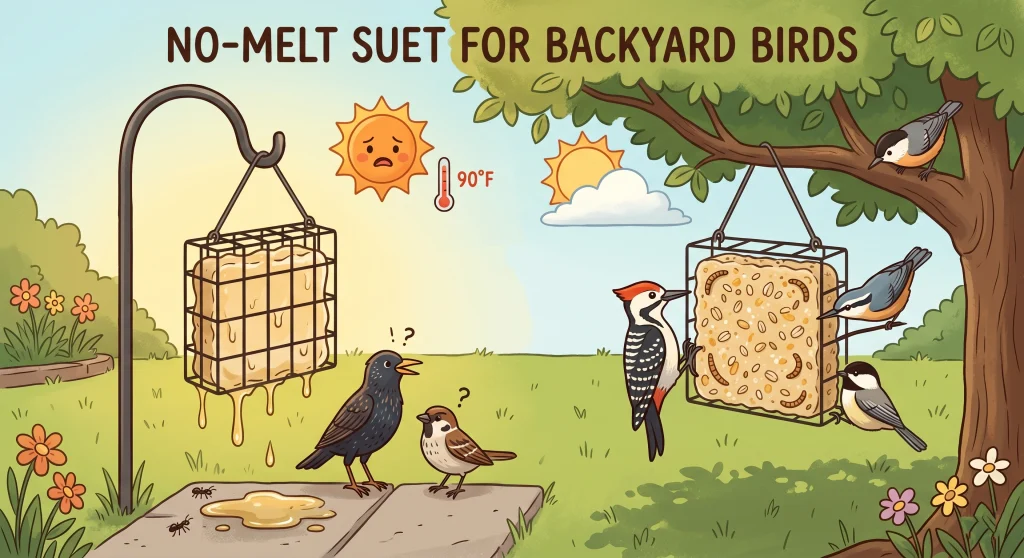
Traditional suet is the hard fat around the kidneys and loins of cattle or sheep, but commercial bird suet cakes are usually rendered fat or a fat substitute mixed with ingredients such as corn, peanuts, fruit, seed, or dried insects. Cornell notes that rendered suet keeps better than raw suet and that many commercial cakes stay firm to around 90°F, but warmer conditions can soften them enough to foul feathers. I would not use the low 80s as a universal melting point or claim every cake becomes liquid in the 90s.
No-melt formulas vary. Cornell has described some commercial no-melt cakes as rendered multiple times so they stay solid at higher temperatures. Current products also use different combinations of rendered beef suet, corn, oats, peanuts, oils, fruit, or insects. Some are sold as soft doughs and others as firmer cakes. There is no single binder recipe or one ingredient that explains every no-melt product.
The formulation changes how a cake behaves in warmth, but label claims still need to be treated as product-specific claims. A cake that holds its shape can still become rancid or contaminated if it sits too long in sustained heat, so physical firmness is only one part of the decision.
The Reality of Temperature Ratings
Some warm-weather suet products advertise resistance to 100°F or higher. Those numbers come from the manufacturer and do not mean the cake remains fresh indefinitely at that temperature. Cornell specifically notes that products advertised to withstand temperatures over 100°F may still go rancid if extreme heat persists.
Ambient temperature is only part of the picture. Direct sun can heat the feeder and cake above shaded conditions, while humidity, rain, how quickly birds consume the food, and the product formulation all affect how long it stays usable. Cornell’s practical advice is to keep summer suet in a cool, shaded location and monitor it closely.
Field Note: When someone told me a supposedly warm-weather cake had gone soft, one of my first questions was whether the feeder was sitting in afternoon sun. Moving a suet feeder into shade often made the setup easier to manage. I would not assign an exact cage temperature without measuring it, but direct sun is an obvious variable worth removing before blaming the product.
If your yard has no shade and the feeder is exposed to sustained high heat, I would rather pull the suet than test the upper edge of a manufacturer’s claim. Cornell currently advises ceasing suet when temperatures are hot enough for it to soften and foul feathers, and Audubon takes an even more conservative approach to summer suet. During those periods, the best bird seed options, natural insect habitat, fruit for appropriate species, and clean water can keep the feeding station useful without a soft fat block.

An upside-down suet feeder that naturally deters nuisance birds like blackbirds and grackles, while welcoming woodpeckers, titmice, nuthatches, and chickadees that feed comfortably in an inverted position. Built from naturally rot-resistant cedar with stainless steel screws for lasting durability. Holds 1 standard suet cake.
Check on AmazonIf you click this link and buy, we earn a commission at no additional cost to you.
Soft Dough vs. Firm No-Melt Cakes: Read the Formula, Not the Flavor
No-melt suet cakes can feel very different right out of the package, but texture is not a reliable shortcut for a universal temperature rating. A soft dough can be specifically formulated for warm weather, and a firm cake can still spoil if it sits too long in heat. Compare the product instructions, ingredients, and how quickly your birds consume it.
Flavor does not determine heat tolerance. For example, C&S currently sells both berry and insect no-melt formulas as soft dough products and advertises both for temperatures up to 100°F. That is a good reminder not to assume berry means soft and heat-sensitive or insect means hard and heat-proof. Treat the number on the package as a manufacturer specification, then watch the cake in your own shaded setup.
The harder-insect-cake idea comes from individual birder experience, not a rule about insect ingredients. One long-running BirdForum discussion included a user whose very hard insect cake lasted a day or two longer than a doughy berry cake in hot weather, but current commercial insect formulas also exist as soft doughs. I would present that as one useful field observation, not a guaranteed product hierarchy.
| Suet Texture | Common Flavors | Heat Tolerance | Best Use Case |
|---|---|---|---|
| Doughy / Soft | Can include berry, peanut, insect, mealworm, or other formulas | Use the specific manufacturer’s rating; some soft dough products claim 100°F | Choose by label, freshness, bird use, and shaded placement rather than flavor alone |
| Firm / Dense | Can include peanut, corn, insect, fruit, or other formulas | Varies by recipe; some manufacturers claim well above 100°F | Useful only while the cake remains fresh, clean, and firm enough not to foul feathers |
Woodpeckers can work at a firm cake, while chickadees and nuthatches also use suet feeders. Acceptance still varies by local birds and formula, so hardness alone does not tell you whether a cake will be popular.
Upside-down suet feeders can reduce starling access because they require birds to cling beneath the food. Cornell specifically recommends this design when you want to favor agile birds such as woodpeckers, chickadees, and nuthatches over starlings. That benefit comes from feeder orientation, not from using an insect cake, and the feeder still belongs in shade during warm weather.
If you want to compare formulas, ingredients, and seasonal use, my page on the best suet for birds is the better place to do that. For this decision, the key is to verify the actual product rather than assigning performance to berry, peanut, or insect flavor names.

Ready-to-use soft dough pressed into cake form, the only true no-melt suet in the world. High-energy formula attracts a wide variety of wild birds year-round. Great value, made in the USA.
Check on AmazonIf you click this link and buy, we earn a commission at no additional cost to you.
When to Keep It Out and When to Just Pull It
No-melt does not remove the need for a stop rule. If you are trying to understand the broader use of suet for birds, watch the food itself and the weather. Cornell recommends taking suet down in hot weather when it can soften, foul plumage, or become rancid, even if the package calls the product no-melt.
Soft suet can coat belly feathers and interfere with normal feather function. Cornell highlights a second concern during spring and summer: an incubating bird with greasy belly feathers may transfer fat to eggs, potentially clogging tiny eggshell pores and reducing oxygen exchange for the developing embryo. That is a real reason to remove a cake before it becomes soft and greasy rather than waiting for it to drip.
These are the signs I use to pull a warm-weather cake, regardless of the number printed on the package:
- The surface becomes greasy or soft enough to smear: Remove it before birds can press feathers into softened fat.
- The cake drips or leaves oily residue: That is already beyond the condition I want in a summer feeder.
- The cake sits through sustained extreme heat: A product can remain shaped and still become rancid, so do not use overnight temperature as a fixed safety threshold.
- There is an off odor, mold, contamination, or obvious spoilage: Discard it rather than trying to salvage it.
I would not automatically refreeze a partially melted cake that has been hanging outdoors and call it perfectly safe. Re-hardening changes the texture, but it does not reverse rancidity, microbial growth, droppings, insects, or other contamination. If an exposed cake has softened substantially in heat, discard it. Keep unused cakes cool according to the manufacturer’s storage instructions instead.
Pro Tip: Refrigerating clean, unused suet that contains corn, cornmeal, or peanuts can be prudent because Cornell notes those ingredients can support bacterial growth. During an actual heatwave, I would skip the cake rather than run an arbitrary morning-to-1:00-PM schedule. Shade and a no-melt formula reduce risk, but they do not make sustained extreme heat irrelevant.
Final Thoughts: Setting Realistic Expectations
No-melt suet can extend the useful season for a suet feeder, but it is not a license to leave fat outside through any heat. Keep the feeder shaded, choose a reputable product with clear ingredients and storage guidance, use amounts that turn over quickly, and remove the cake if it softens, smells off, or sits through sustained extreme heat. I would not choose an insect formula simply because I expect it to be harder than a berry formula.
Temporarily removing suet during a heatwave does not deprive wild birds of their only food source. They continue foraging on natural insects, seeds, fruit, and other foods appropriate to their species, and you can offer suet again when conditions are suitable.

Made with rendered beef suet, dried mealworms, and crickets, fortified with vitamins and minerals. Never melts, making it ideal for spring, summer, and warm climates. 13 oz per cake. Rated 4.3 stars with 75 reviews.
Check on AmazonIf you click this link and buy, we earn a commission at no additional cost to you.
FAQs
🌡️ What is no melt suet made of?
There is no single no-melt recipe. Many commercial products combine rendered beef suet or another fat base with ingredients such as corn, oats, peanuts, oils, fruit, or dried insects, and some manufacturers use additional processing to improve heat stability. Check the ingredient list for the specific cake you are buying.
☀️ Will no melt suet melt in the sun?
It can. A no-melt label means the product is formulated to resist heat better, not that direct sun cannot soften it or that the cake cannot become rancid. Keep the feeder shaded and remove the cake if it becomes greasy, soft, or spoiled.
🐦 Do woodpeckers eat no melt suet?
Yes. Woodpeckers, nuthatches, chickadees, titmice, and several other species use suet feeders. Whether they accept a particular no-melt formula depends on the local birds and ingredients, not on a rule that insect cakes are always harder or more attractive.
🧊 Can I put no melt suet in the fridge?
Unused suet can be refrigerated if the product instructions allow it, and Cornell says refrigeration may be prudent for cakes containing corn, cornmeal, or peanuts. I would not repeatedly return a dirty, partially melted outdoor cake to food storage. If an exposed cake has softened badly or become contaminated, discard it.
🔥 How hot is too hot for suet?
There is no universal 95°F cutoff for every no-melt product. Manufacturers publish different heat-resistance claims, while Cornell advises stopping suet when heat makes it soft enough to foul feathers and notes that even products rated above 100°F can go rancid in persistent extreme heat. Use the cake’s condition and conservative warm-weather guidance rather than one fixed number.