Over my retail career answering questions at a wild bird store, I could usually diagnose a quiet backyard within thirty seconds of talking to a customer. Most people assumed the birds in their neighborhood simply vanished, but the reality was almost always a basic setup error. These are the five most common bird feeder mistakes I saw repeat every single week, and exactly how to fix them.
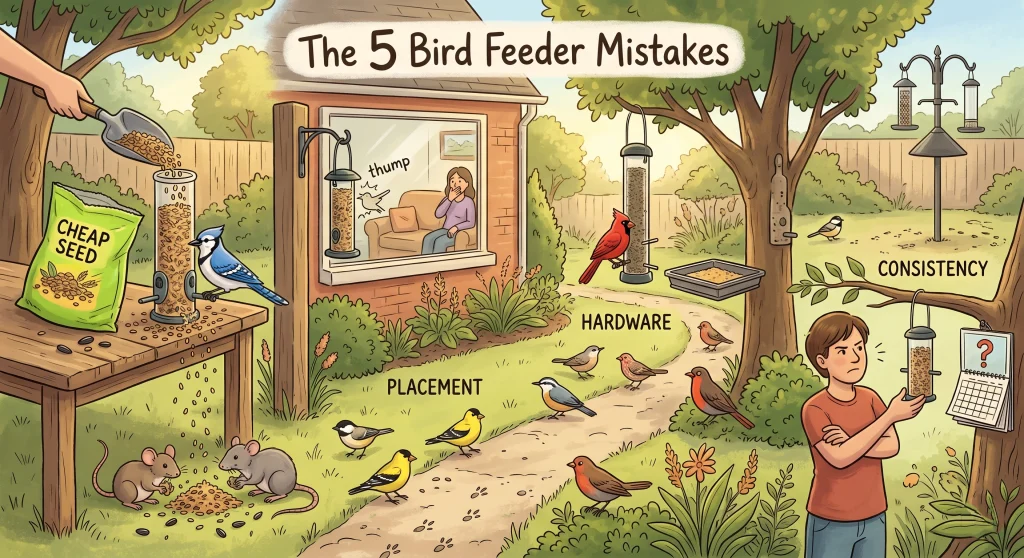
The 30-Second Backyard Diagnosis
When a frustrated customer leaned over the register to tell me their neighborhood birds were somehow broken, I rarely needed to open a textbook. What follows is not academic research. It is a pattern built from seeing thousands of real backyard setups. Fixing bird feeder mistakes rarely requires a biology degree. It just requires adjusting a few basic habits.
Most beginners think they have a unique, highly specific problem. The truth is that almost every single quiet backyard suffers from one of five predictable issues. Once you recognize these patterns, getting the birds back becomes a very simple process.
Mistake 1: The Trap of Cheap Mixed Seed
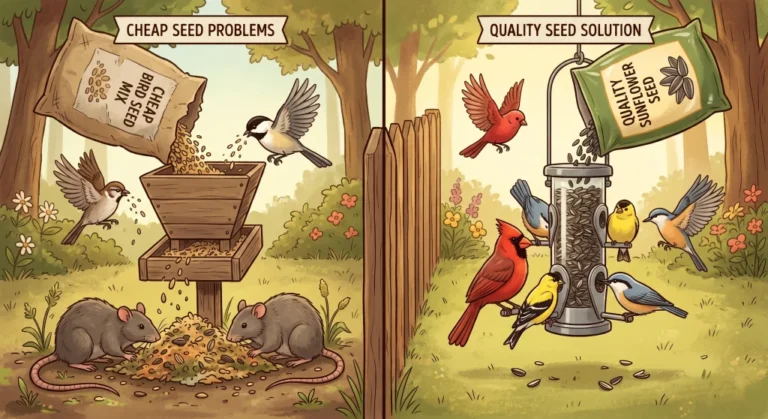
I cannot count how many times a customer walked in holding an empty, brightly colored bag of discount seed they bought at a grocery store. They would set it on the counter and complain that they spent eight dollars, but the birds completely ignored it. They thought they were saving money. In reality, they were just buying a bag of expensive fertilizer and rodent bait.
Those cheap mixes are overwhelmingly filled with milo, wheat, and red millet. The manufacturers pack the bags with these filler seeds because it is a cheap way to increase the weight of the bag. The problem is that very few backyard songbirds actually want to eat milo. The birds will dig through the feeder, tossing all the filler seed directly onto the ground to get to the three sunflower seeds hidden inside.
Once that tossed seed hits the ground, it gets wet and begins to rot. This immediately attracts mice, rats, and raccoons to your yard. The Cornell Lab of Ornithology confirms what I saw daily in my customers’ yards. Most songbirds simply ignore milo entirely. If you want to stop wasting money, you need to understand which bird seed is actually worth buying and avoid the filler completely.
Field Note: I used to show customers a simple breakdown. If you buy a cheap bag of seed and the birds throw sixty percent of it on the ground, your effective cost per pound is actually much higher than if you just bought a premium bag of pure black oil sunflower seed in the first place.
Mistake 2: The Window Collision Zone
Feeder placement is another area where human logic completely clashes with bird instincts. A customer once brought in a hand-drawn map of her yard. She was incredibly upset because birds kept hitting her large living room window. She had placed her beautiful new wooden hopper feeder exactly six feet away from the glass. She thought this was the perfect distance for a great view from her couch.
She did not know about the three-foot or thirty-foot rule. This is one of the most critical tips I ever passed along. If a feeder is placed mid-range from a window, a startled bird will take off at full speed to escape a predator and crash directly into the glass before they realize it is a solid object.
To keep birds safe, you have to place the feeder either closer than three feet or further than thirty feet away from any large windows. When the feeder is closer than three feet, a bird leaving the feeder cannot build up enough momentum to get hurt if they hit the glass. When it is further than thirty feet, they have plenty of room to maneuver. Learning how to set up a bird feeder correctly is about safety just as much as it is about aesthetics.
Mistake 3: The Wrong Tool for the Job
You would be amazed at how many people buy a feeder based purely on how it looks, rather than who it is meant to feed. A woman named Clara once came in looking incredibly disappointed. She had just spent good money on premium safflower seed but told me she never saw a single cardinal. I asked her what kind of feeder she had hanging in her yard. She proudly described a skinny, beautiful plastic tube feeder with tiny metal perches.
Cardinals are large, somewhat clumsy birds that historically feed on the ground. Their biomechanics do not allow them to easily twist their bodies and cling to a tiny metal peg while eating. They need a solid, flat surface to land on. They require a tray feeder, a large hopper, or a platform.
When you are dealing with a quiet yard, the hardware is often the culprit. If you offer the right food in the wrong container, the birds simply cannot access it. You have to match the feeder style to the physical abilities of the bird you want to see.
| Target Bird Species | Required Feeder Style | Why It Is Necessary |
|---|---|---|
| northern cardinal | Hopper or Platform | Heavy body, needs flat space to perch and eat comfortably. |
| woodpecker | Suet Cage with Tail Prop | Needs vertical space to brace its stiff tail feathers while pecking. |
| goldfinch | Mesh Tube or Sock | Acrobatic enough to cling upside down, prefers tiny nyjer seeds. |
| mourning dove | Ground Tray or Platform | Exclusively ground feeders, too large for standard perches. |
Mistake 4: Giving Up on the Scout Birds
Patience is not something most retail customers have in large supply. I had a regular who bought an expensive, copper-roofed hopper feeder on a Friday afternoon. By Monday morning, he was back at my register, convinced the setup was defective because his yard did not look like a nature documentary yet. He expected it to work like a magnet.
If you are wondering why birds are not coming to a brand new setup, it all comes down to how flocks discover food. Birds are naturally cautious prey animals. Project FeederWatch, which tracks backyard bird behavior across North America, consistently documents this discovery window in new setups. Birds need time to test the area for predators and incorporate it into their route. They do not instantly trust a strange new wooden box that suddenly appeared out of nowhere.
This process can take a few days, or it can take three solid weeks depending on your neighborhood. The worst thing you can do is move the feeder every two days trying to find a better spot. Pick a safe location and leave it entirely alone. You can always review how to attract birds to a new feeder to ensure you have the basics right, but the main ingredient is always time.
Mistake 5: The Disappearing Act
The final pattern I watched repeat was the abrupt stop. A local school teacher used to buy large bags of seed every spring, thrilled with the massive flock she had built up. Then, summer break would hit. She would go out of town for three weeks in July, letting the feeders sit completely empty. When she came back in August, she was always shocked to find a completely empty yard.
Inconsistent feeding is one of the most frustrating bird feeding mistakes you can make. Wild birds operate on strict daily foraging routes. They map out the most reliable food sources in a neighborhood and visit them in a sequence.
If your yard is a reliable stop on that route, they will show up like clockwork. If you let the feeder sit empty for weeks, they simply cross your yard off the map. They will adjust their route to find food elsewhere. Getting them to reincorporate your yard back into their daily habit takes just as much time as starting from scratch. If you want to avoid this cycle, read more about why birds stopped coming to your feeder so you can maintain a steady routine.
The Things I Stopped Correcting
Over time, I also realized that some things customers agonized over did not actually matter at all. People would come in panicked because a squirrel ate a few dropped seeds, or because a blue jay was temporarily chasing the smaller birds away. They thought they were failing.
I eventually stopped trying to fix these specific complaints. A squirrel getting a small tax of your dropped seed is just part of feeding wildlife. Larger birds dominating a feeder for three minutes is completely normal flock hierarchy, not a setup error. If the food is safe and the birds are eating, you are already succeeding. Do not let the small stuff ruin a relaxing hobby.
Final Thoughts: Keeping It Simple
Feeding birds does not have to be a complicated science experiment. If you avoid the cheap filler seed, place the setup at a safe distance, pick the right hardware, and practice a little patience, the birds will eventually do the rest. I learned a lot about what selling bird feeders taught me about people, and the biggest lesson was that we tend to overcomplicate simple things. Give them good food in a safe place, and then step back and let nature happen.
FAQs
⏳ How long does it usually take for birds to find a new feeder?
It typically takes anywhere from two days to three weeks for local birds to discover and trust a new feeder. You must leave the feeder in one consistent spot during this time so the scout birds can assess the area for safety.
🗑️ Why are the birds throwing all the seed on the ground?
They are sorting through cheap filler seeds like milo and wheat to find the few edible seeds hidden inside. Switching to a pure black oil sunflower seed mix will almost entirely eliminate this messy behavior.
🪟 How far away from a window should a bird feeder be?
To prevent fatal window strikes, place the feeder either closer than three feet or further than thirty feet away from the glass. Avoid the middle ground where a bird has enough space to build up dangerous flight momentum.
🐦 Why are cardinals ignoring my tube feeder?
Cardinals are large birds that prefer feeding on flat surfaces. They struggle to twist their bodies to eat from the tiny metal perches on standard tube feeders. Swap it out for a hopper or a platform style instead.